Kang HeeEun, Khan Asif N, Kim Justin J, Martin Isabella W, Zuckerman Richard A
Infectious Disease and International Health, Dartmouth-Hitchcock Medical Center, Lebanon, NH, USA.
Geisel School of Medicine at Dartmouth College, Hanover, NH, USA.
Antimicrob Steward Healthc Epidemiol. 2025 Aug 11;5(1):e182. doi: 10.1017/ash.2025.10078. eCollection 2025.
To describe the use of non-beta-lactam agents (NBL) to treat ampicillin-susceptible bacteremia (ASEB), and to identify factors associated with their use.
A single-center retrospective study at a rural tertiary referral center was conducted to identify ASEB episodes between January 1, 2016, and 31 December, 2021. Patient, microbiological, infection, clinical management characteristics, and outcomes were compared between those who received NBL versus BL agents for definitive therapy. Multivariable logistic regression analysis was used to determine factors associated with NBL use.
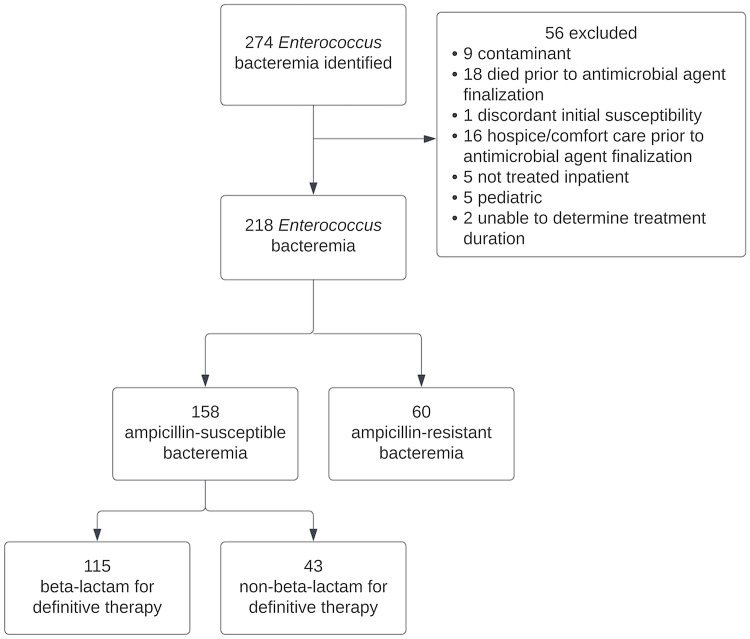
158 episodes of ASEB in 153 patients were included. 43 episodes (27%) were treated with NBL for definitive therapy. Factors associated with NBL therapy were younger age, history of penicillin allergy, history of cancer, end-stage renal disease (ESRD), polymicrobial bacteremia, lack of metastatic foci, and lack of endocarditis. Combination therapy was used in 23% of those treated with BL therapy versus zero patients receiving NBL therapy. All-cause 30-day and 90-day mortality and 30-day relapse rate were not statistically different. In the regression model, NBL therapy was more likely in those with: younger age (AOR 0.95, < .01), any penicillin allergy (AOR 5.87, < .01), history of cancer (AOR 5.25, < .01), ESRD (AOR 12.48, < .001), and polymicrobial bacteremia (AOR 4.20, < .01).
NBL was used as definitive treatment in 27% of ASEB with good clinical outcomes. This real-life experience suggests NBL can be successfully used to treat ASEB based on clinical discretion.
描述使用非β-内酰胺类药物(NBL)治疗对氨苄西林敏感的菌血症(ASEB)的情况,并确定与使用这些药物相关的因素。
在一家农村三级转诊中心进行了一项单中心回顾性研究,以确定2016年1月1日至2021年12月31日期间的ASEB发作。比较接受NBL与β-内酰胺类(BL)药物进行确定性治疗的患者的患者、微生物学、感染、临床管理特征及结局。采用多变量逻辑回归分析来确定与使用NBL相关的因素。
纳入了153例患者的158次ASEB发作。43次发作(27%)接受了NBL确定性治疗。与NBL治疗相关的因素包括年龄较小、青霉素过敏史、癌症病史、终末期肾病(ESRD)、多微生物菌血症、无转移灶和无心内膜炎。接受BL治疗的患者中有23%采用了联合治疗,而接受NBL治疗的患者中无人采用联合治疗。全因30天和90天死亡率以及30天复发率无统计学差异。在回归模型中,年龄较小(比值比[AOR]0.95,P<0.01)、有任何青霉素过敏(AOR 5.87,P<0.01)、癌症病史(AOR 5.25,P<0.01)、ESRD(AOR 12.48,P<0.001)和多微生物菌血症(AOR 4.20,P<0.01)的患者更有可能接受NBL治疗。
27%的ASEB患者将NBL用作确定性治疗,临床结局良好。这一实际经验表明,可根据临床判断成功使用NBL治疗ASEB。