Chen Jinhong, Huang Hongxiang, Zhong Peiyuan, Lu Zhihui, Ding Xinjing, Peng Sujuan, Zhu Xie, Wang Fen, Kong Ping, Tan Aaron C, Song Tiantian, Xiao Fang, Chen Li
Department of Oncology, The First Affiliated Hospital, Jiangxi Medical College, Nanchang University, Nanchang, China.
Department of Oncology, Jiangxi Provincial People's Hospital, The First Affiliated Hospital of Nanchang Medical College, Nanchang, China.
J Thorac Dis. 2025 Jul 31;17(7):5223-5237. doi: 10.21037/jtd-2025-1223. Epub 2025 Jul 25.
Third-generation epidermal growth factor receptor tyrosine kinase inhibitors (EGFR-TKIs) are standard first-line options in advanced or metastatic EGFR mutant non-small cell lung cancer (NSCLC). This study aimed to compare the efficacy and safety of third generation EGFR-TKIs combined with recombinant human endostatin (Endostar) versus EGFR-TKIs alone in previously untreated advanced epidermal growth factor receptor (EGFR) mutant NSCLC patients.
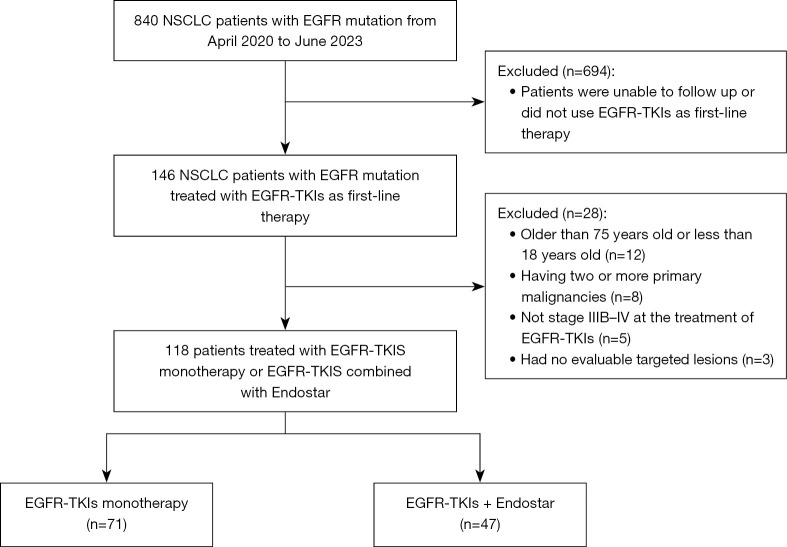
A total of 118 untreated advanced EGFR-sensitive-mutant NSCLC patients from a single center were retrospectively included in the study. Of the patients, 71 received third-generation EGFR-TKIs (the T group) and 47 received combination of Endostar and third-generation EGFR-TKIs therapy (the E + T group). Progression-free survival (PFS), overall survival (OS), the objective response rate (ORR), the disease control rate (DCR), and adverse events (AEs) were evaluated.
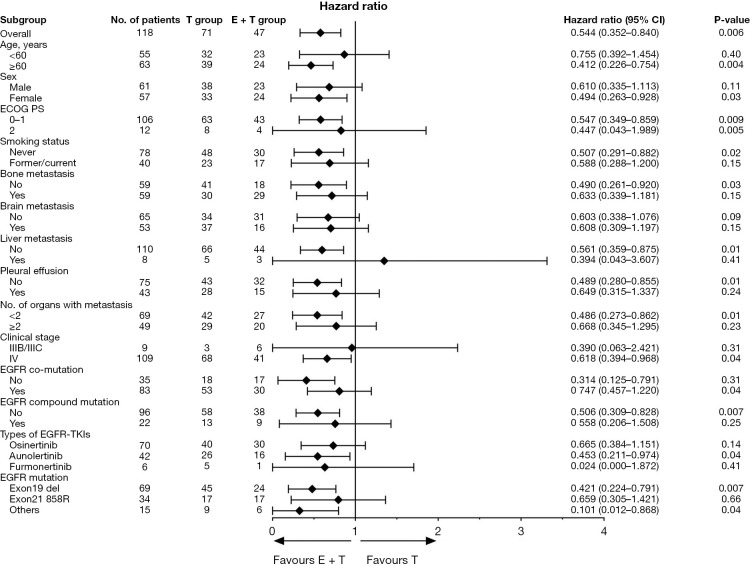
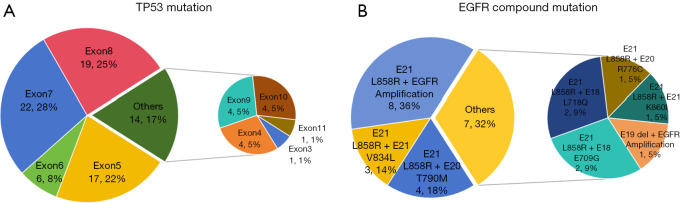
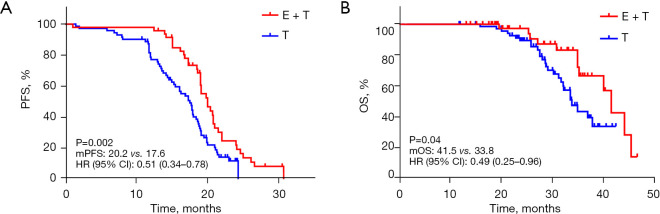
Compared to the T group, the E + T group had a significantly higher ORR (91.5% 77.5%; P=0.047), and improved PFS (20.2 17.6 months; P=0.002) and OS (41.5 33.8 months; P=0.04). However, there was no significant difference in the DCR between the two groups (97.9% 97.2%; P>0.99). Multivariate analysis identified the Eastern Cooperative Oncology Group performance status (ECOG-PS) score, brain metastasis, EGFR co-mutation, and treatment regimen as independent prognostic factors. Subgroup analysis showed that the E + T group had greater clinical benefits for patients with ≥2 distant metastatic organs (P=0.01) and EGFR/TP53 co-mutations (P=0.01). The incidence of AEs of any level was higher in the E + T group than the T group (53.2% 45.1%, P=0.39).
In this real-world study, the combination of recombinant human endostatin and third-generation EGFR-TKIs significantly improved the ORR, PFS, and OS in previously untreated advanced EGFR-mutant NSCLC patients and thus represents a promising treatment option that requires further prospective evaluation.
第三代表皮生长因子受体酪氨酸激酶抑制剂(EGFR-TKIs)是晚期或转移性EGFR突变非小细胞肺癌(NSCLC)的标准一线治疗选择。本研究旨在比较第三代EGFR-TKIs联合重组人血管内皮抑素(恩度)与单纯EGFR-TKIs在既往未治疗的晚期表皮生长因子受体(EGFR)突变NSCLC患者中的疗效和安全性。
本研究回顾性纳入了来自单一中心的118例未经治疗的晚期EGFR敏感突变NSCLC患者。其中,71例接受第三代EGFR-TKIs治疗(T组),47例接受恩度联合第三代EGFR-TKIs治疗(E+T组)。评估无进展生存期(PFS)、总生存期(OS)、客观缓解率(ORR)、疾病控制率(DCR)和不良事件(AEs)。
与T组相比,E+T组的ORR显著更高(91.5%对77.5%;P=0.047),PFS有所改善(20.2个月对17.6个月;P=0.00),OS也有所改善(41.5个月对33.8个月;P=0.04)。然而,两组之间的DCR没有显著差异(97.9%对97.2%;P>0.99)。多因素分析确定东部肿瘤协作组体能状态(ECOG-PS)评分、脑转移、EGFR共突变和治疗方案为独立预后因素。亚组分析显示,E+T组对有≥2个远处转移器官的患者(P=0.01)和EGFR/TP53共突变患者(P=0.01)具有更大的临床获益。E+T组任何级别的AEs发生率均高于T组(53.2%对45.1%,P=0.39)。
在这项真实世界研究中,重组人血管内皮抑素与第三代EGFR-TKIs联合应用显著改善了既往未治疗的晚期EGFR突变NSCLC患者的ORR、PFS和OS,因此是一种有前景的治疗选择,需要进一步进行前瞻性评估。