Nie Xinming, Nie Xin, Xie Qin, Li Changding, He Wenwu, Ni Kunhan, Lu Simiao, Wang Chenghao, Miao Yan, Jiang Longlin, Wang Kangning, Liu Guangyuan, Fang Qiang, Peng Lin, Shi Qiuling, Kanamori Jun, Aiolfi Alberto, Deana Cristian, Han Yongtao, Leng Xuefeng
Department of Thoracic Surgery, Sichuan Clinical Research Center for Cancer, Sichuan Cancer Hospital & Institute, Sichuan Cancer Center, University of Electronic Science and Technology of China, Chengdu, China.
Department of Thoracic Surgery, The Second Affiliated Hospital of Chengdu Medical College, Nuclear Industry 416 Hospital, Chengdu, China.
J Thorac Dis. 2025 Jul 31;17(7):5133-5145. doi: 10.21037/jtd-2025-1229. Epub 2025 Jul 29.
The prognostic nutritional index (PNI) involves both the nutritional status and immune function as crucial factors linked to the prognosis of various gastrointestinal cancers. The relationship between the PNI and postoperative quality of life (QOL) in patients with esophageal cancer (EC) has not been examined. This study sought to examine the effects of the PNI on the postoperative patient-reported outcomes (PROs) of patients with esophageal squamous cell carcinoma (ESCC).
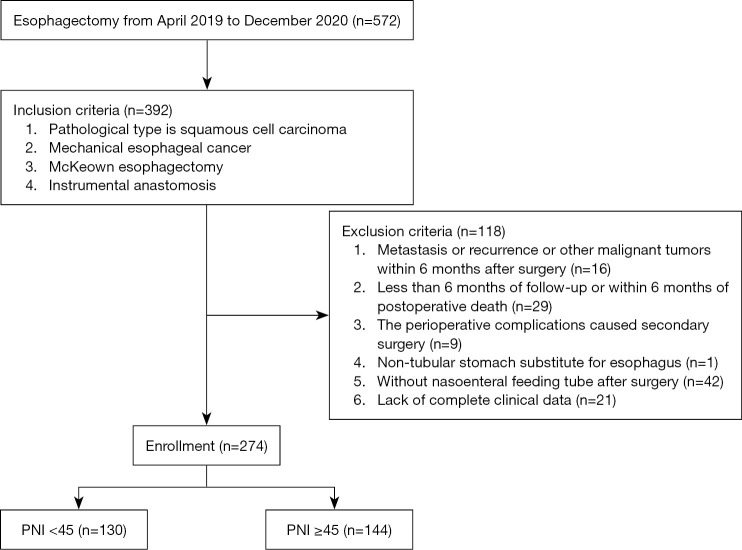
Consecutive ESCC patients undergoing minimally invasive McKeown esophagectomy at a single center from April 2019 to December 2020 were enrolled in this study. The patients were allocated to the PNI-high group (PNI ≥45) and PNI-low group (PNI <45). The longitudinal PROs were handled to compare the functions and symptoms using a linear mixed-effect models. The M.D. Anderson Symptom Inventory (MDASI) and the European Organization for Research and Treatment of Cancer (EORTC) questionnaires were used to assess patients' symptoms and QOL.
A total of 274 patients were included in the study. Patients with esophageal cancer experienced a decline in functional status and significant esophageal cancer-related symptoms shortly after surgery. When PNI was less than 45, a higher PNI might be associated with improved functional status and more obvious symptoms such as pain, problems with taste, sadness, shortness of breath, and drowsiness (P<0.05).
There might be a non-linear association between PNI and the postoperative health-related QOL of ESCC patients. It was emphasized that individualized nutritional intervention should be provided for patients with PNI lower than 45.
预后营养指数(PNI)涉及营养状况和免疫功能,是与各种胃肠道癌症预后相关的关键因素。食管癌(EC)患者的PNI与术后生活质量(QOL)之间的关系尚未得到研究。本研究旨在探讨PNI对食管鳞状细胞癌(ESCC)患者术后患者报告结局(PROs)的影响。
纳入2019年4月至2020年12月在单一中心接受微创McKeown食管切除术的连续ESCC患者。患者被分为PNI高分组(PNI≥45)和PNI低分组(PNI<45)。采用线性混合效应模型处理纵向PROs,以比较功能和症状。使用MD安德森症状问卷(MDASI)和欧洲癌症研究与治疗组织(EORTC)问卷评估患者的症状和QOL。
本研究共纳入274例患者。食管癌患者术后功能状态下降,出现明显的食管癌相关症状。当PNI小于45时,较高的PNI可能与改善的功能状态以及更明显的症状相关,如疼痛、味觉问题、悲伤、呼吸急促和嗜睡(P<0.05)。
PNI与ESCC患者术后健康相关QOL之间可能存在非线性关联。强调应为PNI低于45的患者提供个体化营养干预。