Oyedele Opeoluwa
Department of Computing, Mathematical and Statistical Sciences, School of Science, University of Namibia, Windhoek, Namibia.
Department of Environmental Health, Faculty of Health Sciences, Nelson Mandela University, Gqeberha, South Africa.
Afr Health Sci. 2024 Jun;24(2):302-317. doi: 10.4314/ahs.v24i2.33.
Despite it being treatable and preventable, morbidity from diarrhoeal disease still remains one of the leading killers of young children in developing countries.
To examine the effect of breastfeeding and maternal characteristics on diarrhoea morbidity among 0-2 years old children in Namibia.
A quantitative cross-sectional study design with a multivariable log-binomial model was used to examine the effect of breastfeeding and maternal characteristics on diarrhoea morbidity among 0-2 year old children from data collected from the 2013 NDHS.
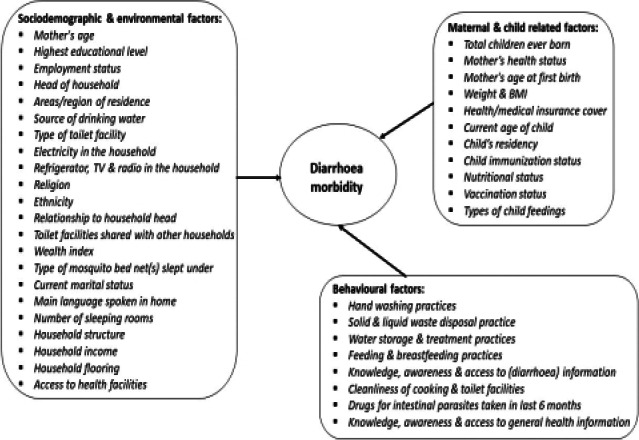
Breastfeeding and maternal related characteristics such as breastfeeding status, sharing toilet facilities with other households, total children ever born, health insurance cover and main language spoken in home had lower risks on child diarrhoea morbidity, while characteristics such as type of place of residence, highest educational level, electricity & refrigerator in the household, religion, wealth index, type of mosquito bed net(s) slept under last night, mother's age at first birth, current age of child, child's residency and drugs taken for intestinal parasites in last 6 months had higher risks and region had mixed risks.
Since studies have shown that the possibility of reducing the risk of morbidity related to diarrhoeal infections in children requires well-informed parents, all relevant organizations and governmental ministries that deals with health services and children's well-being should make use of mass media like radio and television to constantly spread consistent messages on breastfeeding and advocate for better implementation of sanitation and hygiene practices among mothers with children aged 0-2 years, especially in rural and poorest areas of the Kavangos (East/West) and Caprivi/Zambezi regions.
尽管腹泻病是可治疗和可预防的,但在发展中国家,腹泻病的发病率仍然是幼儿的主要杀手之一。
研究纳米比亚0至2岁儿童母乳喂养及母亲特征对腹泻发病率的影响。
采用多变量对数二项式模型的定量横断面研究设计,根据2013年纳米比亚人口与健康调查收集的数据,研究母乳喂养及母亲特征对0至2岁儿童腹泻发病率的影响。
母乳喂养及与母亲相关的特征,如母乳喂养状况、与其他家庭共用厕所设施、生育子女总数、医疗保险覆盖情况及家中主要使用的语言,会降低儿童腹泻发病风险;而居住地点类型、最高教育水平、家中是否有电和冰箱、宗教信仰、财富指数、昨晚睡的蚊帐类型、母亲初育年龄、孩子当前年龄、孩子居住地及过去6个月内是否服用过肠道寄生虫药物等特征会增加发病风险,地区因素的影响则较为复杂。
鉴于研究表明,要降低儿童腹泻感染发病风险,需要家长充分了解相关知识,所有涉及卫生服务和儿童福祉的相关组织和政府部门应利用广播和电视等大众媒体,持续传播关于母乳喂养的一致信息,并倡导0至2岁儿童的母亲更好地落实卫生和清洁措施,特别是在卡万戈斯(东/西)和卡普里维/赞比西地区的农村和最贫困地区。