Singh Jigardeep, Singh Vishwajeet, Sankhwar Satyanarayan, Kumar Manoj, Singh Udham
Urology, King George's Medical University, Lucknow, IND.
Cureus. 2025 Jul 14;17(7):e87896. doi: 10.7759/cureus.87896. eCollection 2025 Jul.
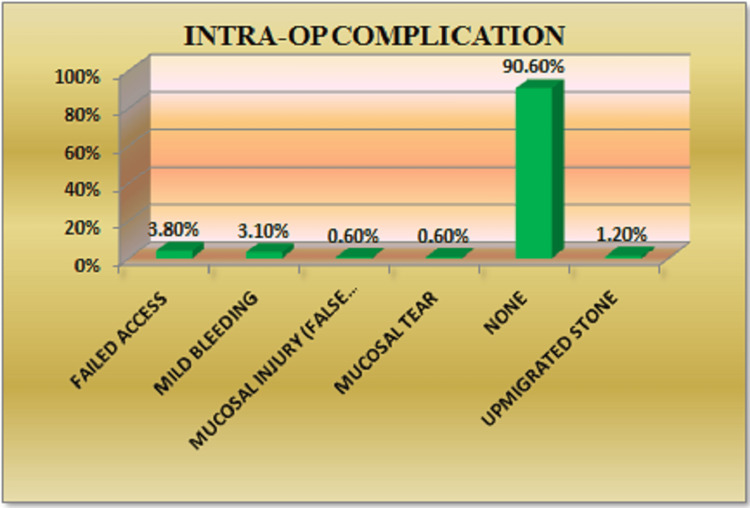
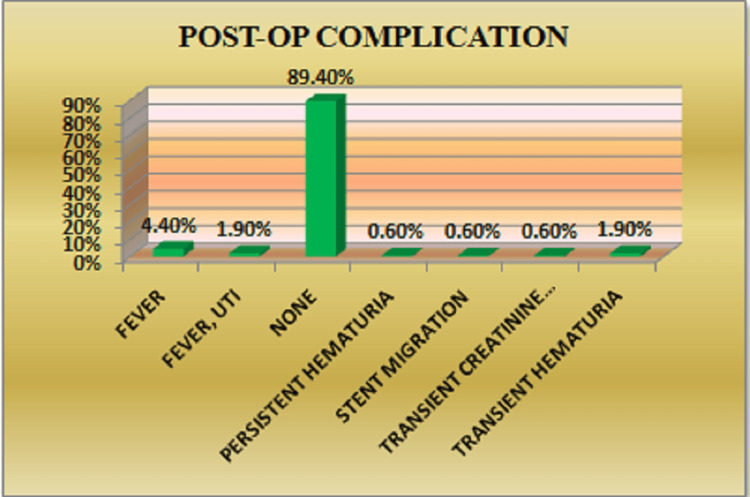
Introduction Ureteroscopy (URS) is a minimally invasive endoscopic technique commonly used to manage ureteric stones. This study prospectively reports and grades the complications associated with semirigid URS for ureteric stone removal and aims to identify factors contributing to these complications. Methods Prospective data were collected from 160 consecutive patients who underwent semirigid URS for ureteric stones at a single center between June 2021 and December 2022. Intraoperative complications were classified using Satava's system, while postoperative complications were categorized according to the Modified Clavien-Dindo classification. Results The overall complication rate was 19.4%. Intraoperative complications occurred in 9.4% of cases, postoperative complications in 10.6%, and 0.6% experienced both. The most frequent intraoperative complication was failure to reach the stone (3.8%), while postoperative fever was the most common postoperative complication (4.4%). Larger stone size (p = 0.03), proximal stone location (p < 0.001), and presence of comorbidities (p = 0.012) were significantly associated with higher complication rates. Conclusions Semirigid URS is generally a safe and effective treatment for ureteric stones, especially in patients with favorable stone characteristics and comorbidity profiles. However, caution is advised when managing larger or proximally located stones and in patients with multiple comorbidities, as these factors increase the risk of complications. Future research should focus on multicenter studies with larger cohorts and longer follow-up periods to better understand late complications such as ureteric strictures. Additionally, investigating the impact of surgeon experience and patient demographics on complication rates could help optimize case selection and management strategies in URS.
引言
输尿管镜检查(URS)是一种常用于处理输尿管结石的微创内镜技术。本研究前瞻性地报告并分级了与半硬性输尿管镜下输尿管结石取出术相关的并发症,并旨在确定导致这些并发症的因素。
方法
前瞻性收集了2021年6月至2022年12月期间在单一中心接受半硬性输尿管镜下输尿管结石取出术的160例连续患者的数据。术中并发症采用萨塔瓦系统分类,术后并发症根据改良的克莱文-迪诺分类法进行分类。
结果
总体并发症发生率为19.4%。术中并发症发生率为9.4%,术后并发症发生率为10.6%,0.6%的患者两者均有发生。最常见的术中并发症是未能到达结石部位(3.8%),而术后发热是最常见的术后并发症(4.4%)。结石体积较大(p = 0.03)、结石位于近端(p < 0.001)以及存在合并症(p = 0.012)与较高的并发症发生率显著相关。
结论
半硬性输尿管镜检查通常是治疗输尿管结石的安全有效方法,尤其是对于结石特征良好且合并症情况有利的患者。然而,在处理较大或位于近端的结石以及合并多种疾病的患者时,建议谨慎操作,因为这些因素会增加并发症的风险。未来的研究应集中在更大样本量、更长随访期的多中心研究上,以更好地了解输尿管狭窄等晚期并发症。此外,研究外科医生经验和患者人口统计学特征对并发症发生率的影响,有助于优化输尿管镜检查的病例选择和管理策略。