Yosboonruang Atchariya, Kiddee Anong, Siriphap Achiraya, Pook-In Grissana, Suwancharoen Chittakun, Duangjai Acharaporn, Praphasawat Ratsada, Reuk-Ngam Nanthawan, Nawong Siriwan, Rawangkan Anchalee
Division of Microbiology and Parasitology, School of Medical Sciences, University of Phayao, Phayao, 56000, Thailand.
Unit of Excellence on Research and Application of Natural products for Health and Well-being, University of Phayao, Phayao, 56000, Thailand.
BMC Complement Med Ther. 2025 Aug 15;25(1):308. doi: 10.1186/s12906-025-05056-w.
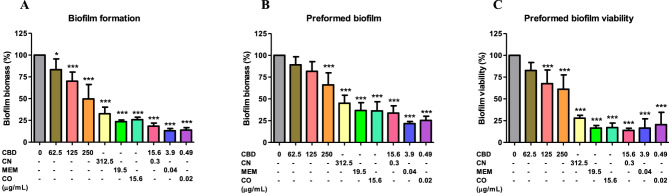
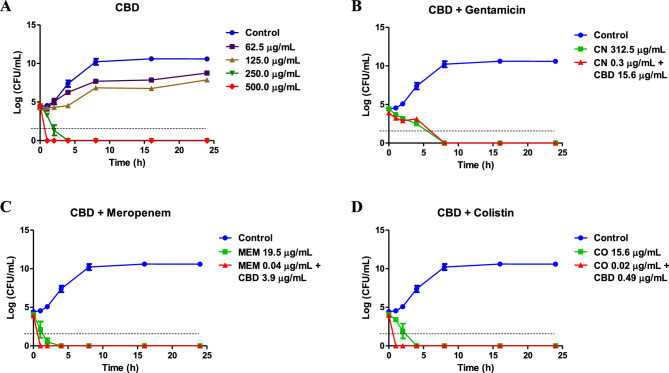
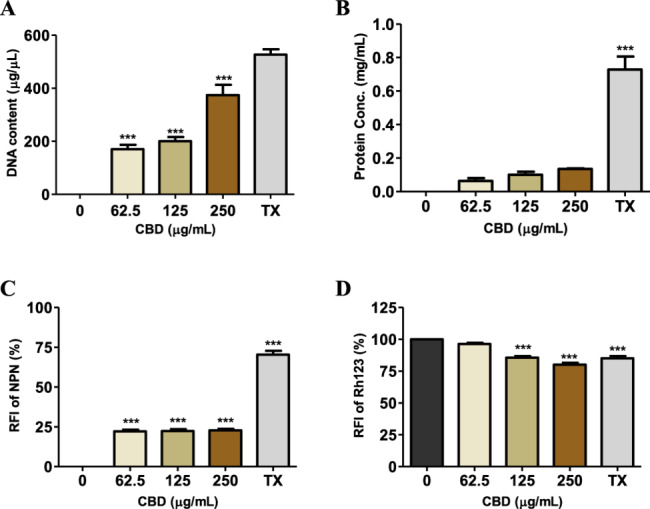
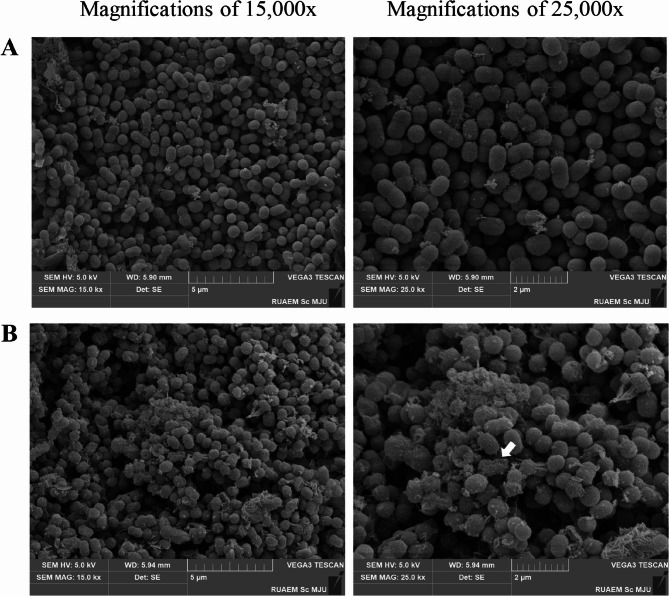
Extensively drug-resistant (XDR) Acinetobacter baumannii poses a serious clinical challenge due to its resistance to nearly all available antibiotics, including carbapenems and colistin. Cannabidiol (CBD), a non-psychoactive phytochemical from Cannabis sativa L., has recently shown promising antimicrobial activity. This study evaluates the antibacterial and anti-biofilm effects of CBD against XDR A. baumannii isolates and explores its mechanism of action and potential as an adjunct therapeutic agent. Twenty-six A. baumannii isolates collected from ICU medical devices were identified using MALDI-TOF/MS. Antimicrobial susceptibility was assessed by disk diffusion and broth microdilution to determine MICs and MBCs for CBD and standard antibiotics. Synergistic effects were evaluated via checkerboard assays and FICI values. Biofilm inhibition and eradication were assessed using crystal violet and MTT assays. Time-kill studies, membrane integrity assays (DNA/protein leakage, NPN uptake, membrane depolarization), and scanning electron microscopy (SEM) were employed to investigate bactericidal kinetics and membrane-disruptive mechanisms. CBD exhibited activity against antimicrobial resistance isolates (MIC: 3.9 to > 500 µg/mL). Remarkably, CBD synergized with gentamicin, meropenem, and colistin, reducing their effective concentrations by up to 1,000-fold. Combination therapy significantly inhibited and eradicated biofilms. Time-kill assays demonstrated rapid, concentration-dependent killing, with complete bacterial clearance at 4× MIC within 2 h. Mechanistic assays and SEM confirmed that CBD induces extensive membrane damage. These findings highlight CBD's potential as an effective adjunct to conventional antibiotics for treating XDR A. baumannii infections, offering a novel strategy to counteract antimicrobial resistance.
广泛耐药(XDR)鲍曼不动杆菌对几乎所有可用抗生素(包括碳青霉烯类和黏菌素)均具有耐药性,这给临床带来了严峻挑战。大麻二酚(CBD)是一种来自大麻的非精神活性植物化学物质,最近已显示出有前景的抗菌活性。本研究评估了CBD对XDR鲍曼不动杆菌分离株的抗菌和抗生物膜作用,并探讨了其作用机制以及作为辅助治疗剂的潜力。使用基质辅助激光解吸电离飞行时间质谱(MALDI-TOF/MS)对从重症监护病房(ICU)医疗设备中收集的26株鲍曼不动杆菌分离株进行鉴定。通过纸片扩散法和肉汤微量稀释法评估抗菌药敏性,以确定CBD和标准抗生素的最低抑菌浓度(MIC)和最低杀菌浓度(MBC)。通过棋盘法和分数抑菌浓度指数(FICI)值评估协同作用。使用结晶紫和MTT法评估生物膜抑制和根除情况。采用时间杀菌研究、膜完整性测定(DNA/蛋白质泄漏、NPN摄取、膜去极化)和扫描电子显微镜(SEM)来研究杀菌动力学和膜破坏机制。CBD对耐药分离株具有活性(MIC:3.9至>500μg/mL)。值得注意的是,CBD与庆大霉素、美罗培南和黏菌素具有协同作用,可将它们的有效浓度降低多达1000倍。联合治疗显著抑制并根除了生物膜。时间杀菌试验表明杀菌迅速且呈浓度依赖性,在2小时内4倍MIC浓度时可实现细菌完全清除。机制分析和SEM证实CBD可引起广泛的膜损伤。这些发现突出了CBD作为治疗XDR鲍曼不动杆菌感染的传统抗生素有效辅助剂的潜力,为对抗抗菌药物耐药性提供了一种新策略。