Yang Lei, Zhang Yuan
Department of Gastroenterology, The First Affiliated Hospital of Zhengzhou University, Zhengzhou, 450052, Henan, China.
Key Clinical Laboratory of Henan Province, Department of Clinical Laboratory, The First Affiliated Hospital of Zhengzhou University, Zhengzhou, 450052, Henan, China.
Sci Rep. 2025 Aug 18;15(1):30155. doi: 10.1038/s41598-025-15389-8.
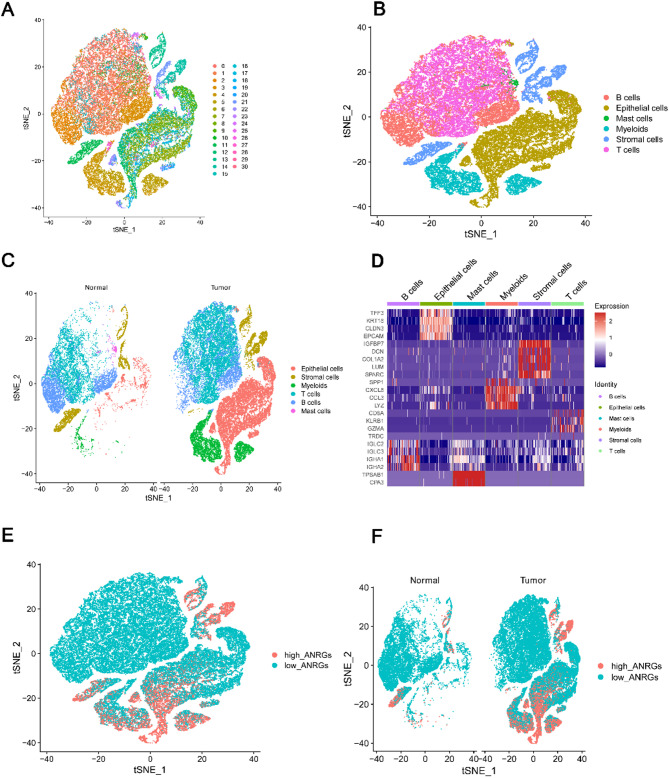
Colorectal cancer (CRC) is a most deadly cancer, and effective prognostic biomarkers are urgently needed. Although anoikis has diverse regulatory roles in tumor progression, the impact of anoikis-related genes (ANRG) by single-cell and bulk transcriptome analyses on the prognostic value for CRC have not been studied. Differentially expressed genes (DEGs) associated with anoikis were obtained by performing single-cell RNA-sequencing (scRNA-seq) analysis in cells with high and low ANRG expression and weighted correlation network analysis (WGCNA) in a bulk RNA sequencing dataset. Key prognostic genes were selected from anoikis associated DEGs by least absolute shrinkage and selection operator (LASSO)-Cox regression analysis, and a prognostic model was established based on the risk score calculated from the expression levels of the identified key prognostic genes. A 10 anoikis-related-gene prognostic model (MGP, TPM2, CRIP2, TUBB6, C1orf54, NOTCH3, LTBP1, CSRP2, FSTL3, and VIM) was developed and the area under the curve (AUC) values of the model in predicting 1-, 3- and 5-year survival probabilities reached 0.744, 0.797, and 0.755, respectively. In conclusion, anoikis related genes could be promising prognostic factors for risk stratification of CRC patients.
结直肠癌(CRC)是一种极具致命性的癌症,迫切需要有效的预后生物标志物。尽管失巢凋亡在肿瘤进展中具有多种调节作用,但通过单细胞和批量转录组分析研究失巢凋亡相关基因(ANRG)对CRC预后价值的影响尚未见报道。通过对高表达和低表达ANRG的细胞进行单细胞RNA测序(scRNA-seq)分析以及在批量RNA测序数据集中进行加权基因共表达网络分析(WGCNA),获得与失巢凋亡相关的差异表达基因(DEG)。通过最小绝对收缩和选择算子(LASSO)-Cox回归分析从失巢凋亡相关的DEG中筛选关键预后基因,并基于从鉴定出的关键预后基因的表达水平计算出的风险评分建立预后模型。构建了一个包含10个失巢凋亡相关基因的预后模型(MGP、TPM2、CRIP2、TUBB6、C1orf54、NOTCH3、LTBP1、CSRP2、FSTL3和VIM),该模型预测1年、3年和5年生存概率的曲线下面积(AUC)值分别达到0.744、0.797和0.755。总之,失巢凋亡相关基因可能是CRC患者风险分层的有前景的预后因素。