Qin Sisi, Xiao Jijie, Yuan Shiqi, Zhang Huitao, Liu Yang, Li Ningjun, He Songjin, Kou Li
The Fifth Affiliated Hospital of Sun Yat-Sen University, Department of Critical Care Medicine, Zhuhai, Guangdong Province, China.
The Third Affiliated Hospital of Southern Medical University, Department of Radiology, Guangzhou, PR China.
J Med Biochem. 2025 Jun 13;44(3):453-469. doi: 10.5937/jomb0-54979.
Stroke is a major cause of disability and cognitive deficits, with ischemic stroke (IS) being the most prevalent type, especially in critically ill patients in intensive care units (ICUs). The lactate-to-albumin ratio (LAR) has emerged as a potential predictor of disease outcomes, but its association with shortand long-term mortality in critically ill IS patients is unclear.
This study analyzed data from 894 critically ill IS patients from the MIMIC-IV database, categorized into LAR tertiles. Clinical endpoints included ICU, hospital, and 30and 90-day all-cause mortality. Survival differences were assessed using Kaplan-Meier analysis. Cox proportional-hazards regression models and restricted cubic spline (RCS) analysis evaluated the association between LAR and mortality outcomes. Subgroup analyses examined the modifying effects of clinical characteristics on LAR's predictive value.
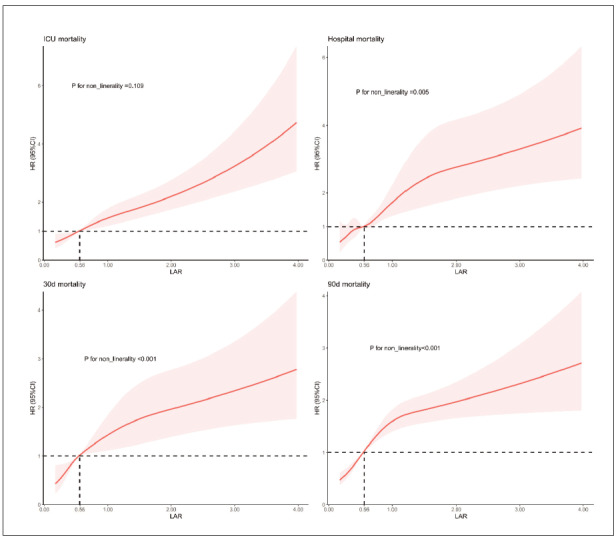
The ICU, hospital, 30-, and 90-day mortality rates were 15.0%, 22.3%, 28.2%, and 36.1%, respectively. Higher LAR levels were associated with reduced survival times and increased mortality risks in all endpoints. Multivariable Cox models confirmed LAR as an independent predictor of 30and 90-day mortality. RCS analysis indicated a linear relationship between LAR and ICU mortality (P = 0.109), and a non-linear association with hospital (P = 0.005), 30-day (P < 0.001), and 90-day mortality (P < 0.001). Subgroup analyses highlighted significant interactions for respiratory failure and GCS.
LAR is a robust predictor of shortand longterm mortality in critically ill IS patients, offering clinicians a valuable tool for risk stratification and decision-making.
中风是导致残疾和认知缺陷的主要原因,缺血性中风(IS)是最常见的类型,尤其是在重症监护病房(ICU)的重症患者中。乳酸与白蛋白比值(LAR)已成为疾病预后的潜在预测指标,但其与重症IS患者短期和长期死亡率的关联尚不清楚。
本研究分析了来自MIMIC-IV数据库的894例重症IS患者的数据,将其分为LAR三分位数组。临床终点包括ICU、医院以及30天和90天全因死亡率。使用Kaplan-Meier分析评估生存差异。Cox比例风险回归模型和受限立方样条(RCS)分析评估LAR与死亡率结局之间的关联。亚组分析检验了临床特征对LAR预测价值的修正作用。
ICU、医院、30天和90天死亡率分别为15.0%、22.3%、28.2%和36.1%。在所有终点中,较高的LAR水平与生存时间缩短和死亡风险增加相关。多变量Cox模型证实LAR是30天和90天死亡率的独立预测指标。RCS分析表明LAR与ICU死亡率之间呈线性关系(P = 0.109),与医院死亡率(P = 0.005)、30天死亡率(P < 0.001)和90天死亡率(P < 0.001)呈非线性关联。亚组分析突出了呼吸衰竭和格拉斯哥昏迷量表(GCS)的显著相互作用。
LAR是重症IS患者短期和长期死亡率的有力预测指标,为临床医生提供了一个用于风险分层和决策的有价值工具。