Lestang Julie, Miescher Schwenninger Susanne, Nyström Laura
Laboratory of Food Biochemistry, Institute of Food Nutrition and Health, Department of Health Science and Technology, ETH Zürich, Zürich, Switzerland.
Food Biotechnology Research Group, Institute for Food and Beverage Innovation, ZHAW Zurich University of Applied Sciences, Wädenswil, Switzerland.
Curr Res Food Sci. 2025 Aug 6;11:101161. doi: 10.1016/j.crfs.2025.101161. eCollection 2025.
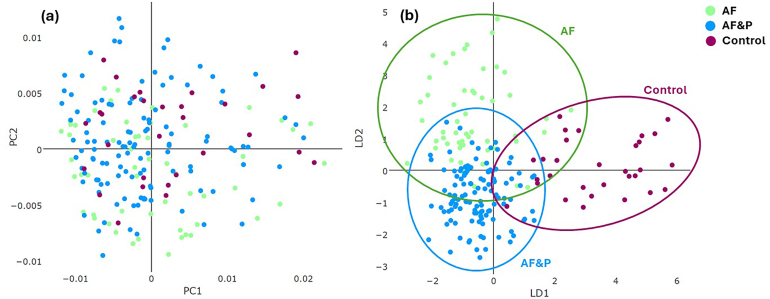
Ensuring the high and consistent quality of cocoa beans presents a significant challenge, driven by concerns related to food safety, economic profitability, and overall quality. Recently, functional microbial cultures have been developed by selecting specific microbial strains that enhance the cocoa bean fermentation process and improve the quality of the fermented and dried beans. These selection processes require extensive and time-consuming screening of numerous microbial strains. To address this, the present study explored a rapid, untargeted, metabolite-based approach to distinguish cocoa beans fermented with specific microbial cultures. This was achieved using rapid evaporative ionization mass spectrometry (REIMS) combined with chemometric analysis. Metabolite fingerprints of cocoa beans fermented with 21 antifungal (AF) and/or pectinolytic (P) microbial cultures were analyzed using REIMS. The fermented beans were differentiated based on their metabolite profiles using LiveID software, which is integrated with the REIMS system. Subsequently, six classification models were compared in detail to evaluate their performance, and tentatively extended to classify metabolite fingerprints from independently fermented beans. Initially, LiveID combined with PCA-LDA successfully distinguished metabolite fingerprints based on single-strain microbial cultures and the expected AF or AF&P functionalities of co-cultures, achieving an accuracy of 80 %. Further analysis of the six classification models demonstrated the strong performance of gradient boosting machines, random forests, and neural networks in differentiating metabolite fingerprints based on the functionality of microbial co-cultures, with accuracy estimates of 85 %, 84 %, and 81 %, respectively. Finally, optimized random forest models were tested on an independent dataset, achieving 70-85 % accuracy for the two-class models. The performance of these models on independent data highlights their potential for broader applications, such as differentiating cocoa beans at the lab scale or in on-farm settings to support the development of functional microbial cultures for the production of cocoa beans with consistently high quality.
由于食品安全、经济盈利能力和整体质量等相关问题,确保可可豆的高质量和一致性面临重大挑战。最近,通过选择特定的微生物菌株开发了功能性微生物培养物,这些菌株可增强可可豆的发酵过程并提高发酵和干燥后可可豆的质量。这些筛选过程需要对大量微生物菌株进行广泛且耗时的筛选。为了解决这一问题,本研究探索了一种基于代谢物的快速、非靶向方法,以区分用特定微生物培养物发酵的可可豆。这是通过将快速蒸发电离质谱(REIMS)与化学计量分析相结合来实现的。使用REIMS分析了用21种抗真菌(AF)和/或果胶分解(P)微生物培养物发酵的可可豆的代谢物指纹图谱。使用与REIMS系统集成的LiveID软件,根据发酵豆的代谢物谱对其进行区分。随后,详细比较了六个分类模型以评估其性能,并初步扩展到对独立发酵豆的代谢物指纹图谱进行分类。最初,LiveID与PCA-LDA相结合,成功地基于单菌株微生物培养物以及共培养物预期的AF或AF&P功能区分了代谢物指纹图谱,准确率达到80%。对六个分类模型的进一步分析表明,梯度提升机、随机森林和神经网络在基于微生物共培养物功能区分代谢物指纹图谱方面表现出色,准确率估计分别为85%、84%和81%。最后,在独立数据集上测试了优化的随机森林模型,两类模型的准确率达到70%-85%。这些模型在独立数据上的表现突出了它们在更广泛应用中的潜力,例如在实验室规模或农场环境中区分可可豆,以支持开发功能性微生物培养物,用于生产始终保持高质量的可可豆。