Netra S N, Srinidhi N N, Naresh E
Manipal Institute of Technology Bengaluru, Manipal Academy of Higher Education, Manipal, India.
Department of Computer Science & Engineering, B.M.S. College of Engineering, Bengaluru, India.
Sci Rep. 2025 Aug 18;15(1):30222. doi: 10.1038/s41598-025-15938-1.
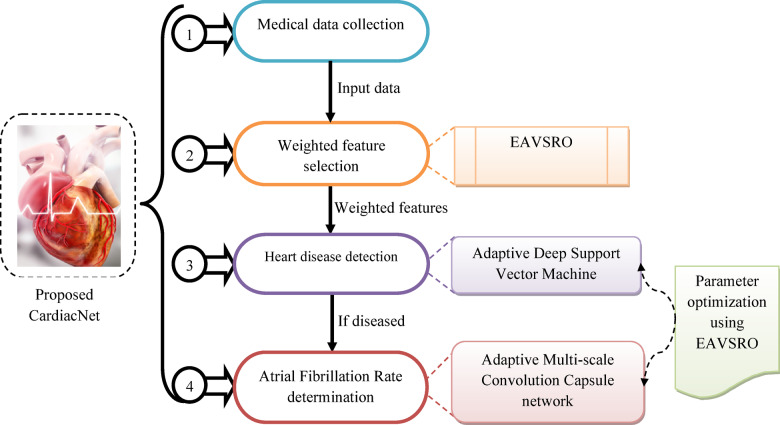
Heart attack is one of the most common heart diseases, which causes more deaths worldwide. Early detection and continuous monitoring are essential in reducing the death rate caused by heart diseases. Machine learning gives a promising solution for early and accurate heart disease detection by analyzing the data from healthcare devices. Although existing studies have employed various machine learning techniques to detect heart disease, most of the techniques still face challenges in handling large healthcare datasets that affect the prediction outcomes. To solve this issue, the research work focuses on developing a novel framework for detecting heart disease in its early stages by using machine learning techniques. In the initial phase, the significant data required for the validation is collected from benchmark resources, and it is subjected to the weighted optimal features selection phase. Here, from the input data, the features are selected optimally and their weights are tuned using Enhanced Arbitrary Variable-based Ship Rescue Optimization (EAVSRO). Further, the optimally selected weighted features are fed into the detection phase. In this phase, an Adaptive Deep Support Vector Machine (AD-SVM) is employed to detect heart diseases. Once heart disease is detected, the Atrial Fibrillation (AF) rate is determined using the Adaptive Multiscale Convolution Capsule Network (AMCCNet). Finally, the AF rate is obtained from the developed AMCCNet, and its parameters are tuned using the same EAVSRO. Later, various experiments are performed in the recommended heart disease detection model over existing models to verify its effectiveness. The accuracy of the designed framework is 96.07%, which is enhanced than the other existing frameworks like CNN-LSTM, DCNN, Adaboost and SVM, respectively. Thus, the results proved that the developed model can effectively detect heart disease at the early stages and identify the AF rate, providing timely treatments.
心脏病发作是最常见的心脏病之一,在全球范围内导致更多人死亡。早期检测和持续监测对于降低心脏病导致的死亡率至关重要。机器学习通过分析来自医疗设备的数据,为早期准确检测心脏病提供了一个有前景的解决方案。尽管现有研究采用了各种机器学习技术来检测心脏病,但大多数技术在处理影响预测结果的大型医疗数据集时仍面临挑战。为了解决这个问题,该研究工作专注于通过使用机器学习技术开发一种用于早期检测心脏病的新颖框架。在初始阶段,从基准资源收集验证所需的重要数据,并将其进行加权最优特征选择阶段。在这里,从输入数据中最优地选择特征,并使用基于增强任意变量的船舶救援优化(EAVSRO)调整其权重。此外,将最优选择的加权特征输入到检测阶段。在这个阶段,采用自适应深度支持向量机(AD-SVM)来检测心脏病。一旦检测到心脏病,使用自适应多尺度卷积胶囊网络(AMCCNet)确定房颤(AF)率。最后,从开发的AMCCNet获得AF率,并使用相同的EAVSRO调整其参数。之后,在推荐的心脏病检测模型上针对现有模型进行各种实验以验证其有效性。所设计框架的准确率为96.07%,分别比其他现有框架如CNN-LSTM、DCNN、Adaboost和SVM有所提高。因此,结果证明所开发的模型能够在早期有效地检测心脏病并识别AF率,从而提供及时的治疗。