Drizyte-Miller Kristina, Talabi Taiwo, Somasundaram Ashwin, Cox Adrienne D, Der Channing J
Lineberger Comprehensive Cancer Center.
Department of Medicine.
J Clin Invest. 2025 Aug 15;135(16). doi: 10.1172/JCI191939.
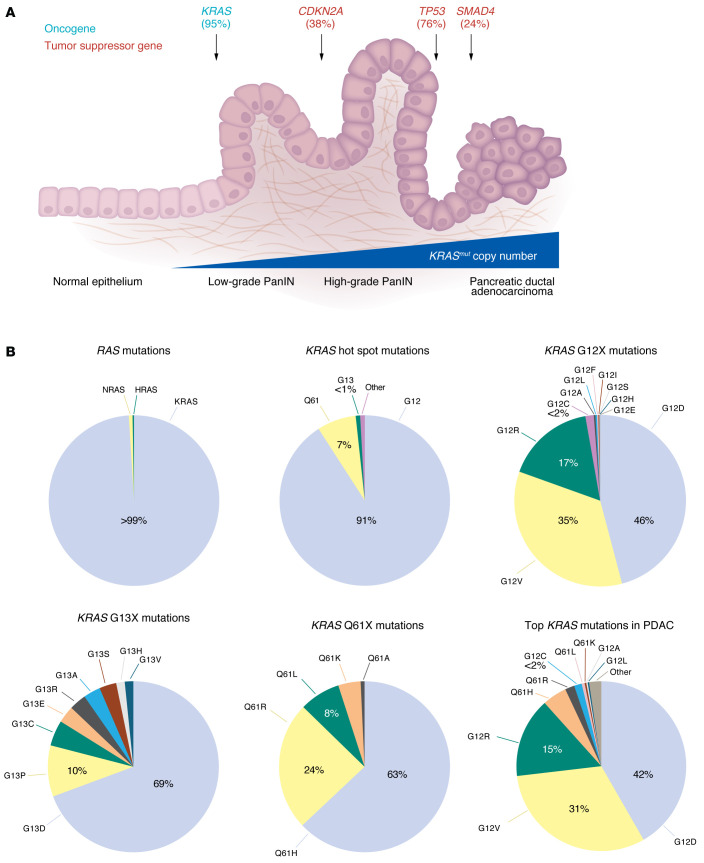
The genetic landscape of pancreatic ductal adenocarcinoma (PDAC) is well-established and dominated by four key genetic driver mutations. Mutational activation of the KRAS oncogene is the initiating genetic event, followed by genetic loss of function of the CDKN2A, TP53, and SMAD4 tumor suppressor genes. Disappointingly, this information has not been leveraged to develop clinically effective targeted therapies for PDAC treatment, where current standards of care remain cocktails of conventional cytotoxic drugs. Nearly all (~95%) PDAC harbors KRAS mutations, and experimental studies have validated the essential role of KRAS mutation in PDAC tumorigenic and metastatic growth. Identified in 1982 as the first gene shown to be aberrantly activated in human cancer, KRAS has been the focus of intensive drug discovery efforts. Widely considered "undruggable," KRAS has been the elephant in the room for PDAC treatment. This perception was shattered recently with the approval of two KRAS inhibitors for the treatment of KRASG12C-mutant lung and colorectal cancer, fueling hope that KRAS inhibitors will lead to a breakthrough in PDAC therapy. In this Review, we summarize the key role of aberrant KRAS signaling in the biology of pancreatic cancer; provide an overview of past, current, and emerging anti-KRAS treatment strategies; and discuss current challenges that limit the clinical efficacy of directly targeting KRAS for pancreatic cancer treatment.
胰腺导管腺癌(PDAC)的基因图谱已得到充分确立,且由四种关键的基因驱动突变主导。KRAS癌基因的突变激活是起始基因事件,随后是CDKN2A、TP53和SMAD4肿瘤抑制基因的功能丧失。令人失望的是,这一信息尚未被用于开发针对PDAC治疗的临床有效靶向疗法,目前的治疗标准仍然是传统细胞毒性药物的联合使用。几乎所有(约95%)的PDAC都存在KRAS突变,实验研究已经证实KRAS突变在PDAC致瘤性和转移性生长中的关键作用。KRAS于1982年被鉴定为首个在人类癌症中显示异常激活的基因,一直是药物研发的重点。KRAS被广泛认为“不可成药”,一直是PDAC治疗中被忽视的重要问题。最近,两种KRAS抑制剂被批准用于治疗KRASG12C突变的肺癌和结直肠癌,这一观念被打破,人们燃起了KRAS抑制剂将在PDAC治疗中取得突破的希望。在本综述中,我们总结了异常KRAS信号在胰腺癌生物学中的关键作用;概述了过去、当前和新兴的抗KRAS治疗策略;并讨论了目前限制直接靶向KRAS进行胰腺癌治疗临床疗效的挑战。