Zhou Lizhi, Lu Hengcheng, Fu Bin, Fu Jianhan
Jiangxi Provincial Key Laboratory of Urinary System Diseases, Department of Urology, The First Affiliated Hospital, Jiangxi Medical College, Nanchang University, Nanchang, Jiangxi, P.R. China.
Postdoctoral Innovation Practice Base, The First Affiliated Hospital, Jiangxi Medical College, Nanchang University, Nanchang, P.R. China.
Ann Med. 2025 Dec;57(1):2548042. doi: 10.1080/07853890.2025.2548042. Epub 2025 Aug 19.
Metastasis represents the primary cause of cancer-related mortality, with a high incidence observed in renal cell carcinoma (RCC). Anoikis, a specialized form of apoptosis, plays a crucial role in preventing displaced cells from adhering to new extracellular matrices (ECM), thus inhibiting their aberrant growth. Notably, cancer cells, especially metastatic ones, exhibit resistance to anoikis. However, the exact mechanisms of anoikis resistance in RCC are not well understood.
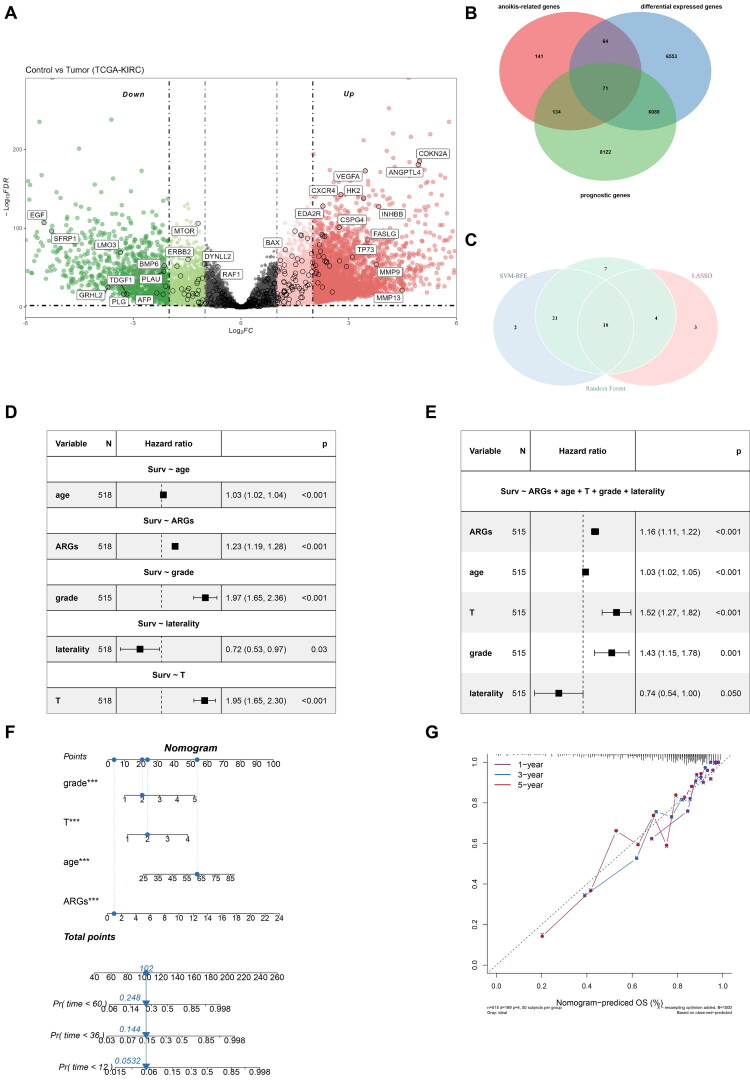
This study integrates bioinformatics, single-cell RNA sequencing and experimental validation to investigate the role of anoikis-related genes (ARG) in RCC, with a focus on MMP9. RNA-seq data from 518 RCC patients and 71 healthy controls (TCGA-KIRC) and external validation cohorts (E-MTAB-1980, GSE22541) were analyzed to construct an ARG-based prognostic model. Single-cell RNA sequencing (scRNA-seq, GSE159115) was used to assess tumour heterogeneity, while experiments in RCC cell lines validated MMP9's impact on anoikis resistance, migration and invasion.
We collected all RNA-seq and single-cell RNA-seq (scRNA-seq) data from multiple online databases and utilized these datasets to develop a novel ARG-based prognostic model called ARGs. Using Cox regression and machine learning, our model achieved a 5-year area under curve (AUC) of 0.79, surpassing existing models in predictive performance. Enrichment analysis revealed distinct immune and metabolic landscapes between ARGs high- and low-risk groups. At the single-cell level, tumour cells were categorized based on ARG expression, revealing heterogeneous anoikis resistance mechanisms. MMP9 was identified as a key prognostic gene (HR = 1.5, = 0.016) associated with anoikis resistance and RCC metastasis. Functional assays confirmed that MMP9 knockdown increased anoikis by 59% and significantly reduced wound-healing migration by about 30% and transwell invasion by 50%, reinforcing its role in RCC progression.
Targeting anoikis-related genes, particularly MMP9, enhances anoikis sensitivity and reduces RCC invasiveness, offering a potential therapeutic strategy to mitigate metastasis and improve clinical outcomes.
转移是癌症相关死亡的主要原因,在肾细胞癌(RCC)中发生率很高。失巢凋亡是一种特殊形式的细胞凋亡,在防止移位细胞粘附于新的细胞外基质(ECM)从而抑制其异常生长方面起着关键作用。值得注意的是,癌细胞,尤其是转移性癌细胞,对失巢凋亡具有抗性。然而,RCC中失巢凋亡抗性的确切机制尚不清楚。
本研究整合生物信息学、单细胞RNA测序和实验验证,以研究失巢凋亡相关基因(ARG)在RCC中的作用,重点是基质金属蛋白酶9(MMP9)。分析了来自518例RCC患者和71例健康对照(TCGA-KIRC)以及外部验证队列(E-MTAB-1980,GSE22541)的RNA测序数据,以构建基于ARG的预后模型。单细胞RNA测序(scRNA-seq,GSE159115)用于评估肿瘤异质性,而在RCC细胞系中的实验验证了MMP9对失巢凋亡抗性、迁移和侵袭的影响。
我们从多个在线数据库收集了所有RNA测序和单细胞RNA测序(scRNA-seq)数据,并利用这些数据集开发了一种名为ARGs的基于ARG的新型预后模型。使用Cox回归和机器学习,我们的模型实现了5年曲线下面积(AUC)为0.79,预测性能超过现有模型。富集分析揭示了ARGs高风险组和低风险组之间不同的免疫和代谢景观。在单细胞水平上,根据ARG表达对肿瘤细胞进行分类,揭示了异质性的失巢凋亡抗性机制。MMP9被确定为与失巢凋亡抗性和RCC转移相关的关键预后基因(HR = 1.5,P = 0.016)。功能测定证实,敲低MMP9可使失巢凋亡增加59%,并显著降低伤口愈合迁移约30%和Transwell侵袭50%,强化了其在RCC进展中的作用。
靶向失巢凋亡相关基因,特别是MMP9,可增强失巢凋亡敏感性并降低RCC侵袭性,为减轻转移和改善临床结果提供了一种潜在的治疗策略。