Hale Evan B, Vona Barbara, Goodyear Richard J, Osgood Richard T, Amr Sami S, Mojica Karen, Vera-Monroy Ricardo, Callahan Katherine, Gudlewski Kerry L, Quadros Rolen, Ohtsuka Masato, McGee JoAnn, Walsh Edward J, Morton Cynthia C, Gurumurthy Channabasavaiah, Saunders James E, Richardson Guy P, Indzhykulian Artur A
Mass Eye and Ear, Eaton Peabody Laboratories, Boston, MA, 02114, USA.
Department of Otolaryngology Head and Neck Surgery, Harvard Medical School, Boston, MA, 02115, USA.
medRxiv. 2025 Aug 14:2025.08.13.25333146. doi: 10.1101/2025.08.13.25333146.
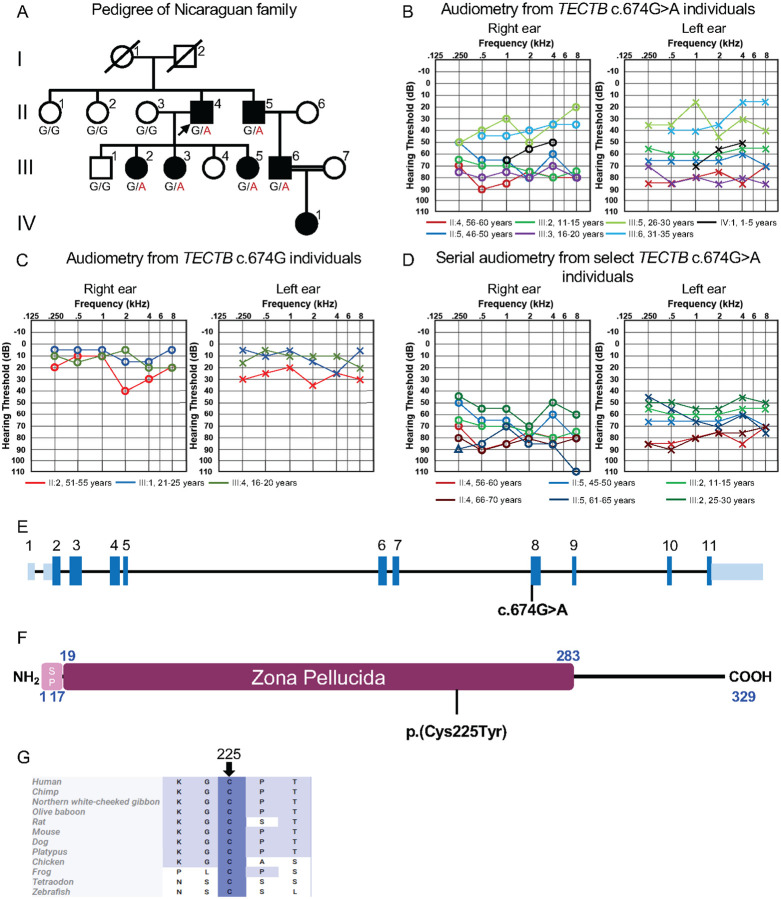
Identifying new genes responsible for non-syndromic hearing loss remains a critical goal, as many individuals with hereditary deafness still lack a molecular diagnosis despite comprehensive genetic testing. The tectorial membrane (TM) is a specialized, collagen-rich, acellular matrix of the inner ear, essential for stimulating mechanosensitive hair cell bundles during sound transduction, and its structural integrity is critical for frequency tuning and auditory sensitivity. Although mutations in genes encoding a number of non-collagenous proteins found in the TM (TECTA, CEACAM16, OTOG, OTOGL) have been identified as deafness genes, definitive evidence implicating β-tectorin (TECTB) in human hearing loss has been lacking. Here, we present multiple lines of genetic and experimental evidence linking a missense variant in (c.674G>A, p.Cys225Tyr) to autosomal dominant, non-syndromic hearing loss in a multigenerational family. The variant alters one of eight highly conserved cysteines present within the zona pellucida (ZP) domain of TECTB and is predicted to disrupt protein folding and matrix assembly. Using a knock-in mouse model, we show that homozygous animals exhibit severe hearing loss and profound disruption of TM morphology, while heterozygote animals display decreased matrix content within the TM and increased susceptibility to noise-induced hearing loss-despite normal auditory thresholds. These findings identify as a novel human deafness gene, further elucidate its structural role in maintaining TM integrity, and highlight its contribution to resilience against environmental and age-related auditory decline.
识别导致非综合征性听力损失的新基因仍然是一个关键目标,因为许多遗传性耳聋患者尽管进行了全面的基因检测,但仍缺乏分子诊断。盖膜(TM)是内耳一种特殊的、富含胶原蛋白的无细胞基质,在声音传导过程中对刺激机械敏感的毛细胞束至关重要,其结构完整性对于频率调谐和听觉敏感性至关重要。尽管已确定在TM中发现的一些非胶原蛋白编码基因(TECTA、CEACAM16、OTOG、OTOG)中的突变是耳聋基因,但一直缺乏确凿证据表明β - 盖膜蛋白(TECTB)与人类听力损失有关。在这里,我们提供了多条遗传和实验证据,将TECTB基因中的一个错义变体(c.674G>A,p.Cys225Tyr)与一个多代家族中的常染色体显性非综合征性听力损失联系起来。该变体改变了TECTB透明带(ZP)结构域中八个高度保守的半胱氨酸之一,预计会破坏蛋白质折叠和基质组装。使用TECTB基因敲入小鼠模型,我们发现纯合动物表现出严重的听力损失和TM形态的严重破坏,而异合子动物的TM内基质含量减少,对噪声诱导的听力损失的易感性增加——尽管听觉阈值正常。这些发现确定TECTB为一种新的人类耳聋基因,进一步阐明了其在维持TM完整性中的结构作用,并突出了其对抵抗环境和年龄相关听力下降的贡献。