Gibson S A, Jackson C J, Crosby J C, Day J A F
Dept of Earth Sciences, University of Cambridge, Cambridge, UK.
Nat Commun. 2025 Aug 22;16(1):7842. doi: 10.1038/s41467-025-62888-3.
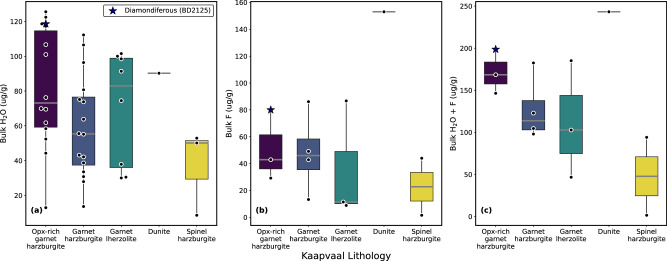
The cratonic 'roots' of Earth's major continents extend to depths of over 160 km and have remained stable for more than 2.5 billion years due to buoyant, refractory harzburgites formed by Archean mantle melting. However, mantle harzburgites from some global cratons (e.g., Kaapvaal, Siberia, Slave, Rae and Tanzania) show unusual orthopyroxene and silica enrichment, alongside titanium depletion, which cannot be explained by simple melting processes. The origins of the orthopyroxene-rich harzburgites are debated and include high-pressure melting residues, with komatiite melt interaction, or subduction-related silicic melts and fluids. To further investigate this we analysed volatile (HO, F, Cl) contents in Kaapvaal craton peridotites. Orthopyroxene-rich harzburgites, including a diamond-bearing sample, show elevated volatile contents, suggesting infiltration by supercritical C-O-H fluids-rich in silica, fluorine and chlorine and depleted in Ti-fluxed from subducted oceanic lithosphere (carbonated pelites, eclogites and serpentinites). These findings highlight the role of C-O-H-F-Cl bearing fluids in shaping cratonic lithosphere and offer a new framework for understanding craton evolution, mantle metasomatism and diamond genesis in early Earth.
地球主要大陆的克拉通“根”延伸至超过160千米的深度,并且由于太古宙地幔熔融形成的浮力大、难熔的方辉橄榄岩,已经保持稳定超过25亿年。然而,来自一些全球克拉通(如卡普瓦尔、西伯利亚、斯拉维、雷和坦桑尼亚)的地幔方辉橄榄岩显示出异常的斜方辉石和二氧化硅富集,同时钛含量降低,这无法用简单的熔融过程来解释。富含斜方辉石的方辉橄榄岩的起源存在争议,包括高压熔融残余物、科马提岩熔体相互作用,或与俯冲相关的硅质熔体和流体。为了进一步研究这一点,我们分析了卡普瓦尔克拉通橄榄岩中的挥发物(HO、F、Cl)含量。富含斜方辉石的方辉橄榄岩,包括一个含金刚石的样品,显示出挥发物含量升高,表明有来自俯冲洋壳(碳酸盐化泥质岩、榴辉岩和蛇纹岩)的富含二氧化硅、氟和氯且贫钛的超临界C - O - H流体渗透。这些发现突出了含C - O - H - F - Cl流体在塑造克拉通岩石圈中的作用,并为理解早期地球的克拉通演化、地幔交代作用和金刚石成因提供了一个新的框架。