Li Fangdi, Zhang Tianhe, Wan Rou, Jiang Peishuo, Gao Xiaoge, Guo Qirong
College of Forestry and Grassland College of Soil and Water Conservation, Nanjing Forestry University, Nanjing, 210037, China.
Co-Innovation Center for Sustainable Forestry in Southern China, Nanjing Forestry University, Nanjing, 210037, China.
BMC Genomics. 2025 Aug 25;26(1):773. doi: 10.1186/s12864-025-11935-w.
Tree rejuvenation is the transition from adult state to juvenile state. Successive grafting can result in tree rejuvenation. Flavonoids constitute a prominent class of secondary metabolites that play critical roles in regulating cellular physiology, signaling, and the transduction between plant and environment interactions. Meanwhile, endogenous phytohormones are instrumental in restoring the juvenile features of trees. However, little is known about the flavonoid and hormone biosynthesis in rejuvenated Ginkgo biloba L.
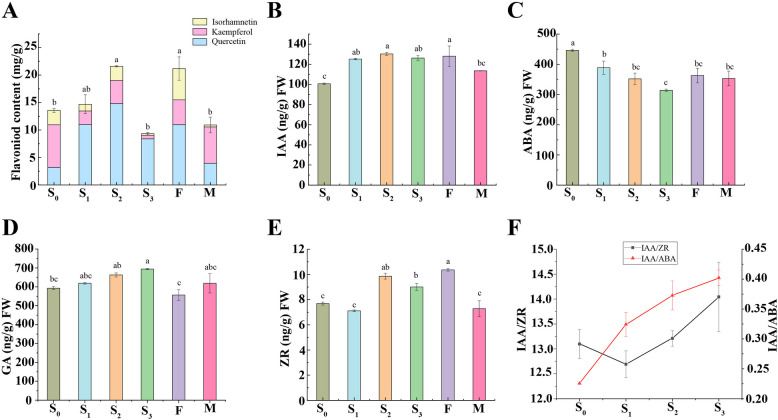
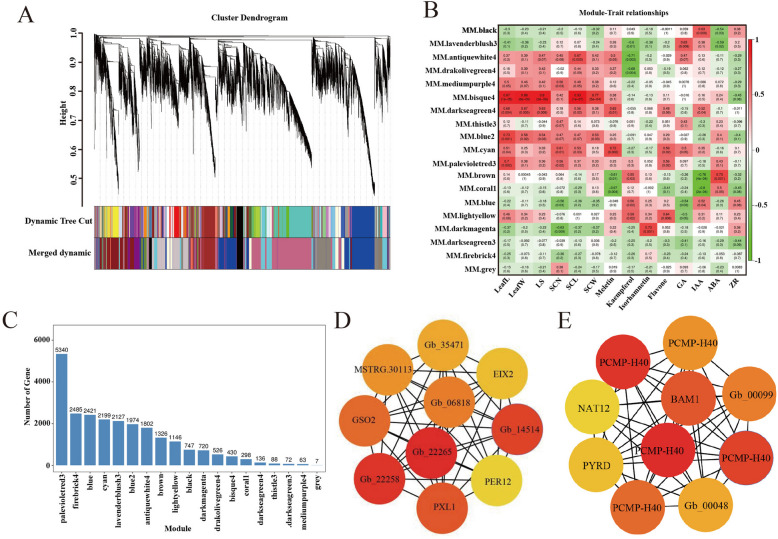
Here we rejuvenated the surviving 4,000-year-old Ginkgo through successive grafting. The results revealed leaf cleavage, leaf width, leaf length, and leaf area increased significantly in S (first-step graft). Additionally, the total flavonoid content of S (second-step graft) was the highest. Indole acetic acid (IAA), gibberellins (GA), and zeatin-riboside (ZR) increased, and abscisic acid (ABA) decreased in each successive generation. Transcriptome analysis of gene expression fragments per kilobase of exon model per million mapped fragments (FPKM) revealed 1756-5689 significantly differentially expressed genes (DEGs) that clustered into nine distinct expression modules. The weighted gene co-expression network analysis (WGCNA) revealed bisque4 and palevioletred3 had the highest correlation coefficient with the phenotype and physiology of rejuvenated Ginkgo and identified only eight genes were annotated in top hub ten. The expression profiles corresponding DEGs in flavonoid biosynthesis (25 DEGs) and plant hormone signal transduction (36 DEGs) were revealed. Most of these DEGs were up-regulated from S to S, while down-regulated in S (third-step graft). Small RNA sequencing revealed 3281 miRNAs including 621 novel miRNAs. Combined analysis both of transcriptome and small RNA, miR395 was the core miRNA and targeted to iron-containing protein (FAO1) and pentatricopeptide repeat-containing protein At1g11290 (PCMP-H40).
The comprehensive analysis of the RNA-seq, small RNA, and physiological data in this study provided candidate genes and clarified the regulatory mechanism of successive grafting in rejuvenated Ginkgo, suggesting that the number of successive generations of grafted rejuvenation should not exceed the third generation (S₃).
树木复壮是从成年状态向幼年状态的转变。连续嫁接可导致树木复壮。黄酮类化合物是一类重要的次生代谢产物,在调节细胞生理、信号传导以及植物与环境相互作用的转导中发挥关键作用。同时,内源植物激素有助于恢复树木的幼年特征。然而,对于复壮银杏中黄酮类化合物和激素生物合成的了解甚少。
在此,我们通过连续嫁接使存活了4000年的银杏实现了复壮。结果显示,在S(第一步嫁接)中,叶片裂片、叶宽、叶长和叶面积显著增加。此外,S(第二步嫁接)中的总黄酮含量最高。在每一代连续嫁接中,吲哚乙酸(IAA)、赤霉素(GA)和玉米素核苷(ZR)增加,而脱落酸(ABA)减少。每千碱基外显子模型每百万映射片段(FPKM)的基因表达片段的转录组分析揭示了1756 - 5689个显著差异表达基因(DEG),这些基因聚集成九个不同的表达模块。加权基因共表达网络分析(WGCNA)显示,米色4和浅紫红色3与复壮银杏的表型和生理具有最高的相关系数,并且在前十大枢纽基因中仅鉴定出八个有注释的基因。揭示了黄酮类生物合成(25个DEG)和植物激素信号转导(36个DEG)中相应DEG的表达谱。这些DEG中的大多数从S到S上调,而在S(第三步嫁接)中下调。小RNA测序揭示了3281个miRNA,包括621个新的miRNA。对转录组和小RNA的联合分析表明,miR395是核心miRNA,靶向含铁蛋白(FAO1)和含五肽重复序列蛋白At1g11290(PCMP - H40)。
本研究对RNA测序、小RNA和生理数据的综合分析提供了候选基因,并阐明了复壮银杏中连续嫁接的调控机制,表明连续嫁接复壮的代数不应超过第三代(S₃)。