Radermacher Jonas, Thiel Steffen, Kannt Aimo, Fröhlich Holger
Department of Bioinformatics, Fraunhofer Institute for Algorithms and Scientific Computing (SCAI), Schloss Birlinghoven 1, Sankt Augustin, 53757, Germany.
University of Applied Sciences Bonn-Rhein-Sieg, Sankt Augustin, Germany.
BMC Public Health. 2025 Aug 25;25(1):2910. doi: 10.1186/s12889-025-24149-2.
The COVID-19 pandemic has profoundly affected daily life and posed significant challenges for politics, the economy, and the education system. To better prepare for such situations and implement effective measures, it is crucial to accurately assess, monitor, and forecast the progression of a pandemic. This study examines the potential of integrating wastewater surveillance data to enhance an autoregressive COVID-19 forecasting model for Germany and its federal states.
First, we explore the cross-correlations between SARS-CoV-2 viral RNA load measured in wastewater and COVID-19 hospitalization considering different time-lags. Further, the study compares the performance of different models, including Random Forest regressors, XGBoost regressors, ARIMA models, linear regression, and ridge regression models, both with and without the use of wastewater data as predictors. For decision tree-based models, we also analyze the performance of fully cross-modal models that rely solely on viral load measurements to predict COVID-19 hospitalization rates.
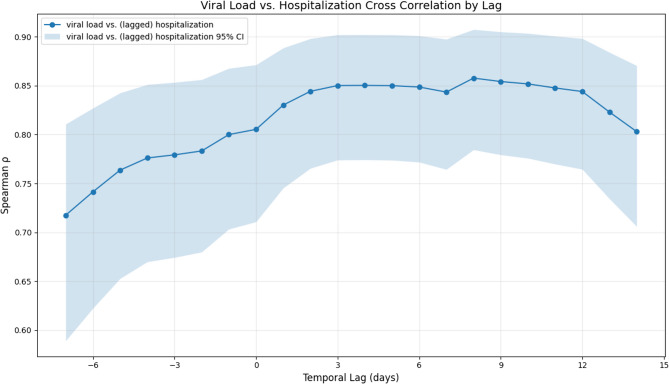
Our retrospective analysis suggest that wastewater data can potentially serve as an early warning indicator of impending trends in hospitalization at a national level, as it shows a strong correlation with hospitalization figures of up to 86% and tends to lead them by up to 8 days. Despite this, including wastewater data in the prediction models did not statistical significantly enhance the accuracy of COVID-19 hospitalization forecasts. The ARIMA model without the inclusion of wastewater viral load data emerged as the best-performing model, achieving a Mean Absolute Percentage Error of 4.76% forecasting hospitalization 7 days ahead. However, wastewater viral load proved to be a valuable standalone predictor, offering an objective alternative to classical surveillance methods for monitoring pandemic trends.
This study reinforces the potential of wastewater surveillance as an early warning tool for COVID-19 hospitalizations in Germany. While strong correlations were observed, the integration of wastewater data into predictive models did not improve their performance. Nevertheless, wastewater viral load serves as a valuable indicator for monitoring pandemic trends, suggesting its utility in public health surveillance and resource allocation. Further research may help to clarify the real-time applicability of wastewater data and expand its use to other pathogens and data sources.
新冠疫情对日常生活产生了深远影响,给政治、经济和教育系统带来了重大挑战。为了更好地应对此类情况并实施有效措施,准确评估、监测和预测疫情的发展至关重要。本研究探讨了整合污水监测数据以增强德国及其联邦州的自回归新冠预测模型的潜力。
首先,我们考虑不同的时间滞后,探索污水中测得的新冠病毒核糖核酸(SARS-CoV-2 viral RNA)载量与新冠住院情况之间的交叉相关性。此外,本研究比较了不同模型的性能,包括随机森林回归模型、极端梯度提升(XGBoost)回归模型、自回归积分移动平均(ARIMA)模型、线性回归模型和岭回归模型,对比了使用和不使用污水数据作为预测因子的情况。对于基于决策树的模型,我们还分析了仅依靠病毒载量测量来预测新冠住院率的完全跨模态模型的性能。
我们的回顾性分析表明,污水数据有可能作为国家层面住院情况即将出现趋势的早期预警指标,因为它与住院数据显示出高达86%的强相关性,且往往比住院数据提前多达8天。尽管如此,将污水数据纳入预测模型并未在统计学上显著提高新冠住院预测的准确性。未纳入污水病毒载量数据的ARIMA模型成为表现最佳的模型,提前7天预测住院情况时的平均绝对百分比误差为4.76%。然而,污水病毒载量被证明是一个有价值的独立预测因子,为监测疫情趋势提供了一种替代传统监测方法的客观手段。
本研究强化了污水监测作为德国新冠住院情况早期预警工具的潜力。虽然观察到了强相关性,但将污水数据纳入预测模型并未改善其性能。尽管如此,污水病毒载量是监测疫情趋势的重要指标,表明其在公共卫生监测和资源分配中的作用。进一步的研究可能有助于阐明污水数据的实时适用性,并将其应用扩展到其他病原体和数据源。