
血液系统恶性肿瘤患者游离DNA和中性粒细胞胞外陷阱的性别差异
Sex-related differences in cell-free DNA and neutrophil extracellular traps in patients with hematologic malignancies.
作者信息
Gnecco Gaia, Davini Alessandro, Valeriano Arianna, Mancuso Patrizia, Derenzini Enrico, Lamorte Giuseppe, Prati Daniele, Talarico Giovanna, Bertolini Francesco
机构信息
Laboratory of Hematology-Oncology, European Institute of Oncology IRCCS, Via Ripamonti 435, 20141, Milan, Italy.
Onco-Tech Lab, European Institute of Oncology IRCCS and Politecnico Di Milano, Milan, Italy.
出版信息
Immunol Res. 2025 Aug 26;73(1):124. doi: 10.1007/s12026-025-09677-8.
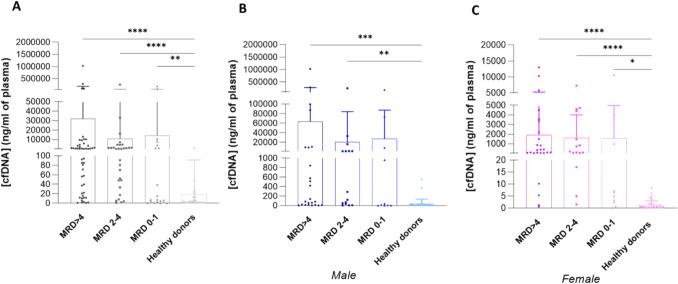
Cell-free DNA (cfDNA) is emerging as a promising biomarker in liquid biopsy applications for cancer, with growing interest in its potential utility also for the diagnosis, monitoring of treatment response, and detection of relapse in hematologic malignancies. However, the precise origin and clinical relevance of cfDNA in these disorders remain to be fully clarified. In this study, we analyzed plasma samples from 98 patients with hematologic malignancies and 80 healthy donors using quantitative PCR (qPCR) to quantify cfDNA concentrations. We further examined associations between cfDNA levels and clinical parameters, including sex and measurable residual disease (MRD). Our results demonstrated significantly elevated cfDNA levels in patients compared to healthy individuals, with a strong correlation between cfDNA concentration and presence/MRD of the disease. We also identified sex-specific differences in cfDNA levels. Notably, our findings suggest that neutrophils, through the release and degradation of neutrophil extracellular traps (NETs), may constitute a relevant source of circulating cfDNA. In addition, cfDNA concentrations were significantly associated with MRD status, supporting the potential role of cfDNA as a non-invasive biomarker for disease monitoring. Overall, our data highlight the clinical relevance of cfDNA in hematologic malignancies, both as a surrogate for disease burden and as a possible player in disease pathophysiology, thus offering a promising avenue for improved diagnostic and therapeutic strategies.
游离DNA(cfDNA)正在成为癌症液体活检应用中一种有前景的生物标志物,人们对其在血液系统恶性肿瘤的诊断、治疗反应监测和复发检测方面的潜在用途也越来越感兴趣。然而,这些疾病中cfDNA的确切来源和临床相关性仍有待充分阐明。在本研究中,我们使用定量聚合酶链反应(qPCR)分析了98例血液系统恶性肿瘤患者和80名健康供者的血浆样本,以量化cfDNA浓度。我们进一步研究了cfDNA水平与临床参数之间的关联,包括性别和可测量残留疾病(MRD)。我们的结果表明,与健康个体相比,患者的cfDNA水平显著升高,cfDNA浓度与疾病的存在/MRD之间存在很强的相关性。我们还发现了cfDNA水平的性别差异。值得注意的是,我们的研究结果表明,中性粒细胞通过释放和降解中性粒细胞胞外陷阱(NETs),可能是循环cfDNA的一个相关来源。此外,cfDNA浓度与MRD状态显著相关,支持了cfDNA作为疾病监测的非侵入性生物标志物的潜在作用。总体而言,我们的数据突出了cfDNA在血液系统恶性肿瘤中的临床相关性,它既是疾病负担的替代指标,也是疾病病理生理学中可能的参与者,从而为改进诊断和治疗策略提供了一条有前景的途径。



 Zotero 插件