
正畸教育中用于诊断和治疗计划的基于案例的严肃游戏的开发与评估:准实验研究
Development and Evaluation of a Case-Based Serious Game for Diagnosis and Treatment Planning in Orthodontic Education: Quasi-Experimental Study.
作者信息
Chintavalakorn Rochaya, Chanwanichkulchai Chayuth, Buranasing Napat, Parivisutt Napatsaporn, Patchasri Naruchol, Sipiyaruk Kawin
机构信息
Department of Orthodontics, Faculty of Dentistry, Mahidol University, 6 Yothi Road, Ratchathewi, Bangkok, 10400, Thailand, 66 22007813.
Doctor of Dental Surgery Program, Faculty of Dentistry, Mahidol University, Bangkok, Thailand.
出版信息
JMIR Serious Games. 2025 Aug 27;13:e73956. doi: 10.2196/73956.
BACKGROUND
Orthodontic education requires effective training in diagnosis and treatment planning, but traditional teaching methods may lack engagement and opportunities in offering a safe learning environment. Serious games are gaining momentum in dental education due to their positive educational impact in enhancing learner knowledge and motivation. However, their application in orthodontic diagnosis and treatment planning training remains unexplored.
OBJECTIVE
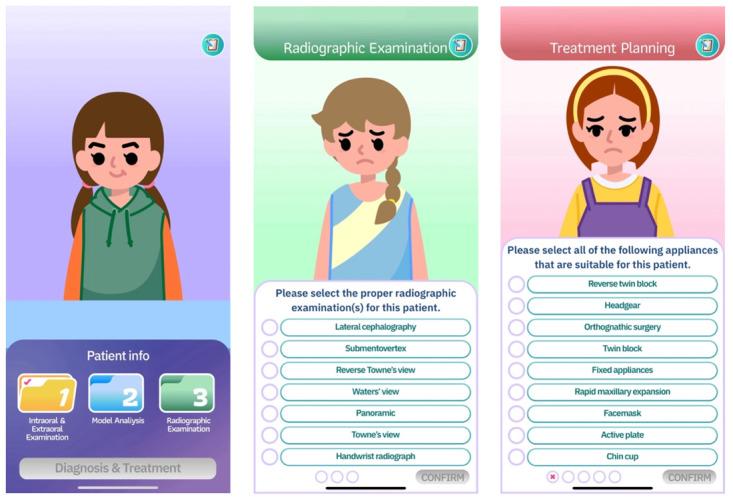
The aim of this study was to develop and evaluate a simulation-based serious game for training orthodontic diagnosis and treatment planning in virtual patients (OrthoVirt), examining its impact on student knowledge and satisfaction. This study also explored whether prior gaming experience influenced learning outcomes.
METHODS
A quasi-experimental study was conducted with 32 fourth-year dental students, who were requested to complete a preknowledge assessment, 3 simulated patients within OrthoVirt, a postknowledge assessment, and a satisfaction survey. Participants were categorized as gamers (n=16) or nongamers (n=16) based on self-reported weekly gaming time. The primary outcome was knowledge improvement, analyzed using 2-tailed paired t tests (Cohen dz). Group comparisons were conducted using 2-tailed independent t tests (Cohen d). User satisfaction was measured using a validated questionnaire based on the technology acceptance model. A stricter significance threshold (P<.01) and effect size metrics (Cohen d and Cohen dz) were used to account for the small sample size, multiple comparisons, and exploratory nature of the study.
RESULTS
Both gamer and nongamer groups showed significant knowledge improvement after using OrthoVirt (mean score increased from 10.75 (SD 2.75) to 14.75 (SD 1.81) out of 20; P<.001). The mean scores of the gamer group increased from 10.31 (SD 3.07) to 15.19 (SD 1.83) while those of the nongamer group rose from 11.19 (SD 2.40) to 14.31 (SD 1.74). No statistically significant differences were found between groups in pre- and postknowledge assessments as well as improvement scores (P>.01), suggesting that the educational benefit was consistent regardless of gaming background. Participants from both groups rated OrthoVirt positively, particularly for "perceived ease of use." However, "perceived enjoyment" was rated slightly lower than other aspects, with nongamers scoring it 3.60 (SD 0.81) and gamers 3.45 (SD 0.73) out of 5, indicating a potential area for design enhancement. Overall satisfaction ratings were similar between the 2 groups (P>.01).
CONCLUSIONS
OrthoVirt demonstrated potential as a supplementary tool for diagnosis and treatment planning in orthodontic education, with statistically significant improvements observed in learner knowledge. While feedback was generally positive, these findings should be interpreted with caution due to the quasi-experimental design and small sample size. Future development should focus on improving user enjoyment and engagement through entertaining design elements. Further research should explore how OrthoVirt can be integrated as a case discussion tool alongside lectures, with the potential to enhance learning not only in orthodontic education but also across other areas of dental training.
背景
正畸教育需要在诊断和治疗计划方面进行有效的培训,但传统教学方法可能缺乏吸引力,也无法提供安全的学习环境。严肃游戏因其在提高学习者知识和动机方面的积极教育影响,在牙科教育中越来越受到关注。然而,其在正畸诊断和治疗计划培训中的应用仍未得到探索。
目的
本研究旨在开发并评估一款基于模拟的严肃游戏,用于虚拟患者的正畸诊断和治疗计划培训(OrthoVirt),考察其对学生知识和满意度的影响。本研究还探讨了先前的游戏经验是否会影响学习成果。
方法
对32名牙科四年级学生进行了一项准实验研究,要求他们完成一项知识预评估、在OrthoVirt中处理3个模拟患者、进行一项知识后评估以及填写一份满意度调查问卷。根据自我报告的每周游戏时间,参与者被分为游戏玩家组(n = 16)和非游戏玩家组(n = 16)。主要结果是知识的提高,使用双尾配对t检验(Cohen dz)进行分析。组间比较使用双尾独立t检验(Cohen d)。使用基于技术接受模型的有效问卷来衡量用户满意度。由于样本量小、存在多次比较以及研究具有探索性,因此采用了更严格的显著性阈值(P <.01)和效应量指标(Cohen d和Cohen dz)。
结果
游戏玩家组和非游戏玩家组在使用OrthoVirt后知识均有显著提高(满分20分,平均分从10.75(标准差2.75)提高到14.75(标准差1.81);P <.001)。游戏玩家组的平均分从10.31(标准差3.07)提高到15.19(标准差1.83),而非游戏玩家组的平均分从11.19(标准差2.40)提高到14.31(标准差1.74)。在知识预评估和后评估以及提高分数方面,两组之间未发现统计学上的显著差异(P >.01),这表明无论游戏背景如何,教育收益都是一致的。两组参与者对OrthoVirt的评价都很高,特别是对“感知易用性”方面。然而,“感知趣味性”的评分略低于其他方面,非游戏玩家组在5分制中的得分为3.60(标准差0.81),游戏玩家组为3.45(标准差0.73),这表明在设计方面有改进的潜力。两组的总体满意度评分相似(P >.01)。
结论
OrthoVirt展示了作为正畸教育中诊断和治疗计划辅助工具的潜力,学习者的知识有统计学上的显著提高。虽然反馈总体上是积极的,但由于采用了准实验设计且样本量较小,这些结果应谨慎解读。未来的发展应侧重于通过有趣的设计元素来提高用户的趣味性和参与度。进一步的研究应探索如何将OrthoVirt作为一种案例讨论工具与讲座相结合,这不仅有可能加强正畸教育中的学习,也有可能在牙科培训的其他领域中提高学习效果。

 Zotero 插件