Zvartau-Hind Jarod, Sadozai Hassan, Kayani Hateem Z, Acharjee Animesh, Williams Rory, Gould Phillip, Reynolds Christopher A, Burke Bernard
Research Centre for Health & Life Sciences, University of Coventry, Coventry CV1 2DS, UK.
Cancer and Genomic Sciences, School of Medical Sciences, College of Medicine and Health, University of Birmingham, Birmingham B15 2TT, UK.
Biomolecules. 2025 Aug 8;15(8):1144. doi: 10.3390/biom15081144.
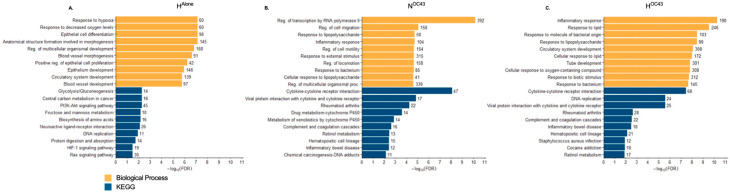
Cytokine storm (CS) is associated with poor prognosis in COVID-19 patients. Hypoxic signaling has been proposed to influence proinflammatory pathways and to be involved in the development of CS. Here, for the first time, the role of hypoxia in coronavirus-mediated inflammation has been investigated, using transcriptomic and proteomic approaches. Analysis of the transcriptome of A549 lung epithelial cells using RNA sequencing revealed 191 mRNAs which were synergistically upregulated and 43 mRNAs which were synergistically downregulated by the combination of human OC43 (HCoV-OC43) infection and hypoxia. Synergistically upregulated mRNAs were strongly associated with inflammatory pathway activation. Analysis of the expression of 105 cytokines and immune-related proteins using antibody arrays identified five proteins (IGFBP-3, VEGF, CCL20, CD30, and myeloperoxidase) which were markedly upregulated in HCoV-OC43 infection in hypoxia compared to HCoV-OC43 infection in normal oxygen conditions. Our findings show that COVID-19 patients with lung hypoxia may face increased risk of inflammatory complications. Two of the proteins we have identified as synergistically upregulated, the cytokines VEGF and CCL20, represent potential future therapeutic targets. These could be targeted directly or, based on the novel findings described here by inhibiting hypoxia signaling pathways, to reduce excessive inflammatory cytokine responses in patients with severe infections.
细胞因子风暴(CS)与COVID-19患者的不良预后相关。缺氧信号已被认为会影响促炎途径并参与CS的发展。在此,首次使用转录组学和蛋白质组学方法研究了缺氧在冠状病毒介导的炎症中的作用。使用RNA测序分析A549肺上皮细胞的转录组,发现191种mRNA在人OC43(HCoV-OC43)感染和缺氧的联合作用下协同上调,43种mRNA协同下调。协同上调的mRNA与炎症途径激活密切相关。使用抗体阵列分析105种细胞因子和免疫相关蛋白的表达,确定了五种蛋白(胰岛素样生长因子结合蛋白3、血管内皮生长因子、CC趋化因子配体20、CD30和髓过氧化物酶),与正常氧条件下的HCoV-OC43感染相比,在缺氧的HCoV-OC43感染中显著上调。我们的研究结果表明,肺部缺氧的COVID-19患者可能面临更高的炎症并发症风险。我们确定为协同上调的两种蛋白,即细胞因子血管内皮生长因子和CC趋化因子配体20,代表了未来潜在的治疗靶点。可以直接针对这些靶点,或者基于此处描述的新发现,通过抑制缺氧信号通路,以减少严重感染患者过度的炎性细胞因子反应。