Elamraoui Sabah, Asdiou Nouhaila, El Kaim Billah Rachid, El Achaby Mounir, Kounbach Said, Benhida Rachid, Achak Mounia
Science Engineer Laboratory for Energy, National School of Applied Sciences, Chouaïb Doukkali University, El Jadida 24000, Morocco.
Materials Science, Energy, and Nano-Engineering (MSN) Department, Mohammed VI Polytechnic University (UM6P), Lot 660-Hay Moulay Rachid, Benguerir 43150, Morocco.
Int J Mol Sci. 2025 Aug 11;26(16):7738. doi: 10.3390/ijms26167738.
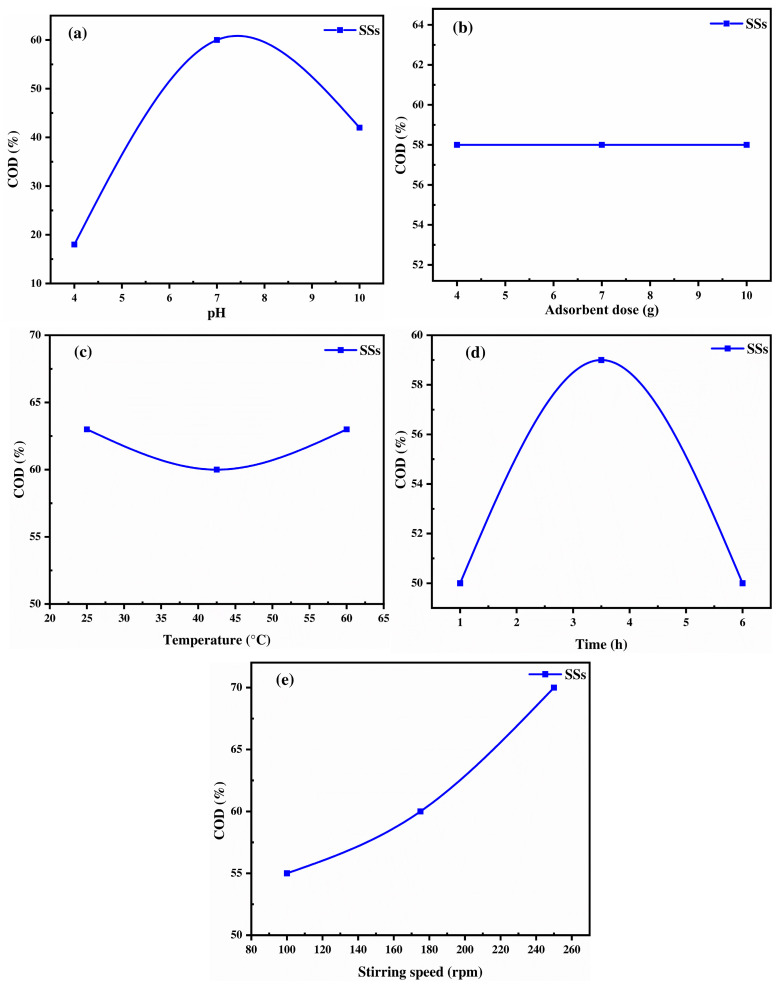
This study evaluates the structural properties and adsorption capacities of four bio-based adsorbents, sawdust (SD), straw (ST), chicken feathers (CFs), and shrimp shells (SSs), for chemical oxygen demand (COD) removal from olive mill wastewater (OMW). Response Surface Methodology (RSM) with a Box-Behnken Design (BBD) was applied to optimize the operational parameters, resulting in maximum COD uptake capacities of 450 mg/g (SD), 575 mg/g (ST), 700 mg/g (CFs), and 750 mg/g (SSs). Among these materials, SSs exhibited the highest COD removal efficiency of 85% under optimal conditions (pH 8, 20 g/L, 30 °C, 5 h, 111 rpm). A mixture design approach was then used to explore the synergistic effects of combining lignocellulosic (SD and ST), chitin-based (SSs), and keratin-based (CFs) adsorbents. The optimized blend (SD 10%, ST 28.9%, SS 38.3%, and CF 22.6%) achieved a COD removal efficiency of 82%, demonstrating the advantage of using mixed biopolymer systems over individual adsorbents. Adsorption mechanisms were investigated through isotherm models (Langmuir, Freundlich, Temkin, and Redlich-Peterson) and kinetic models (pseudo-first-order, pseudo-second-order, Elovich, and intraparticle diffusion). Lignocellulosic adsorbents predominantly followed physisorption mechanisms, while chitin- and keratin-rich materials exhibited a combination of physisorption and chemisorption. Thermodynamic analysis confirmed the spontaneous nature of the adsorption process, with SSs showing the most favorable Gibbs free energy (ΔG = -21.29 kJ/mol). A proposed mechanism for the adsorption of organic compounds onto the bio-adsorbents involves hydrogen bonding, electrostatic interactions, π-π interactions, n-π stacking interactions, hydrophobic interactions, and van der Waals forces. These findings highlight the potential of biopolymer-based adsorbents and their optimized combinations as cost-effective and sustainable solutions for OMW treatment.
本研究评估了四种生物基吸附剂,即锯末(SD)、秸秆(ST)、鸡毛(CF)和虾壳(SS),对橄榄榨油废水(OMW)中化学需氧量(COD)的去除效果及其结构特性和吸附能力。采用带有Box-Behnken设计(BBD)的响应面方法(RSM)来优化操作参数,得到的最大COD吸附容量分别为450 mg/g(SD)、575 mg/g(ST)、700 mg/g(CF)和750 mg/g(SS)。在这些材料中,SS在最佳条件(pH 8、20 g/L、30°C、5 h、111 rpm)下表现出最高的COD去除效率,为85%。然后采用混合设计方法来探究木质纤维素类(SD和ST)、几丁质基(SS)和角蛋白基(CF)吸附剂组合的协同效应。优化后的混合物(SD 10%、ST 28.9%、SS 38.3%和CF 22.6%)实现了82%的COD去除效率,证明了使用混合生物聚合物系统比单独使用吸附剂更具优势。通过等温线模型(Langmuir、Freundlich、Temkin和Redlich-Peterson)和动力学模型(伪一级、伪二级、Elovich和颗粒内扩散)研究了吸附机制。木质纤维素类吸附剂主要遵循物理吸附机制,而富含几丁质和角蛋白的材料表现出物理吸附和化学吸附的结合。热力学分析证实了吸附过程的自发性,SS表现出最有利的吉布斯自由能(ΔG = -21.29 kJ/mol)。提出的有机化合物在生物吸附剂上的吸附机制涉及氢键、静电相互作用、π-π相互作用、n-π堆积相互作用、疏水相互作用和范德华力。这些发现突出了基于生物聚合物的吸附剂及其优化组合作为OMW处理的经济高效且可持续解决方案的潜力。