Lanning Beth A, Smith Cory M, Ugale Cierra, Nazarenko Elena, Marchand William R
Department of Public Health, Baylor University, Waco, TX 76655, USA.
Department of Health, Human Performance and Recreation, Baylor University, Waco, TX 76655, USA.
Int J Environ Res Public Health. 2025 Aug 19;22(8):1294. doi: 10.3390/ijerph22081294.
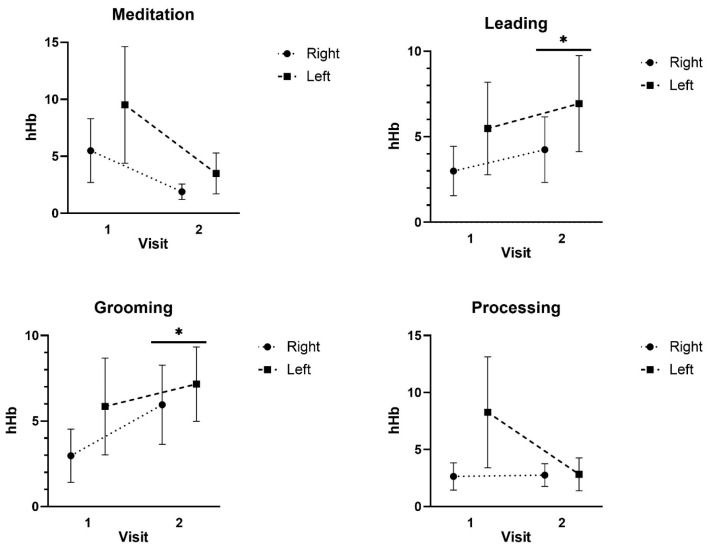
Equine-assisted services (EAS) are used for civilian and military trauma survivors to reduce depression and posttraumatic stress symptoms. While early scientific evidence supports the benefits of EAS, the neurophysiological mechanisms underlying these benefits are unknown. The specific aims of this exploratory study were to determine (1) whether functional near-infrared spectroscopy (fNIRS) neuroimaging can be used to explore neural responses of EAS veteran participants and (2) the correlation between neural responses and psychological outcomes of the participants interacting with equines. Fifteen veterans participated in a 2-day EAS program consisting of four randomized activities. An fNIRS sensor cap was used to measure the oxygenated (OHb), deoxygenated (hHb), and total hemoglobin (tHb) of the participants during each activity. The results indicated no significant differences for OHb and tHb across the visits or activities, however, a significant difference in hHb was observed. There was an increase in hHb during the activities that included an equine, which indicated a greater cognitive load and attention. Further, data from pre-/post-psychometric assessments showed a significant improvement in participants' trait anxiety, psychological flexibility, and positive and negative affect after interacting with the horse. Preliminary data revealed a potential association between the cognitive attention and psychological health of participants during an EAS session.
马术辅助服务(EAS)被用于 civilian 和军事创伤幸存者,以减轻抑郁和创伤后应激症状。虽然早期科学证据支持 EAS 的益处,但其潜在的神经生理机制尚不清楚。这项探索性研究的具体目的是确定:(1)功能近红外光谱(fNIRS)神经成像是否可用于探索参与 EAS 的退伍军人的神经反应;(2)参与者与马匹互动时神经反应与心理结果之间的相关性。15 名退伍军人参加了一个为期 2 天的 EAS 项目,该项目包括四项随机活动。在每项活动期间,使用 fNIRS 传感器帽测量参与者的氧合血红蛋白(OHb)、脱氧血红蛋白(hHb)和总血红蛋白(tHb)。结果表明,OHb 和 tHb 在各次访视或活动之间无显著差异,然而,观察到 hHb 有显著差异。在与马相关的活动中,hHb 有所增加,这表明认知负荷和注意力增强。此外,心理测量评估前后的数据显示,参与者在与马互动后,特质焦虑、心理灵活性以及积极和消极情绪有显著改善。初步数据揭示了 EAS 课程期间参与者的认知注意力与心理健康之间的潜在关联。