Chioncel Valentin, Gherasie Flavius, Iancu Alexandru, Avram Anamaria-Georgiana
Department of Cardiology, University of Medicine and Pharmacy Carol Davila, 050474 Bucharest, Romania.
Emergency Clinical Hospital Dr. Bagdasar-Arseni, 041915 Bucharest, Romania.
Medicina (Kaunas). 2025 Aug 15;61(8):1470. doi: 10.3390/medicina61081470.
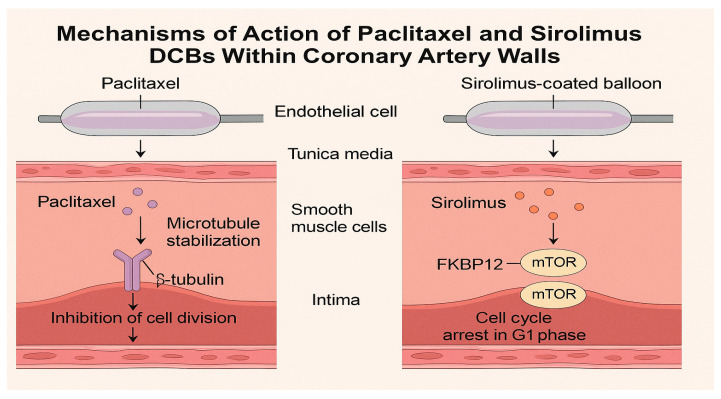
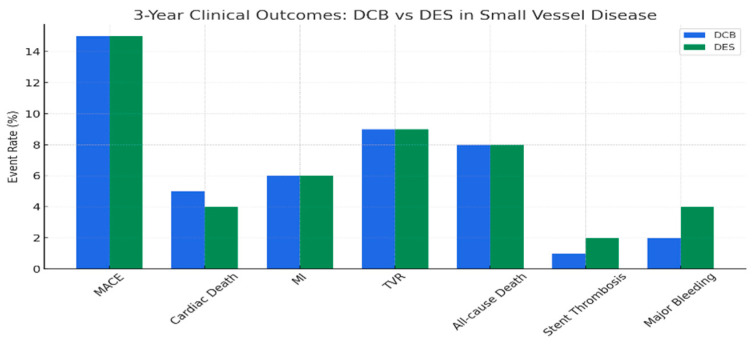
Drug-coated balloons (DCBs) have transformed percutaneous coronary intervention (PCI) by delivering antiproliferative drugs directly to the arterial wall, offering a stent-less approach that mitigates the risks associated with permanent metallic implants. Initially developed for in-stent restenosis (ISR), DCBs have demonstrated robust efficacy in reducing neointimal hyperplasia and target lesion revascularization (TLR) rates across diverse coronary lesions, including small vessel disease (SVD), de novo lesions, and complex anatomies such as bifurcation lesions. Paclitaxel-coated balloons have long been the cornerstone of DCB therapy due to their established clinical outcomes, but sirolimus-coated balloons are emerging as a promising alternative with potentially superior safety profiles and sustained drug release. The pharmacological mechanism of DCBs relies on rapid drug transfer during brief balloon inflation, achieving high local concentrations without residual foreign material. Landmark trials, such as BASKET-SMALL 2, RESTORE SVD, and AGENT IDE, have demonstrated comparable or non-inferior outcomes of DCBs versus drug-eluting stents (DESs) in specific settings, with lower rates of stent thrombosis and shorter dual antiplatelet therapy (DAPT) requirements. Despite these advances, challenges persist, including optimizing drug formulations, ensuring uniform delivery, and addressing calcified lesions. Ongoing research into novel coatings, dual-drug systems, and artificial intelligence (AI)-guided interventions is poised to redefine PCI strategies. This review provides a comprehensive analysis of drug-coated balloon (DCB) angioplasty, not limited to specific clinical scenarios such as in-stent restenosis, small vessel disease, or bifurcation lesions, highlighting their transformative role in coronary artery disease (CAD) management. Instead, it addresses the full spectrum of pharmacological principles, mechanisms of action, clinical indications, comparative efficacy across various coronary artery disease contexts, and future directions of DCBs.
药物涂层球囊(DCB)通过将抗增殖药物直接输送到动脉壁,改变了经皮冠状动脉介入治疗(PCI),提供了一种无支架方法,减轻了与永久性金属植入物相关的风险。DCB最初是为治疗支架内再狭窄(ISR)而开发的,已证明在减少各种冠状动脉病变(包括小血管疾病(SVD)、初发病变以及分叉病变等复杂解剖结构)的新生内膜增生和靶病变血管重建(TLR)率方面具有强大的疗效。由于其已确立的临床疗效,紫杉醇涂层球囊长期以来一直是DCB治疗的基石,但西罗莫司涂层球囊正作为一种有前景的替代方案出现,其安全性可能更高且药物释放持续。DCB的药理机制依赖于在短暂球囊扩张期间快速的药物转移,在无残留异物的情况下实现高局部浓度。诸如BASKET - SMALL 2、RESTORE SVD和AGENT IDE等具有里程碑意义的试验表明,在特定情况下,DCB与药物洗脱支架(DES)相比,其结果相当或不劣,支架血栓形成率更低,双联抗血小板治疗(DAPT)需求更短。尽管取得了这些进展,但挑战依然存在,包括优化药物配方、确保均匀输送以及处理钙化病变。对新型涂层、双药系统和人工智能(AI)引导干预的持续研究有望重新定义PCI策略。本综述对药物涂层球囊(DCB)血管成形术进行了全面分析,不限于支架内再狭窄、小血管疾病或分叉病变等特定临床场景,突出了它们在冠状动脉疾病(CAD)管理中的变革性作用。相反,它阐述了药理学原理、作用机制、临床适应症、在各种冠状动脉疾病背景下的比较疗效以及DCB的未来发展方向的全貌。