Abechi Priscilla, George Uwem E, Adejumobi Olawale A, Ahmad Umar, Aborisade Olamide Y, Oragwa Arthur O, Ajayi Oluremi I, Akinlo Oluwasemilogo O, Happi Christian, Folarin Onikepe A
Institute of Genomics and Global Health (Formerly ACEGID), Redeemer's University, Ede 232101, Nigeria.
Department of Biological Sciences, Faculty of Natural Sciences, Redeemer's University, Ede 232101, Nigeria.
Viruses. 2025 Aug 10;17(8):1101. doi: 10.3390/v17081101.
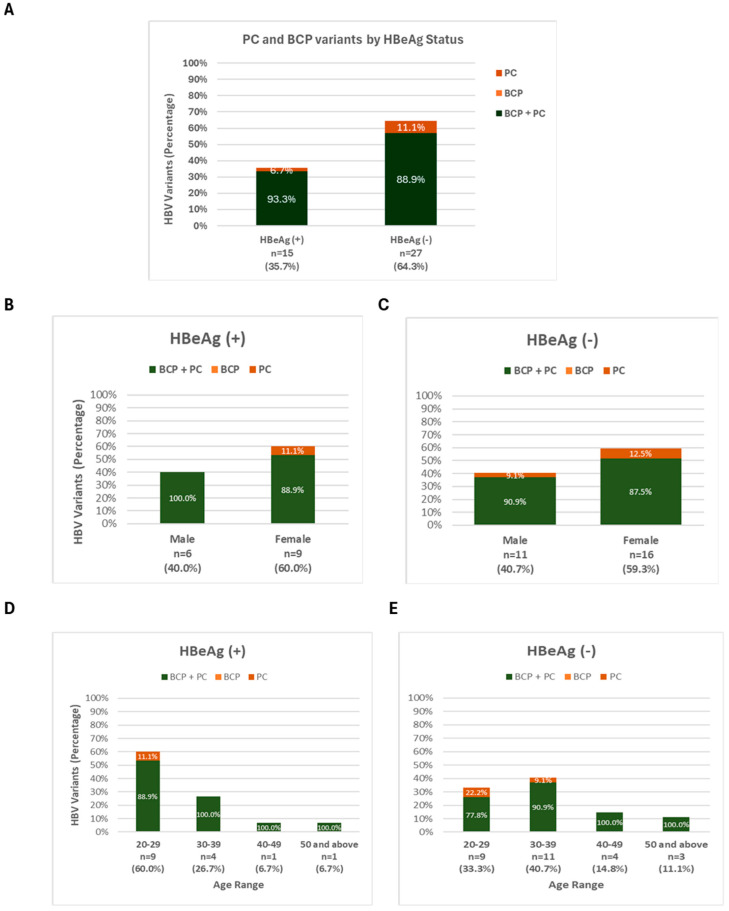
In Nigeria, hepatitis B virus (HBV) infection remains a significant public health issue. The emergence of immune escape mutants (IEMs), basal core promoters, and precore (BCP/PC) mutants among asymptomatic individuals has enabled the continuous evolution of the virus in the country. In this study, we used Sanger sequencing of the S gene and the BCP/PC region to investigate the genetic diversity, phylogenetic relationships, and mutational profiles of HBV strains detected in two regions in Nigeria. A total of 178 HBsAg-positive samples confirmed by ELISA underwent viral DNA extraction and PCR amplification of the surface and BCP/PC genes, and 76 and 60 sequences were found to be exploitable for S and BCP/PC genes, respectively, which were used for HBV genotyping and mutational analysis. We detected various mutations in the major hydrophilic loop (target of neutralizing antibodies), including vaccine escape mutants (VEMs) (L127P/R, S140T/L, and G145A), HBV immunoglobulin resistance mutants (T131N, S143T, and W156R), and mutations previously reported in patients with reactivated infections (T115N, G159A/R, and F161Y). We also identified a high proportion of C1741T in 34/42 (81%) along with A1762T or G1764A mutation in 14/42 (33%) and 18/42 (43%) as the dominant variants in the BCP region. The predominant classical PC G1896A and G1899A variants were identified in 26/42 (62%) and 17/42 (40%) participants in this study. Two HBV genotypes were identified (A and E). However, HBV genotype E was the most frequently identified genotype, and is still the dominant strain circulating in Nigeria. We report the circulation of HBV IEMs and the preponderance of BCP and classical PC variants among asymptomatic carriers. Our findings suggest that the spread of these HBV mutant variants among asymptomatic carriers may have an impact on the effectiveness of diagnostic immunoassays and the success of HBsAg-based vaccinations. This highlights the need for robust surveillance.
在尼日利亚,乙型肝炎病毒(HBV)感染仍然是一个重大的公共卫生问题。无症状个体中免疫逃逸突变体(IEMs)、基础核心启动子和前核心(BCP/PC)突变体的出现,使得该国的病毒不断进化。在本研究中,我们使用S基因和BCP/PC区域的桑格测序法,来调查在尼日利亚两个地区检测到的HBV毒株的遗传多样性、系统发育关系和突变谱。总共178份经ELISA确认的HBsAg阳性样本进行了病毒DNA提取以及表面基因和BCP/PC基因的PCR扩增,分别发现76条和60条序列可用于S基因和BCP/PC基因,这些序列用于HBV基因分型和突变分析。我们在主要亲水性环(中和抗体的靶点)中检测到各种突变,包括疫苗逃逸突变体(VEMs)(L127P/R、S140T/L和G145A)、HBV免疫球蛋白抗性突变体(T131N、S143T和W156R),以及先前在再激活感染患者中报道的突变(T115N、G159A/R和F161Y)。我们还在42份样本中的34份(81%)中鉴定出高比例的C1741T,以及在42份样本中的14份(33%)和18份(43%)中分别鉴定出A1762T或G1764A突变,作为BCP区域的主要变异体。在本研究的42名参与者中,分别有26份(62%)和17份(40%)鉴定出主要的经典PC G1896A和G1899A变异体。鉴定出两种HBV基因型(A和E)。然而,HBV基因型E是最常鉴定出的基因型,并且仍然是在尼日利亚流行的优势毒株。我们报告了HBV IEMs的流行情况以及无症状携带者中BCP和经典PC变异体的优势。我们的研究结果表明,这些HBV突变变异体在无症状携带者中的传播可能会影响诊断免疫测定的有效性以及基于HBsAg的疫苗接种的成功率。这突出了进行有力监测的必要性。