Gilio Donatella, Foss-Freitas Maria, Oral Elif A
Metabolism, Endocrinology and Diabetes (MEND) Division, Internal Medicine Department, University of Michigan, 2800 Plymouth Road Building 25, Room 3696, Ann Arbor, MI, 48105, USA.
Department of Clinical and Translational Sciences, University of Pisa, Pisa, Italy.
Curr Diab Rep. 2025 Sep 2;25(1):47. doi: 10.1007/s11892-025-01603-4.
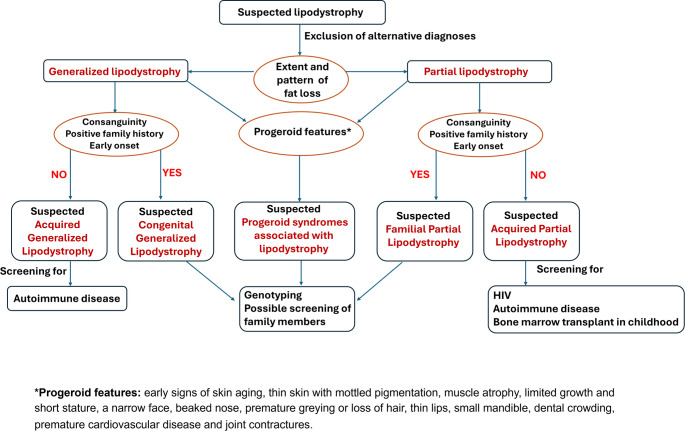
The goal of this review is to address the challenges in diagnosing and managing lipodystrophy syndromes.
Clinical and metabolic assessments, along with genetic analyses, are essential for tailoring medical care and providing appropriate genetic counseling. Efforts are underway to develop more objective diagnostic tools using imaging techniques or novel biomarkers. Leptin therapy has been a significant breakthrough for generalized lipodystrophy treatment; however, more effective treatments are still needed for partial and acquired forms. While gene editing and transcript modification strategies are being explored for specific forms of lipodystrophy, reducing the burden on adipocytes by lowering caloric intake remains a fundamental approach across all forms of the condition. As supporting data emerge, agents that reduce caloric intake may become integral to treatment algorithms. This review offers practical guidance for clinicians managing patients with lipodystrophy, highlighting advances in diagnosis, treatment, and ongoing challenges in clinical care.
本综述的目的是探讨脂肪营养不良综合征诊断和管理方面的挑战。
临床和代谢评估以及基因分析对于定制医疗护理和提供适当的遗传咨询至关重要。目前正在努力利用成像技术或新型生物标志物开发更客观的诊断工具。瘦素治疗是全身性脂肪营养不良治疗的一项重大突破;然而,对于部分性和获得性脂肪营养不良形式,仍需要更有效的治疗方法。虽然正在针对特定形式的脂肪营养不良探索基因编辑和转录修饰策略,但通过降低热量摄入减轻脂肪细胞负担仍然是所有形式该病症的基本方法。随着支持数据的出现,减少热量摄入的药物可能会成为治疗方案的重要组成部分。本综述为管理脂肪营养不良患者的临床医生提供实用指导,突出了诊断、治疗方面的进展以及临床护理中持续存在的挑战。