Wang Hao, Liu Ying, Wang Zhao, Xia PeiYi, Li Zhiwei, Liu Ming, Fu Yang
Department of Biochemistry School of Medicine, SUSTech Homeostatic Medicine Institute, Southern University of Science and Technology Shenzhen China.
The Third People's Hospital of Shenzhen the Second Affiliated Hospital of Southern University of Science and Technology Shenzhen China.
mLife. 2025 Jul 22;4(4):363-377. doi: 10.1002/mlf2.70018. eCollection 2025 Aug.
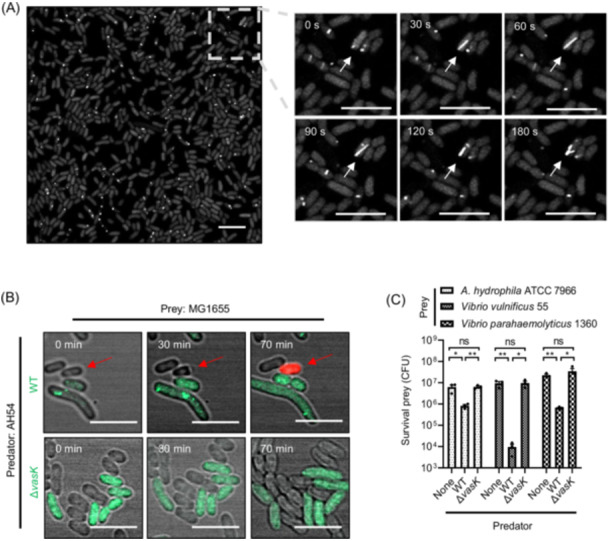
, an opportunistic pathogen, often encodes Type VI Secretion System (T6SS) genes. However, the specific functions of T6SS, particularly in the context of clinical strains, remain poorly understood. In this study, we characterize a multi-drug-resistant strain, AH54, which possesses a complete and functional T6SS, composed of a structural cluster and two homologous auxiliary clusters (Aux1 and Aux2). Each auxiliary cluster encodes two distinct effector proteins: a rearrangement hotspot (Rhs) protein and a proline-alanine-arginine repeat (PAAR) protein-Rhs1/PAAR1 in Aux1 and Rhs2/PAAR2 in Aux2. Our findings reveal that AH54 assembles a fully operational T6SS capable of delivering these effectors, driving inter-bacterial antagonism. Interestingly, the T6SS activity in AH54 is temperature-regulated, with enhanced secretion and antibacterial activity at lower temperatures. To protect itself from self-intoxication, AH54 produces immunity proteins (Tsi1-Tsi4) that neutralize the toxic effectors. While PAAR1 and PAAR2 are critical for Hcp secretion, immunity proteins Tsi3 and Tsi4 do not cross-protect against PAAR effectors, suggesting distinct roles for each PAAR protein in optimizing AH54's competitive fitness. In addition, using a phagocytosis model, we demonstrate that Rhs2, a metal ion-dependent DNase effector, plays a crucial role in protecting AH54 from eukaryotic predation via T6SS. These findings highlight the pivotal role of T6SS in bacterial competition and pathogenesis, offering new insights into the virulence mechanisms of .
作为一种机会致病菌,通常会编码VI型分泌系统(T6SS)基因。然而,T6SS的具体功能,尤其是在临床菌株背景下,仍知之甚少。在本研究中,我们对一株多重耐药菌株AH54进行了表征,该菌株拥有完整且功能正常的T6SS,由一个结构簇和两个同源辅助簇(Aux1和Aux2)组成。每个辅助簇编码两种不同的效应蛋白:一个重排热点(Rhs)蛋白和一个脯氨酸 - 丙氨酸 - 精氨酸重复(PAAR)蛋白——Aux1中的Rhs1/PAAR1和Aux2中的Rhs2/PAAR2。我们的研究结果表明,AH54组装了一个能够递送这些效应蛋白的完全可操作的T6SS,驱动细菌间的拮抗作用。有趣的是,AH54中的T6SS活性受温度调节,在较低温度下分泌和抗菌活性增强。为了保护自身免受自我中毒,AH54产生免疫蛋白(Tsi1 - Tsi4)来中和有毒效应蛋白。虽然PAAR1和PAAR2对Hcp分泌至关重要,但免疫蛋白Tsi3和Tsi4不能交叉保护免受PAAR效应蛋白的影响,这表明每个PAAR蛋白在优化AH54的竞争适应性方面具有不同的作用。此外,使用吞噬作用模型,我们证明Rhs2,一种金属离子依赖性DNase效应蛋白,在通过T6SS保护AH54免受真核捕食方面起着关键作用。这些发现突出了T6SS在细菌竞争和发病机制中的关键作用,为[具体细菌名称]的毒力机制提供了新的见解。