Vasileiadis Georgios K, Zhang Yuan, Laudette Marion, Fatima Tahzeeb, Hultgård Ekwall Anna-Karin, Sureshkumar Reshmi, van Vollenhoven Ronald, Lampa Jon, Gudbjornsson Bjorn, Haavardsholm Espen A, Nordström Dan, Gröndal Gerdur, Hørslev-Petersen Kim, Lend Kristina, Hetland Merete L, Nurmohamed Michael, Østergaard Mikkel, Uhlig Till, Sokka-Isler Tuulikki, Rudin Anna, Borén Jan, Guma Monica, Maglio Cristina
Department of Rheumatology and Inflammation Research, Institute of Medicine, Sahlgrenska Academy, University of Gothenburg, Gothenburg, Sweden.
Department of Molecular and Clinical Medicine/Wallenberg Laboratory, Institute of Medicine, Sahlgrenska Academy, University of Gothenburg, Gothenburg, Sweden.
J Transl Autoimmun. 2025 Aug 19;11:100310. doi: 10.1016/j.jtauto.2025.100310. eCollection 2025 Dec.
In rheumatoid arthritis (RA), fibroblast-like synoviocytes (FLS) alter their metabolism to support their activation. We aimed to analyse the full spectrum of metabolic alterations associated with RA by performing untargeted metabolomics in RA FLS vs. non-inflamed (NI) FLS.
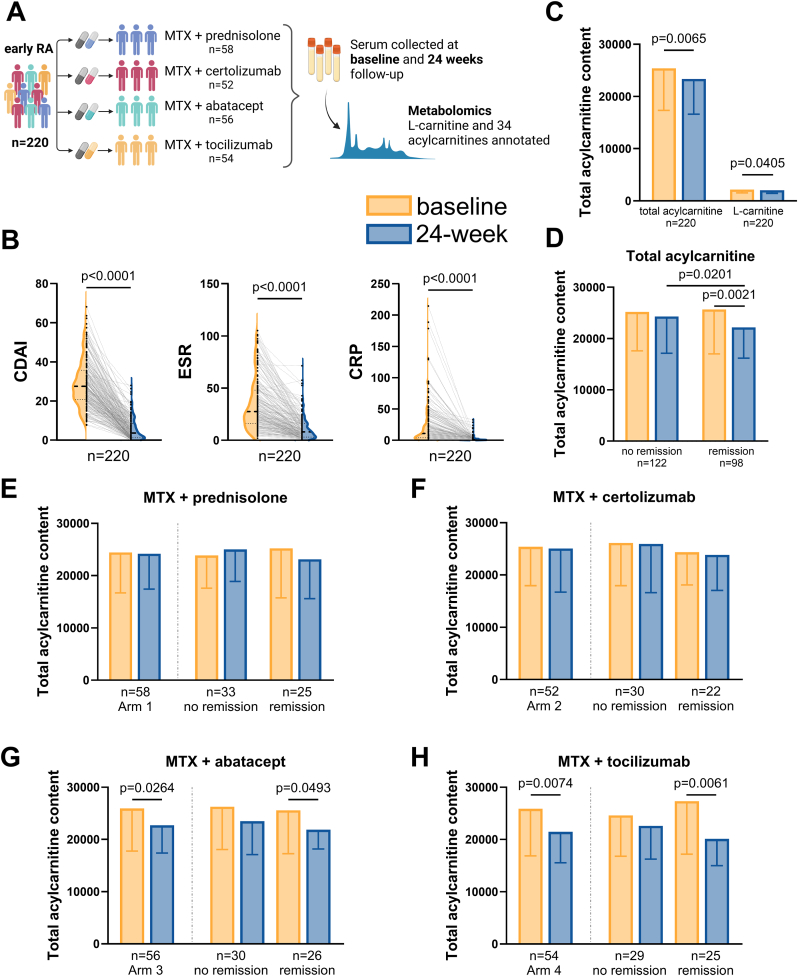
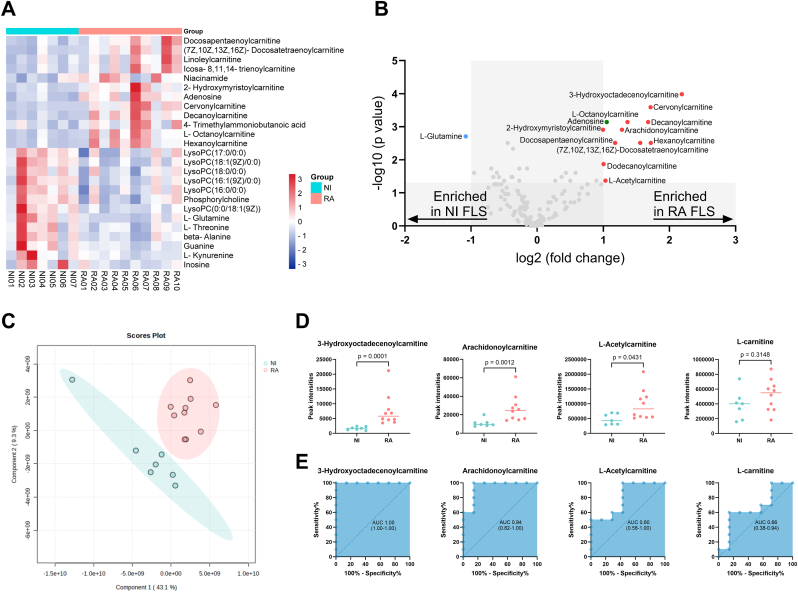
Untargeted annotated metabolomics was performed using mass spectrometry on ten primary RA and seven NI FLS culture extracts and 220 serum samples from participants with early RA from the randomised controlled NORD-STAR trial. Carnitine-related proteins were measured with Western blot. FLS bioenergetic profile was assessed with a Seahorse flux analyser.
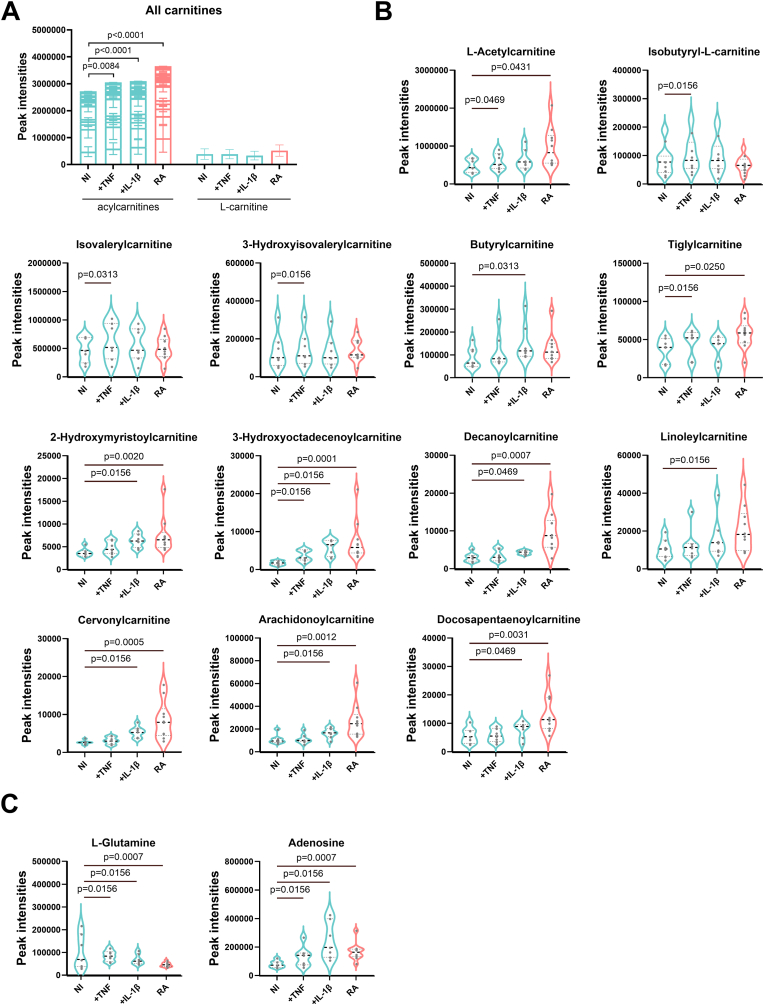
Metabolomics analysis based on 138 annotated metabolites revealed a distinct metabolic fingerprint between RA and NI FLS. Of the 12 metabolites enriched in RA FLS, 11 were acylcarnitines. Pro-inflammatory stimulation of NI FLS also led to acylcarnitine accumulation. RA FLS exhibited lower levels of CD36, a fatty acid transporter, but similar levels of L-carnitine transporter, and carnitine palmitoyltransferase 1 A and 2 compared to NI FLS. Seahorse analyses showed no difference in fatty acid oxidation between RA and NI FLS; however, RA FLS displayed mitochondrial dysfunction and energetic impairment. Serum acylcarnitine content decreased after 24 weeks of treatment with methotrexate combined with abatacept or tocilizumab in patients with early RA achieving remission.
Acylcarnitine accumulation is a characteristic of RA FLS metabolic fingerprint and could be linked to mitochondrial dysfunction. In patients with early RA, acylcarnitine content in serum decreases after successful anti-rheumatic treatment. These results indicate a dysregulation in acylcarnitine metabolism in RA at the joint level and systemically.
在类风湿关节炎(RA)中,成纤维样滑膜细胞(FLS)会改变其代谢以支持自身的活化。我们旨在通过对RA FLS与非炎症(NI)FLS进行非靶向代谢组学分析,来分析与RA相关的代谢改变的全貌。
使用质谱法对10份原发性RA和7份NI FLS培养提取物以及来自随机对照NORD - STAR试验的220例早期RA患者的血清样本进行非靶向注释代谢组学分析。用蛋白质免疫印迹法检测肉碱相关蛋白。用海马通量分析仪评估FLS的生物能量谱。
基于138种注释代谢物的代谢组学分析揭示了RA和NI FLS之间独特的代谢指纹。在RA FLS中富集的12种代谢物中,有11种是酰基肉碱。对NI FLS进行促炎刺激也导致酰基肉碱积累。与NI FLS相比,RA FLS中脂肪酸转运蛋白CD36的水平较低,但左旋肉碱转运蛋白、肉碱棕榈酰转移酶1A和2的水平相似。海马分析显示RA和NI FLS之间脂肪酸氧化没有差异;然而,RA FLS表现出线粒体功能障碍和能量损伤。在达到缓解的早期RA患者中,甲氨蝶呤联合阿巴西普或托珠单抗治疗24周后,血清酰基肉碱含量降低。
酰基肉碱积累是RA FLS代谢指纹的一个特征,可能与线粒体功能障碍有关。在早期RA患者中,成功的抗风湿治疗后血清中的酰基肉碱含量降低。这些结果表明RA在关节水平和全身的酰基肉碱代谢存在失调。