Gregson Simon, Moorhouse Louisa, Maswera Rufurwokuda, Dadirai Tawanda, Mandizvidza Phyllis, Skovdal Morten, Nyamukapa Constance
School of Public Health, Imperial College London, London, England, W2 1PG, UK.
Biomedical Research and Training Institute, Harare, Harare Province, Zimbabwe.
Gates Open Res. 2025 May 27;8:22. doi: 10.12688/gatesopenres.15127.2. eCollection 2024.
Gender norms against adolescent girls and young women (AGYW)'s having pre-marital sex and using condoms in marriage are included as barriers to motivation to use condoms in HIV prevention cascades. Representative data on gender norms are needed to test this assumption.
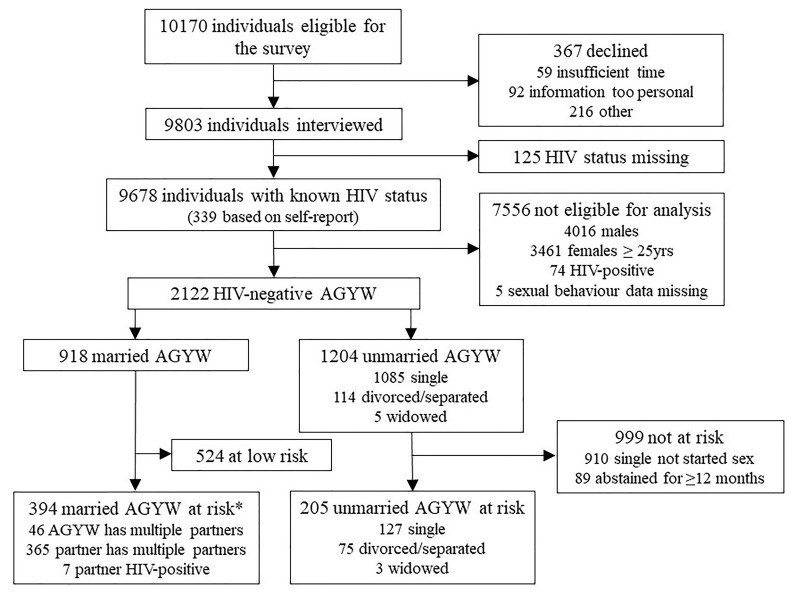
General-population survey participants in Manicaland, Zimbabwe (ages≥15, N=9803) reported agreement/disagreement with statements on gender norms. AGYW at risk of HIV infection reported whether community views discouraged condom use. Multivariable logistic regression was used to measure associations between AGYW's perceiving negative gender norms and condom HIV prevention cascades.
57% of men and 70% of women disagreed that 'If I have a teenage daughter and she has sex before marriage, I would be ok with this'; and 41% of men and 57% of women disagreed that 'If I have a teenage daughter, I would tell her about condoms'. 32% and 69% of sexually-active HIV-negative unmarried AGYW, respectively, said negative community views were important in their decisions to use condoms and their friends were not using condoms. In each case, those who agreed had lower motivation to use condoms. Fewer unmarried AGYW with friends not using condoms used condoms themselves (39% 68%; age- and site-adjusted odds ratios (aOR)=0.29, 95%CI, 0.15-0.55). 21% of men and 32.5% of women found condom use in marriage acceptable. 74% and 93% of married AGYW at risk, respectively, said negative community views influenced their decisions to use condoms and their friends did not use condoms. Fewer married AGYW reporting friends not using condoms were motivated to use condoms but no difference was found in their own condom use (4.1% 6.9%; aOR=0.57, 95%CI, 0.08-2.66).
Negative gender norms can form a barrier to motivation to use condoms in unmarried and married AGYW at risk of HIV infection, and, for unmarried AGYW, to condom use.
反对青春期女孩和年轻女性(AGYW)婚前性行为以及在婚姻中使用避孕套的性别规范,被视为艾滋病毒预防环节中使用避孕套动机的障碍。需要有代表性的性别规范数据来验证这一假设。
津巴布韦马尼卡兰省的普通人群调查参与者(年龄≥15岁,N = 9803)报告了对性别规范相关陈述的同意/不同意情况。有感染艾滋病毒风险的AGYW报告社区观点是否不鼓励使用避孕套。多变量逻辑回归用于衡量AGYW感知到负面性别规范与避孕套艾滋病毒预防环节之间的关联。
57%的男性和70%的女性不同意“如果我有一个十几岁的女儿,她婚前发生性行为,我会接受”;41%的男性和57%的女性不同意“如果我有一个十几岁的女儿,我会告诉她避孕套的事”。分别有32%和69%性活跃的未感染艾滋病毒的未婚AGYW表示,社区的负面观点对她们使用避孕套的决定很重要,且她们的朋友不使用避孕套。在每种情况下,持同意观点的人使用避孕套的动机较低。朋友不使用避孕套的未婚AGYW中,自己使用避孕套的较少(39%对68%;年龄和地点调整后的优势比(aOR)=0.29,95%置信区间,0.15 - 0.55)。21%的男性和32.5%的女性认为在婚姻中使用避孕套是可以接受的。分别有74%和93%有感染风险的已婚AGYW表示,社区的负面观点影响了她们使用避孕套的决定,且她们的朋友不使用避孕套。报告朋友不使用避孕套的已婚AGYW中,有使用避孕套动机的较少,但她们自己使用避孕套的情况没有差异(4.1%对6.9%;aOR = 0.57,95%置信区间,0.08 - 2.66)。
负面的性别规范可能会成为有感染艾滋病毒风险的未婚和已婚AGYW使用避孕套动机的障碍,对于未婚AGYW来说,也是使用避孕套的障碍。