Villanueva-Espino Luis Alberto, Avila-Eulogio Irais, de Santiago-Hernández M Hesajim, Flores-Ortiz César Mateo, Lira Saade Rafael, Cortés Pérez Adonaji, Fuchs Eric J, Quesada Mauricio
Laboratorio Nacional de Análisis y Síntesis Ecológica, Escuela Nacional de Estudios Superiores Universidad Nacional Autónoma de México (UNAM) Morelia Michoacán Mexico.
Posgrado en Ciencias Biológicas, Unidad de Posgrado, Edificio D, 1° Piso, Circuito de Posgrados Ciudad Universitaria Ciudad de México Mexico.
Ecol Evol. 2025 Aug 29;15(9):e72028. doi: 10.1002/ece3.72028. eCollection 2025 Sep.
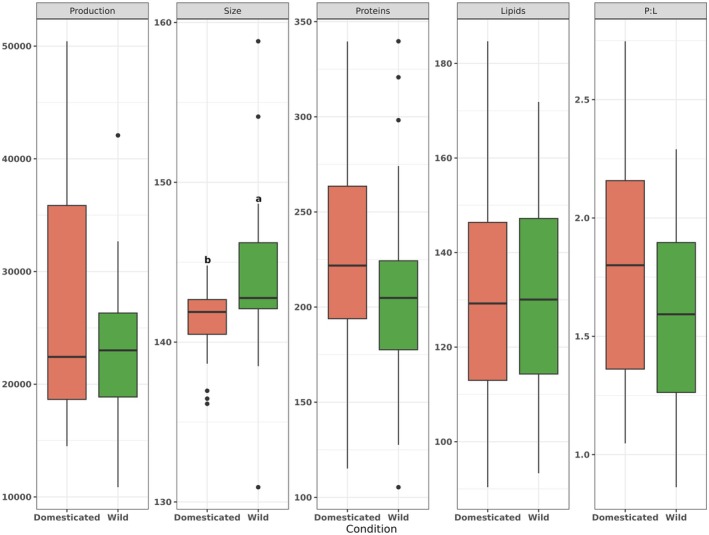
Plant domestication primarily targets traits of direct human interest, such as fruit and seed characteristics; however, its indirect effects on other traits, including floral morphology and rewards (nectar and pollen), remain less understood. In this study, we investigated how domestication has influenced floral traits and rewards in domesticated and wild species of the genus . We compared three domesticated and three wild species in an experimental plot. We measured floral morphological traits, nectar volume, sugar (fructose, glucose, and sucrose), and amino acid concentrations in staminate and pistillate flowers. In addition, we evaluated pollen production and size, as well as protein and lipid concentrations, and the protein: lipid ratio in staminate flowers. Our results show that domesticated species exhibit larger floral morphological traits in both pistillate and staminate flowers compared to their wild relatives. While nectar volume increased in domesticated species, sugar and amino acid concentrations remained unchanged. In contrast, domestication had no significant effect on pollen traits, including production, size, and protein and lipid content. These findings highlight that domestication differentially affects floral traits: while floral morphology is significantly altered, most of the traits of floral rewards remain largely unaffected. This conservation may arise from the recent evolutionary history of these species and their close coevolutionary relationship with bees, emphasizing pollinator nutritional needs over artificial selection. These results underscore the complex interplay between domestication, resource allocation, and plant-pollinator interactions in shaping floral traits.
植物驯化主要针对直接引起人类兴趣的性状,如果实和种子特征;然而,其对包括花形态和报酬(花蜜和花粉)在内的其他性状的间接影响仍鲜为人知。在本研究中,我们调查了驯化如何影响该属驯化物种和野生物种的花性状及报酬。我们在一个实验地块中比较了三个驯化物种和三个野生物种。我们测量了雄花和雌花的花形态性状、花蜜体积、糖(果糖、葡萄糖和蔗糖)以及氨基酸浓度。此外,我们评估了雄花中的花粉产量和大小,以及蛋白质和脂质浓度,还有蛋白质与脂质的比率。我们的结果表明,与野生近缘种相比,驯化物种在雌花和雄花中均表现出更大的花形态性状。虽然驯化物种的花蜜体积增加了,但糖和氨基酸浓度保持不变。相比之下,驯化对花粉性状,包括产量、大小以及蛋白质和脂质含量,没有显著影响。这些发现突出表明,驯化对花性状的影响存在差异:虽然花形态发生了显著改变,但花报酬的大多数性状基本未受影响。这种保留可能源于这些物种最近的进化历史以及它们与蜜蜂的紧密协同进化关系,强调了传粉者的营养需求而非人工选择。这些结果强调了驯化、资源分配以及植物 - 传粉者相互作用在塑造花性状方面的复杂相互作用。