Ferrer Emily, Marhan Shannon, Haller Leora, O'Connor Shannon M
Department of Psychology, Montclair State University, Montclair, NJ USA.
Department of Child and Adolescent Psychiatry, Children's Hospital of Philadelphia, Philadelphia, PA USA.
J Child Fam Stud. 2025;34(8):2070-2080. doi: 10.1007/s10826-025-03078-z. Epub 2025 Aug 14.
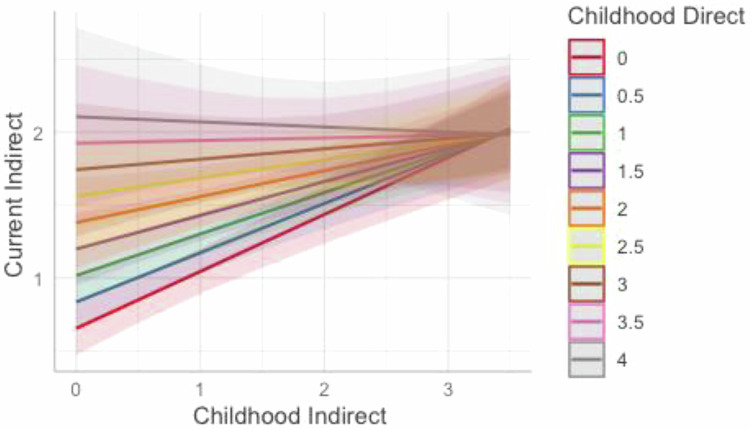
Parental communication about body weight and shape is associated with offspring's eating behaviors and body image. However, predictors of parental weight/shape communication are less known. The present study explored whether direct (i.e., comments to the child about their weight and encouragement to diet) and indirect (i.e., modeling of the importance of body weight/shape via parent's own dieting and comments about their own weight) communication about weight, shape, and eating from parents in childhood predicted women's direct and indirect communication about weight/shape to their own child in adulthood. Participants were 634 adult mothers who provided retrospective reports of their parents' direct and indirect weight/shape-related communication during childhood. Participants then self-reported their own current direct and indirect weight/shape communication towards their own child. Multiple linear regression explored whether childhood direct and indirect communication predicts maternal weight/shape communication towards participants' own child in adulthood. Childhood direct weight/shape communication was a salient predictor of both current direct and indirect weight/shape communication. Childhood indirect weight/shape communication did not predict current direct communication when modeled with childhood direct communication, however, it was predictive of current indirect communication. Findings may highlight a need for parental psychoeducation on the lasting influence of familial weight/shape communication.
父母关于体重和体型的交流与子女的饮食行为及身体形象有关。然而,父母体重/体型交流的预测因素却鲜为人知。本研究探讨了童年时期父母关于体重、体型和饮食的直接交流(即对孩子体重的评论以及节食鼓励)和间接交流(即通过父母自身节食及对自身体重的评论来树立体重/体型重要性的榜样)是否能预测成年女性对自己孩子体重/体型的直接和间接交流。研究参与者为634名成年母亲,她们回顾性报告了童年时期父母与体重/体型相关的直接和间接交流情况。参与者随后自我报告了她们目前对自己孩子体重/体型的直接和间接交流情况。多元线性回归分析探讨了童年时期的直接和间接交流是否能预测成年后母亲对自己孩子体重/体型的交流。童年时期父母关于体重/体型的直接交流是当前直接和间接体重/体型交流的显著预测因素。当与童年时期的直接交流一起建模时,童年时期父母关于体重/体型的间接交流并不能预测当前的直接交流,然而,它能预测当前的间接交流。研究结果可能凸显了对父母进行关于家庭体重/体型交流的持久影响的心理教育的必要性。