Gu Ruonan, Xu Shanxiang, Jiang Shouyin, Lu Xiao, Wang Haizhen, Zhao Xiaogang
Department of Emergency Medicine, Haiyan People's Hospital, Haiyan, Zhejiang, China.
Zhejiang Key Laboratory of Trauma, Burn, and Medical Rescue, Hangzhou, China.
Front Med (Lausanne). 2025 Aug 18;12:1603778. doi: 10.3389/fmed.2025.1603778. eCollection 2025.
The ultrasound-guided axillary vein approach for central venous catheterization (UAVC) demonstrates high success rates and low complications; however, its utilization in trauma care settings remains limited. This study aimed to characterize UAVC practices in a trauma intensive care unit (TICU) at a tertiary teaching hospital, specifically investigating optimal catheter positioning, procedure-related complications, and risk factors associated with catheter inaccurate placement and venous thromboembolism (VTE) development.
A retrospective analysis was performed on trauma patients who underwent UAVC between October 2021 and April 2023. This analysis was based on electronic medical records. Details of patients, procedures, and instances of catheter misplacement were carefully documented. The immediate complications after UAVC, including pneumothorax, hemothorax, hematoma, arteriovenous fistula, arterial dissection, and skin infection, were recorded. Moreover, late-onset complications such as VTE and catheter-related bloodstream infections (CRBSI) were also noted. Logistic regression was utilized to determine the independent risk factors for non-optimal catheter tip placement and VTE.
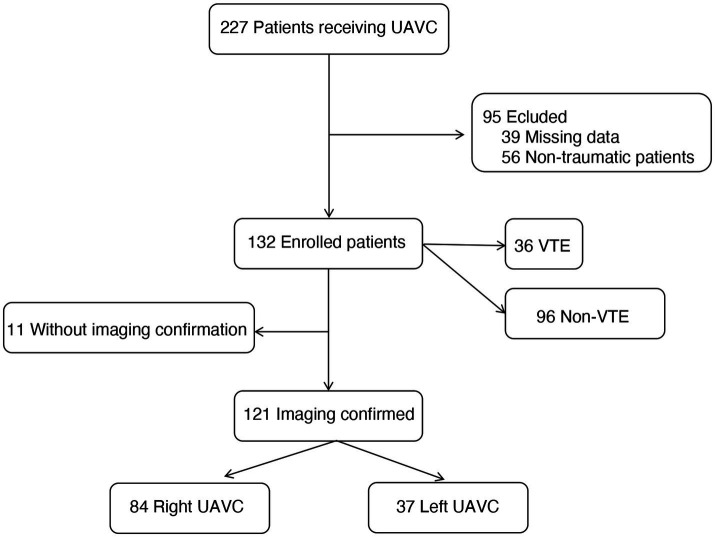
A total of 132 UAVC cases were analyzed, with 113 (85.6%) performed by resident physicians and no immediate complications observed. The VTE incidence was 27.3%, particularly higher in elderly patients (≥ 65 years, 43.4%), and fever during TICU stay was noted in 55.3% of cases. Catheter-related infections occurred at a rate of 3.38 per 1,000 catheter days, with eight cases (6.06%) of catheter misplacement. Accurate placement was achieved in 29.8% of 121 patients, predominantly on the right side (40.4%). Factors influencing inaccurate placement included patient age [odds ratios (OR) 1.06, 95% confidence interval (CI) 1.02-1.10], obesity (OR 9.31, 95% CI 2.58-33.56), and left-side placement (OR 133.04, 95% CI 21.66-817.29), while patient age (>54 years), fever, and ventilation duration (>6.6 days) were associated with VTE development.
In severely injured trauma patients, UAVC is associated with a high incidence of VTE and a low rate of optimal catheter tip positioning. Our findings underscore the necessity of standardized protocols to refine catheter tip placement and warrant further investigation through randomized controlled trials.
超声引导下腋静脉中心静脉置管术(UAVC)成功率高且并发症少;然而,其在创伤护理环境中的应用仍然有限。本研究旨在描述一家三级教学医院创伤重症监护病房(TICU)中UAVC的操作情况,具体调查最佳导管位置、与操作相关的并发症以及与导管放置不准确和静脉血栓栓塞(VTE)发生相关的危险因素。
对2021年10月至2023年4月期间接受UAVC的创伤患者进行回顾性分析。该分析基于电子病历。仔细记录患者、操作及导管误置情况的详细信息。记录UAVC后的即刻并发症,包括气胸、血胸、血肿、动静脉瘘、动脉夹层和皮肤感染。此外,还记录了VTE和导管相关血流感染(CRBSI)等迟发性并发症。采用逻辑回归确定导管尖端放置不理想和VTE的独立危险因素。
共分析了132例UAVC病例,其中113例(85.6%)由住院医师操作,未观察到即刻并发症。VTE发生率为27.3%,老年患者(≥65岁,43.4%)尤其更高,55.3%的病例在TICU住院期间出现发热。导管相关感染发生率为每1000导管日3.38例,有8例(6.06%)导管误置。121例患者中有29.8%实现了准确放置,主要在右侧(40.4%)。影响放置不准确的因素包括患者年龄[比值比(OR)1.06,95%置信区间(CI)1.02 - 1.10]、肥胖(OR 9.31,95% CI 2.58 - 33.56)和左侧放置(OR 133.04,95% CI 21.66 - 817.29),而患者年龄(>54岁)、发热和通气时间(>6.6天)与VTE发生相关。
在重伤创伤患者中,UAVC与VTE的高发生率和导管尖端最佳定位的低发生率相关。我们的研究结果强调了制定标准化方案以优化导管尖端放置的必要性,并需要通过随机对照试验进行进一步研究。