Tabegna Fabiana G A, Garton Mark, D'Amore Simona, Skingle Linda, Dillon Scott, Duer Melinda J, Clunie Gavin P R, Poole Kenneth E S
NIHR Cambridge Biomedical Research Centre, Department of Medicine, Addenbrooke's Hospital, University of Cambridge, Cambridge, United Kingdom.
Wrexham Glyndwr University, Clywd & Nuffield Health, Wrexham, Shrewsbury, Shropshire, United Kingdom.
Curr Osteoporos Rep. 2025 Sep 4;23(1):36. doi: 10.1007/s11914-025-00929-y.
In this review, we will examine the pathophysiology, anatomy, biochemistry, and genotype-phenotype correlation of femoral fractures in adult hypophosphatasia.
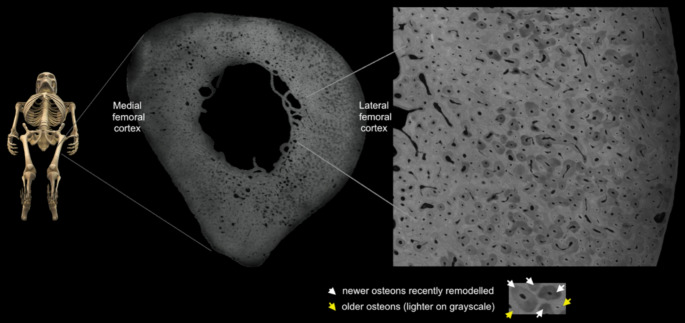
Hypophosphatasia (HPP) is a rare genetic disease characterized by low activity of tissue-nonspecific alkaline phosphatase (TNAP). The disease presents a broad spectrum of clinical manifestations primarily determined by the degree of residual TNAP activity. Adults with HPP of moderate clinical severity may present with spontaneous femoral fractures that are like the atypical femoral fractures (AFF) of long-term bisphosphonates users. In this review, we will focus on the paradox that while HPP can cause biopsy-proven osteomalacia (pathologically impaired bone mineralisation), the spontaneous femoral fractures that characterise adult HPP do not exhibit typical osteomalacia features. Instead, they resemble the femoral fractures that occur in other diseases such as osteopetrosis where bone becomes excessively dense, brittle and highly mineralised due to osteoclast dysfunction. This review examines the key aspects of the pathophysiology of femoral fractures in adults with HPP, offering new insights into the role of anatomical, molecular and biochemical bone abnormalities that characterise the disease. Further investigations of HPP patients with femoral fracture are needed to examine the nanoscale crystal structure of the bone and to study abnormalities in fracture healing and bone resorption.
在本综述中,我们将探讨成人低磷性骨软化症股骨骨折的病理生理学、解剖学、生物化学以及基因型 - 表型相关性。
低磷性骨软化症(HPP)是一种罕见的遗传性疾病,其特征为组织非特异性碱性磷酸酶(TNAP)活性降低。该疾病呈现出广泛的临床表现,主要由残余TNAP活性程度决定。临床严重程度为中度的成人HPP患者可能会出现自发性股骨骨折,这些骨折类似于长期使用双膦酸盐类药物患者的非典型股骨骨折(AFF)。在本综述中,我们将聚焦于这样一个矛盾现象:虽然HPP可导致经活检证实的骨软化症(病理上骨矿化受损),但成人HPP特征性的自发性股骨骨折却不表现出典型的骨软化症特征。相反,它们类似于其他疾病(如石骨症)中发生的股骨骨折,在石骨症中,由于破骨细胞功能障碍,骨骼变得过度致密、脆弱且矿化程度高。本综述探讨了成人HPP患者股骨骨折病理生理学的关键方面,为该疾病特征性的解剖学、分子和生物化学骨异常的作用提供了新的见解。需要对患有股骨骨折的HPP患者进行进一步研究,以检查骨骼的纳米级晶体结构,并研究骨折愈合和骨吸收的异常情况。