Okasha Lamiaa A, Farag Enas A H, Sayed-ElAhl Rasha M H, Sherif Ahmed H
Bacteriology Unit, Agriculture Research Center ARC, Animal Health Research Institute AHRI, Kafrelsheikh, 12619, Egypt.
Department of Pharmacology, Agriculture Research Center ARC, Animal Health Research Institute AHRI, Benha, 12619, Egypt.
BMC Microbiol. 2025 Sep 5;25(1):572. doi: 10.1186/s12866-025-04232-9.
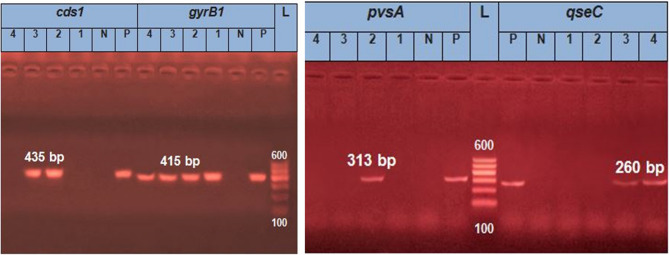
The production of striped catfish (Pangasianodon hypothalamus) has increased worldwide; recently, it was farmed with Nile tilapia in polyculture farms. Polyculture systems and water temperature (25℃ and 33℃) could affect Edwardsiella tarda infection, antibiotic efficacy, and residues. Moribund fishes were collected from three Farms 1-3: Farm 1 (monoculture, Nile tilapia), Farm 2 (monoculture, striped catfish), and Farm 3 (polyculture). Four E. tarda, LAMSH1, and LAMAH2-4 were isolated, whereas LAMAH3 was isolated from both fish spp., where striped catfish were highly susceptible to infection. The obtained E. tarda, which was isolated from striped catfish, has a significantly lower LD than those retrieved from Nile tilapia, and co-infection occurred only in striped catfish on Farm 3. The infection was screened and confirmed by gyrB1 gene presence while detecting the cds1, pvsA, and qseC genes indicated virulence. All isolates were sensitive to ciprofloxacin and florfenicol but showed resistance to a high number of other antibiotics, resulting in high multi-drug resistant (MDR) indices exceeding 0.2, except for strain LAMAH4, which had an index of 0.18.Analyses of farms water revealed high ammonia compounds total ammonia nitrogen (TAN), unionized ammonia (NH), nitrite (NO), and nitrate (NO) in Farm 2 (monoculture, striped catfish), and the recorded significantly higher concentrations were 2.75, 0.29, 0.24, and 2.01 mg/L, respectively, which were compared with Farm 1 and Farm 3. In the indoor experiment, at high water temperatures (33 °C), Nile tilapia and striped catfish had a high mortality rate and re-isolation of E. tarda (10-20%) compared to those exposed to low water temperatures (25 °C). These observations were concurrent with low antibiotic residues in their hepatic tissues. Despite water temperature, Nile tilapia showed higher ciprofloxacin residues than striped catfish.The study concluded that striped catfish are more susceptible to the bacteria E. tarda compared to Nile tilapia, particularly in polyculture farms, which resulted in a higher infection rate. Both Nile tilapia and striped catfish exposed to elevated water temperatures exhibited increased vulnerability to bacterial infections. Additionally, these fish showed a high re-isolation rate of E. tarda while having low ciprofloxacin residues in their hepatic tissues.
苏氏圆腹芒(Pangasianodon hypothalamus)的产量在全球范围内有所增加;最近,它在混养养殖场中与尼罗罗非鱼一起养殖。混养系统和水温(25℃和33℃)可能会影响迟缓爱德华氏菌感染、抗生素疗效和残留。从三个养殖场1 - 3收集濒死鱼:养殖场1(尼罗罗非鱼单养)、养殖场2(苏氏圆腹芒单养)和养殖场3(混养)。分离出了四株迟缓爱德华氏菌,即LAMSH1和LAMAH2 - 4,而LAMAH3是从两种鱼中都分离出来的,其中苏氏圆腹芒对感染高度敏感。从苏氏圆腹芒中分离出的迟缓爱德华氏菌的半数致死剂量(LD)显著低于从尼罗罗非鱼中分离出的菌株,并且共感染仅发生在养殖场3的苏氏圆腹芒中。通过gyrB1基因的存在筛选并确认感染,同时检测cds1、pvsA和qseC基因表明具有毒力。所有分离株对环丙沙星和氟苯尼考敏感,但对大量其他抗生素耐药,导致多药耐药(MDR)指数高,超过0.2,除了LAMAH4菌株,其指数为0.18。对养殖场水体的分析显示,养殖场2(苏氏圆腹芒单养)中的氨化合物、总氨氮(TAN)、非离子氨(NH)、亚硝酸盐(NO)和硝酸盐(NO)含量较高,记录到的显著较高浓度分别为2.75、0.29、0.24和2.01mg/L,与养殖场1和养殖场3相比。在室内实验中,与暴露于低温(25℃)的尼罗罗非鱼和苏氏圆腹芒相比,在高温(33℃)下它们的死亡率较高,并且迟缓爱德华氏菌的再分离率为10 - 20%。这些观察结果与它们肝脏组织中低抗生素残留情况一致。尽管水温不同,但尼罗罗非鱼的环丙沙星残留量高于苏氏圆腹芒。该研究得出结论,与尼罗罗非鱼相比,苏氏圆腹芒对迟缓爱德华氏菌更敏感,特别是在混养养殖场中,这导致了更高的感染率。暴露于高温的尼罗罗非鱼和苏氏圆腹芒对细菌感染的易感性均增加。此外,这些鱼的迟缓爱德华氏菌再分离率高,而肝脏组织中的环丙沙星残留量低。