Lockie Robert G, Dulla Joseph M, Meloni Jennifer, Ross Kristina A, Orr Robin M, Dawes J Jay, Ruvalcaba Tomas J
Center for Sport Performance, Department of Kinesiology, California State University, Fullerton, Fullerton, CA, USA.
Tactical Research Unit, Bond University, Robina, Qld, Australia.
Int J Exerc Sci. 2025 Sep 1;18(8):895-909. doi: 10.70252/LGER1776. eCollection 2025.
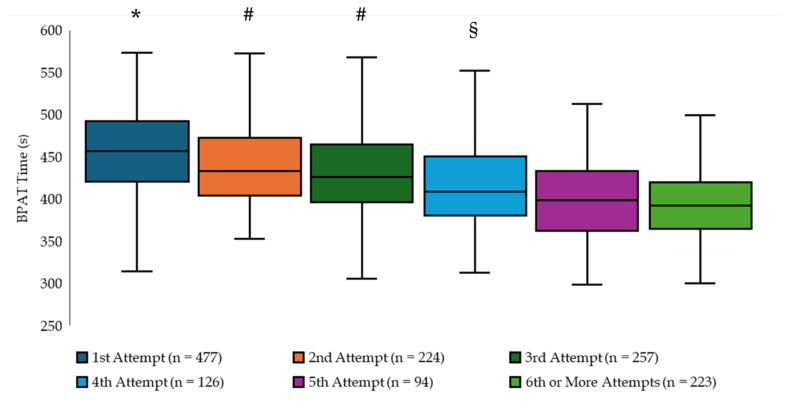
The Biddle Physical Ability Test (BPAT) is a job task simulation that must be completed in ≤9:34 min:s by structural firefighter candidates to be accepted to a fire training academy. This study investigated the influence of prior attempts on BPAT time. Retrospective analysis was conducted on 1435 male and 72 female candidates. All participants received equivalent instruction on how to complete the BPAT which incorporated: dry hose drag; charged hose drag; halyard raise; roof walk; attic crawl; roof ventilation; victim removal; ladder removal and carry; stair climb with hose bundle; crawling search; stair climb with air bottles; and hose hoist. Candidates in the dataset were split into 1st, 2nd, 3rd, 4th, 5th, and ≥6th attempt groups. A one-way ANOVA, with Bonferroni post hoc, compared groups in BPAT time (all times combined and passing times only; ≤0.05). All candidates who failed to meet time requirements, did not finish, or were disqualified, were recorded. The 1st, 2nd, and 3rd attempt groups were significantly (≤0.007) slower than the 4th, 5th, and ≥6th attempt groups when considering all and passing times. The percentage of candidates that did not pass the BPAT relative to their attempt group was: 1st = 13%; 2nd = 6%; 3rd = 7%; 4th = 2%; 5th = 0%; ≥6th = <1%. Most candidates passed the BPAT. However, BPAT practice based on previous attempts generally led to faster times and more candidates passing. It could be beneficial for candidates to attend practice courses and fitness training sessions to improve BPAT performance.
比德尔体能测试(BPAT)是一项工作任务模拟,结构消防员候选人必须在9分34秒内完成该测试才能被消防训练学院录取。本研究调查了之前的测试尝试对BPAT完成时间的影响。对1435名男性和72名女性候选人进行了回顾性分析。所有参与者都接受了关于如何完成BPAT的同等指导,其中包括:干式水带拖拽;充水式水带拖拽;升降索提升;屋顶行走;阁楼爬行;屋顶通风;搬运遇难者;移除并搬运梯子;携带水带束爬楼梯;爬行搜索;背着气瓶爬楼梯;以及水带提升。数据集中的候选人被分为首次、第二次、第三次、第四次、第五次和≥第六次尝试组。采用单因素方差分析,并进行Bonferroni事后检验,比较各小组的BPAT时间(所有时间总和以及仅通过时间;≤0.05)。记录所有未达到时间要求、未完成或被取消资格的候选人。在考虑所有时间和通过时间时,首次、第二次和第三次尝试组明显(≤0.007)比第四次、第五次和≥第六次尝试组慢。相对于其尝试组未通过BPAT的候选人百分比为:首次 = 13%;第二次 = 6%;第三次 = 7%;第四次 = 2%;第五次 = 0%;≥第六次 = <1%。大多数候选人通过了BPAT。然而,基于之前尝试的BPAT练习通常会使时间更快,且更多候选人通过。候选人参加练习课程和体能训练课程可能有助于提高BPAT表现。