Liu Zhichao, Wang Guoqiang, Yang Yang, Su Yuchen, Zhang Hong, Liu Jun, Cui Peng, Fan Xuning, Yang Jinyu, Zhang Zhihong, Gao Xing, Chao Yinkai, Mostert Bianca, van Lanschot J Jan B, Wijnhoven Bas P L, Law Simon, Li Chunguang, Cai Shangli, Li Zhigang
Department of Thoracic Surgery, Shanghai Key Laboratory of Thoracic Tumor Biotherapy, Shanghai Chest Hospital, Shanghai Jiao Tong University School of Medicine, Shanghai 200030, China; Shanghai Institute of Thoracic Oncology, Shanghai 200030, China.
Burning Rock Biotech, Guangzhou 510300, China.
Cell Rep Med. 2025 Sep 16;6(9):102334. doi: 10.1016/j.xcrm.2025.102334. Epub 2025 Sep 5.
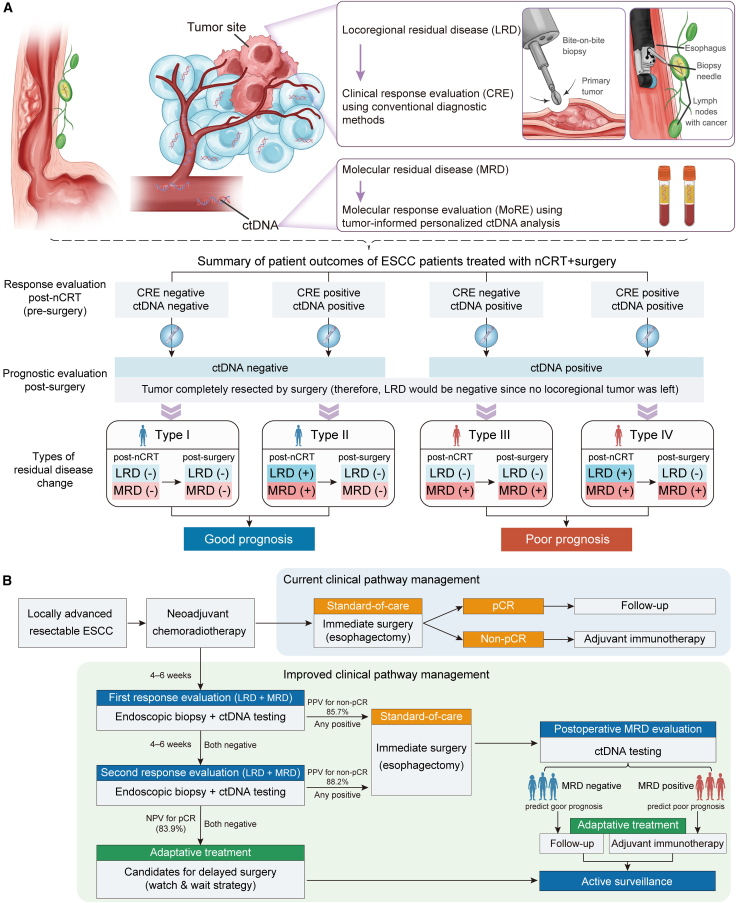
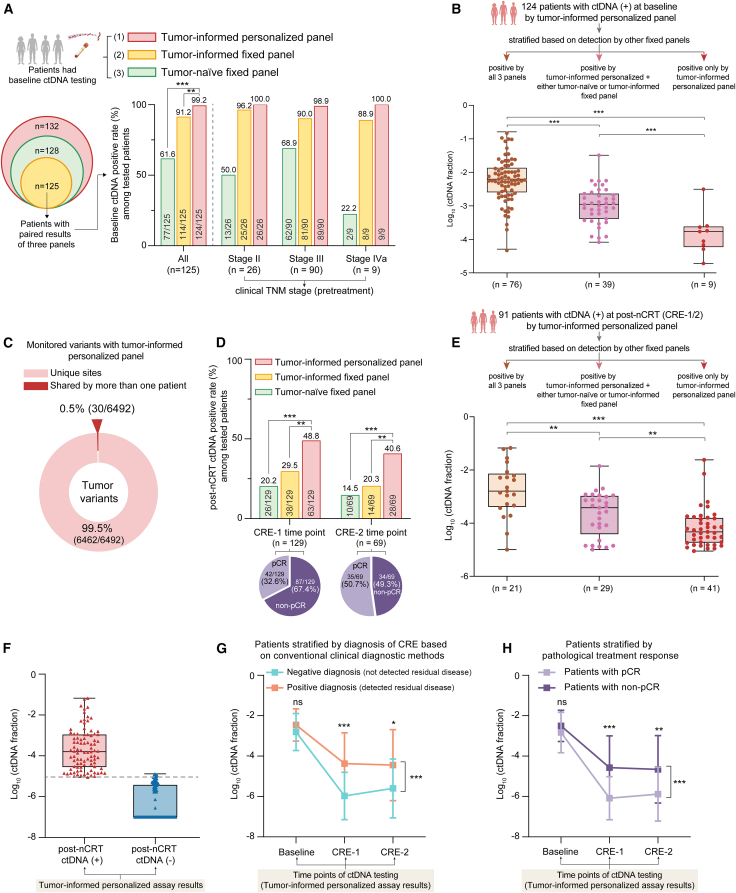
The diagnostic accuracy of circulating tumor DNA (ctDNA) for detecting molecular residual disease (MRD) after multimodal treatment remains unclear. In a prospective cohort of 132 patients with locally advanced esophageal squamous cell carcinoma (ESCC) undergoing neoadjuvant chemoradiotherapy (nCRT) followed by clinical response evaluation and surgery, tumor-informed personalized-panel and fixed-panel ctDNA assays are applied to serial blood samples. Personalized ctDNA assay demonstrates a superior baseline detection rate (99.2%) and outperforms fixed panels in diagnosing post-nCRT residual disease. Integrating personalized ctDNA with conventional clinical diagnostic methods increases sensitivity for predicting non-pathological complete response (non-pCR) from 78.4%-80.7% to 92.0%-93.2%. Patients with detectable MRD post-nCRT and/or post-surgery exhibit worse survival outcomes. In non-pCR patients, adjuvant immunotherapy improves disease-free survival in post-surgery MRD-positive cases, whereas MRD-negative patients derive no benefit. These findings support incorporating ctDNA into response assessment to guide organ-sparing strategies and adjuvant therapy decisions in ESCC. This study is registered at ClinicalTrials.gov (NCT03937362).
循环肿瘤DNA(ctDNA)用于检测多模式治疗后分子残留病(MRD)的诊断准确性仍不清楚。在一项前瞻性队列研究中,对132例局部晚期食管鳞状细胞癌(ESCC)患者进行新辅助放化疗(nCRT),随后进行临床反应评估和手术,将肿瘤知情的个性化检测板和固定检测板ctDNA检测方法应用于系列血样。个性化ctDNA检测显示出更高的基线检测率(99.2%),在诊断nCRT后残留病方面优于固定检测板。将个性化ctDNA与传统临床诊断方法相结合,可将预测非病理完全缓解(non-pCR)的敏感性从78.4%-80.7%提高到92.0%-93.2%。nCRT后和/或手术后可检测到MRD的患者生存结果较差。在non-pCR患者中,辅助免疫治疗可改善手术后MRD阳性病例的无病生存期,而MRD阴性患者则无获益。这些发现支持将ctDNA纳入反应评估,以指导ESCC的器官保留策略和辅助治疗决策。本研究已在ClinicalTrials.gov(NCT03937362)注册。