Sun Min, Guo Mengran, He Zhongshan, Luo Yaoyao, Yang Huiling, Zhang Yupei, Gao Yuntao, Ruan Xuli, Liu Ruyue, Li Jingrun, Cao Wenjiang, Huang Chuansheng, Wang Liping, Yuan Yong, Song Xiangrong, Wang Xinchun
Department of Pharmacy, First Affiliated Hospital, Shihezi University, Shihezi, 832008, China.
Department of Critical Care Medicine, Department of Pharmacy, State Key Laboratory of Biotherapy and Cancer Center, West China Hospital, Sichuan University, Chengdu, 610000, China.
Mater Today Bio. 2025 Aug 16;34:102204. doi: 10.1016/j.mtbio.2025.102204. eCollection 2025 Oct.
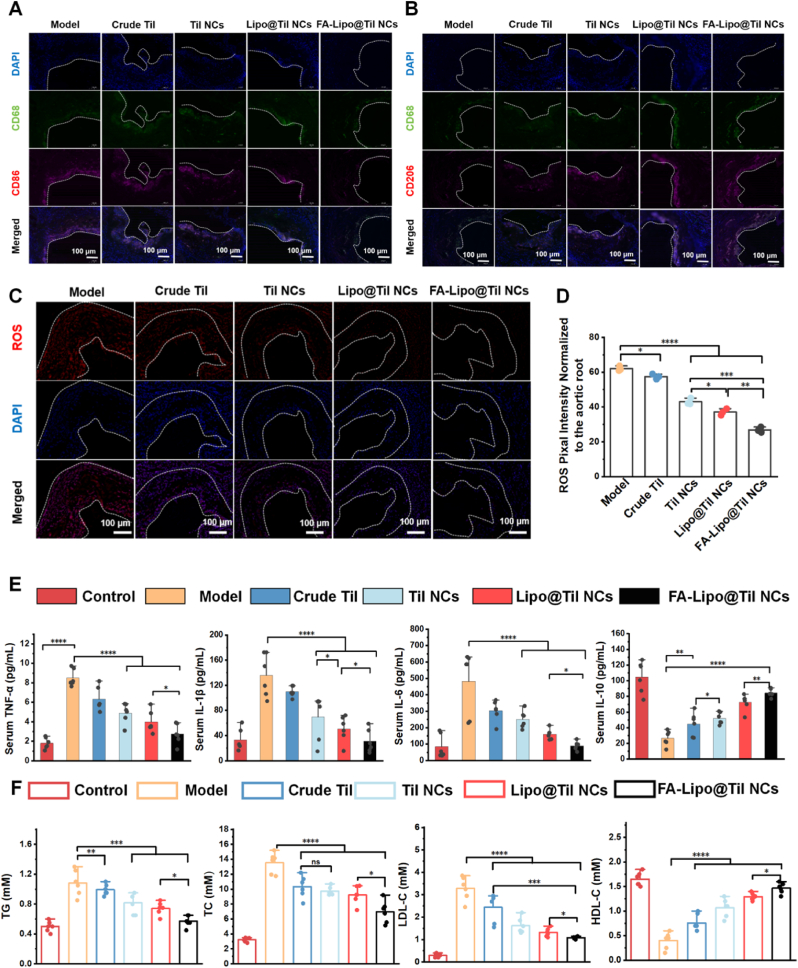
Modulating macrophage function is an effective strategy for treating atherosclerosis. Our previous research shows that tilianin (Til) effectively regulates macrophage polarization. This immune modulation positions Til as a promising plant-derived therapeutic agent with potential for atherosclerosis treatment and management. Due to its biopharmaceutics classification system (BCS) IV drug properties, it is a challenge to delivering Til to macrophages in atherosclerotic plaques, especially via the oral route. Herein, we introduced a folate-modified oral Til nanocrystal liposome (FA-Lipo@Til NCs) that showed enhanced mucus permeability and transmembrane transport ability across the intestinal epithelium. It could subsequently target and accumulate in macrophages within aortic plaques. After three months of oral treatment with FA-Lipo@Til NCs in apolipoprotein E deficient ( ) mice with atherosclerosis, significant therapeutic effects were observed. The treatment effectively stabilized atherosclerotic plaques. Additionally, FA-Lipo@Til NCs effectively inhibited reactive oxygen species (ROS) production in macrophages, thereby reducing oxidative stress. The treatment also promoted macrophage polarization towards the anti-inflammatory M2 phenotype, enhancing their ability to clear apoptotic cells (efferocytosis) and resolving local inflammation. Notably, throughout the treatment period, significant alterations in blood lipid levels were observed. In summary, FA-Lipo@Til NCs offer a targeted and effective approach to regulate macrophage polarization while also hindering the advancement of atherosclerosis. Besides, our study proposes a promising therapeutic approach for atherosclerosis by leveraging an innovative oral targeted delivery system for BCS IV drugs.
调节巨噬细胞功能是治疗动脉粥样硬化的有效策略。我们之前的研究表明,田蓟苷(Til)能有效调节巨噬细胞极化。这种免疫调节作用使Til成为一种有前景的植物源治疗剂,具有治疗和管理动脉粥样硬化的潜力。由于其生物药剂学分类系统(BCS)IV类药物的性质,将Til递送至动脉粥样硬化斑块中的巨噬细胞具有挑战性,尤其是通过口服途径。在此,我们引入了一种叶酸修饰的口服田蓟苷纳米晶体脂质体(FA-Lipo@Til NCs),其在肠道黏液中的渗透性增强,跨肠上皮的跨膜转运能力提高。随后它可以靶向并积聚在主动脉斑块内的巨噬细胞中。在用FA-Lipo@Til NCs对载脂蛋白E缺陷( )的动脉粥样硬化小鼠进行三个月的口服治疗后,观察到显著的治疗效果。该治疗有效地稳定了动脉粥样硬化斑块。此外,FA-Lipo@Til NCs有效抑制巨噬细胞中活性氧(ROS)的产生,从而降低氧化应激。该治疗还促进巨噬细胞向抗炎M2表型极化,增强其清除凋亡细胞(胞葬作用)和缓解局部炎症的能力。值得注意的是,在整个治疗期间,观察到血脂水平有显著变化。总之,FA-Lipo@Til NCs提供了一种靶向且有效的方法来调节巨噬细胞极化,同时也阻碍动脉粥样硬化的进展。此外,我们的研究通过利用一种创新的针对BCS IV类药物的口服靶向递送系统,提出了一种有前景的动脉粥样硬化治疗方法。