Zhang Jinhui, Huang Zirui, Song Cailu, Wu Song, Xie Jindong, Zou Yutian, Xie Xiaoming, Wu Tao, Yang Han, Tang Hailin
State Key Laboratory of Oncology in South China, Guangdong Provincial Clinical Research Center for Cancer, Sun Yat-sen University Cancer Center, Guangzhou 510060, China.
Changde Hospital, Xiangya School of Medicine, Central South University (The First People's Hospital of Changde City), Changde, China.
Research (Wash D C). 2025 Sep 8;8:0854. doi: 10.34133/research.0854. eCollection 2025.
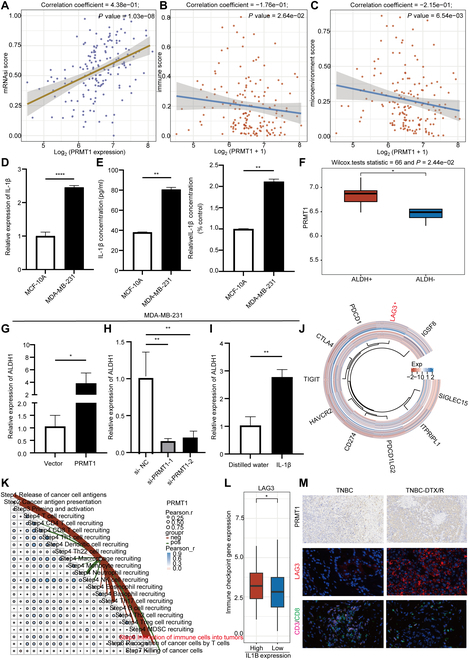
Triple-negative breast cancer (TNBC) is the most aggressive breast cancer subtype, characterized by a high propensity for metastasis, poor prognosis, and limited treatment options. Research has demonstrated a substantial correlation between the expression of protein arginine N-methyltransferase 1 (PRMT1) and enhanced proliferation, metastasis, and poor outcomes in TNBC. However, the specific role of PRMT1 in lung metastasis and chemoresistance remains unclear. Single-cell RNA sequencing coupled with bioinformatics analysis was employed to identify pertinent genes within metastatic TNBC samples. Functional assays, including cell cycle, apoptosis, wound healing, Transwell migration, colony formation, and Cell Counting Kit-8 Assay (CCK-8), were conducted to evaluate the role of PRMT1. The interaction between PRMT1 and PARP1 was validated by mass spectrometry (MS) and immunoprecipitation. Downstream signaling pathways were explored, with a focus on P65 activation. Enzyme-linked immunosorbent assay was used to quantify the effect of PRMT1 on interleukin-1β secretion. Our study identified a significant association between elevated PRMT1 expression and both lung metastasis and chemoresistance in TNBC. PRMT1 boosts TNBC cell growth, invasion, and lung metastasis. Additionally, high PRMT1 expression contributed to increased resistance to docetaxel in TNBC. Mechanistically, PRMT1 methylates PARP1. On the one hand, this methylation promotes the DNA damage repair ability of PAPA1. On the other hand, it in turn modulates the NF-κB signaling pathway. This modulation enhances the stemness of tumor cells and induces immune suppression within the tumor microenvironment, thereby exacerbating chemoresistance in TNBC. PRMT1 drives lung metastasis and chemoresistance in TNBC through PARP1 methylation and P65 activation. These findings position PRMT1 as a promising biomarker and therapeutic target to overcome resistance and limit metastatic progression in TNBC.
三阴性乳腺癌(TNBC)是最具侵袭性的乳腺癌亚型,其特点是转移倾向高、预后差且治疗选择有限。研究表明,蛋白质精氨酸N-甲基转移酶1(PRMT1)的表达与TNBC的增殖增强、转移及不良预后之间存在显著相关性。然而,PRMT1在肺转移和化疗耐药中的具体作用仍不清楚。采用单细胞RNA测序结合生物信息学分析来鉴定转移性TNBC样本中的相关基因。进行了包括细胞周期、凋亡、伤口愈合、Transwell迁移、集落形成和细胞计数试剂盒-8检测(CCK-8)在内的功能试验,以评估PRMT1的作用。通过质谱(MS)和免疫沉淀验证了PRMT1与PARP1之间的相互作用。探索了下游信号通路,重点是P65激活。采用酶联免疫吸附测定法来量化PRMT1对白介素-1β分泌的影响。我们的研究发现PRMT1表达升高与TNBC的肺转移和化疗耐药均显著相关。PRMT1促进TNBC细胞生长、侵袭和肺转移。此外,PRMT1高表达导致TNBC对多西他赛的耐药性增加。机制上,PRMT1使PARP1甲基化。一方面,这种甲基化促进了PAPA1的DNA损伤修复能力。另一方面,它反过来调节NF-κB信号通路。这种调节增强了肿瘤细胞的干性并诱导肿瘤微环境内的免疫抑制,从而加剧TNBC的化疗耐药性。PRMT1通过PARP1甲基化和P65激活驱动TNBC的肺转移和化疗耐药。这些发现使PRMT1成为克服TNBC耐药性和限制转移进展的有前景的生物标志物和治疗靶点。