Zhu Eric, Prentice Holly, Oh Jason, Shaheen Hussam, Gandhi Namita A, Wickman Grant, Dabora Rebecca, Dambkowski Carl L, Dillinger Lukas
Paragon Therapeutics, Inc, Waltham, Mass.
Apogee Therapeutics, Inc, Waltham, Mass.
J Allergy Clin Immunol Glob. 2025 Jul 30;4(4):100545. doi: 10.1016/j.jacig.2025.100545. eCollection 2025 Nov.
IL-13 plays a key role in the induction and perpetuation of type 2 immune responses associated with the development of atopic dermatitis and other chronic inflammatory diseases. mAbs targeting IL-13 have demonstrated efficacy in IL-13-driven diseases; however, current therapeutics require dosing every 2 to 4 weeks, resulting in significant injection burden for patients. APG777 is a humanized, IgG1 IL-13-targeting mAb that has been engineered to have an optimized pharmacokinetic profile, allowing for less frequent dosing.
We sought to investigate the potency and pharmacokinetics of APG777.
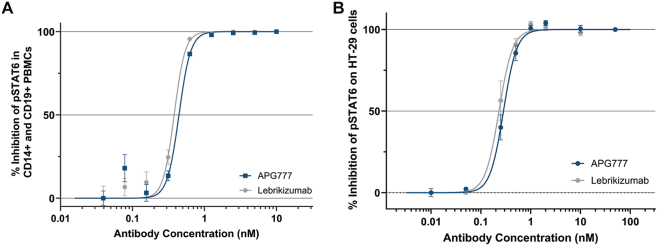
The affinity of APG777 was characterized using surface plasmon resonance; the half-maximal inhibitory concentration (IC) of APG777 was determined in various assays measuring inhibition of IL-13 signaling via signal transducer and activator of transcription 6 phosphorylation and chemokine release in relevant cell lines. Pharmacokinetics of APG777 were evaluated in nonhuman primates following a single intravenous or subcutaneous infusion. All studies included lebrikizumab produced based on the publicly available sequence as key comparator.
APG777 demonstrated a similar potency across numerous assays compared with lebrikizumab and a 2-fold longer serum half-life following subcutaneous injection in nonhuman primates.
These data provide evidence in support of the clinical potential of APG777 in diseases where IL-13 signaling is a main driver of the inflammatory response. The prolonged half-life of APG777 may enable less frequent dosing compared with current treatments, which could reduce injection burden and increase compliance. APG777 is currently being investigated in a phase 2 randomized, controlled trial in patients with atopic dermatitis.
白细胞介素13(IL-13)在与特应性皮炎及其他慢性炎症性疾病发生相关的2型免疫反应的诱导和持续过程中发挥关键作用。靶向IL-13的单克隆抗体(mAb)已在IL-13驱动的疾病中显示出疗效;然而,目前的治疗方法需要每2至4周给药一次,给患者带来了沉重的注射负担。APG777是一种人源化的IgG1型靶向IL-13的单克隆抗体,其设计具有优化的药代动力学特征,可减少给药频率。
我们旨在研究APG777的效力和药代动力学。
使用表面等离子体共振对APG777的亲和力进行表征;在各种测定中,通过信号转导和转录激活因子6磷酸化以及相关细胞系中趋化因子释放来测量IL-13信号传导抑制,从而确定APG777的半数最大抑制浓度(IC)。在单次静脉内或皮下输注后,在非人类灵长类动物中评估APG777的药代动力学。所有研究均包括基于公开可用序列生产的lebrikizumab作为关键对照。
与lebrikizumab相比,APG777在众多测定中显示出相似的效力,并且在非人类灵长类动物皮下注射后血清半衰期延长了2倍。
这些数据为APG777在IL-13信号传导是炎症反应主要驱动因素的疾病中的临床潜力提供了证据支持。与目前的治疗方法相比,APG777延长的半衰期可能使给药频率降低,这可以减轻注射负担并提高依从性。APG777目前正在一项针对特应性皮炎患者的2期随机对照试验中进行研究。