
利用脑电图检测自动驾驶车辆的不当行为。
Detecting unacceptable behavior of an autonomous vehicle using electroencephalography.
作者信息
Bertheau Maren A K, Herrmann Christoph S
机构信息
Department of Psychology, Experimental Psychology Lab, Carl-von-Ossietzky University, Ammerländer Heerstr. 114-118, 26111, Oldenburg, Germany.
Department of Informatics, Karlsruhe Institute of Technology (KIT), Am Fasanengarten 5, 76131, Karlsruhe, Germany.
出版信息
Sci Rep. 2025 Sep 12;15(1):32462. doi: 10.1038/s41598-025-18305-2.
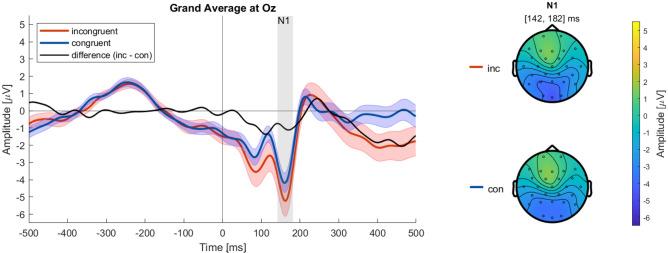
In the present study, we investigated event related potentials (ERPs) in the context of autonomous driving - specifically in left-turn situations through oncoming traffic. We recorded electroencephalography while participants (n = 33) observed a simulated autonomous vehicle executing a left turn maneuver through oncoming traffic. In the ERP, we observed an increased N2 (251 to 431 ms) when the AV behaved incongruently to the participant's assessment of the turn situation compared to when it behaved congruently. There were no significant effects in N1 (142 to 182 ms), P2 (177 to 237 ms), nor P3 (439 to 689 ms). This suggests that, in human-AV interaction interaction, ERP-based devices might, in the future, be able to identify critical situations. However, further research is needed to bring current findings from fundamental research closer to application.
在本研究中,我们在自动驾驶的背景下研究了事件相关电位(ERP)——具体是在车辆左转穿过迎面而来的车流的情况下。我们记录了脑电图,当时参与者(n = 33)观察一辆模拟的自动驾驶车辆在迎面而来的车流中执行左转动作。在ERP中,我们观察到,与自动驾驶车辆行为与参与者对转弯情况的评估一致时相比,当自动驾驶车辆行为与参与者的评估不一致时,N2(251至431毫秒)增加。在N1(142至182毫秒)、P2(177至237毫秒)和P3(439至689毫秒)方面没有显著影响。这表明,在人与自动驾驶车辆的交互中,基于ERP的设备未来可能能够识别关键情况。然而,需要进一步的研究,以便将基础研究的当前结果更贴近实际应用。



 Zotero 插件