Schmauder Stefanie, Sandström Anna, Boman Magnus, Martin Christian, Stephansson Olof
Clinical Epidemiology Division, Department of Medicine Solna, Karolinska Institutet, Stockholm, Sweden.
Department of Obstetrics, Karolinska University Hospital, Stockholm, Sweden.
Sci Rep. 2025 Sep 12;15(1):32487. doi: 10.1038/s41598-025-19198-x.
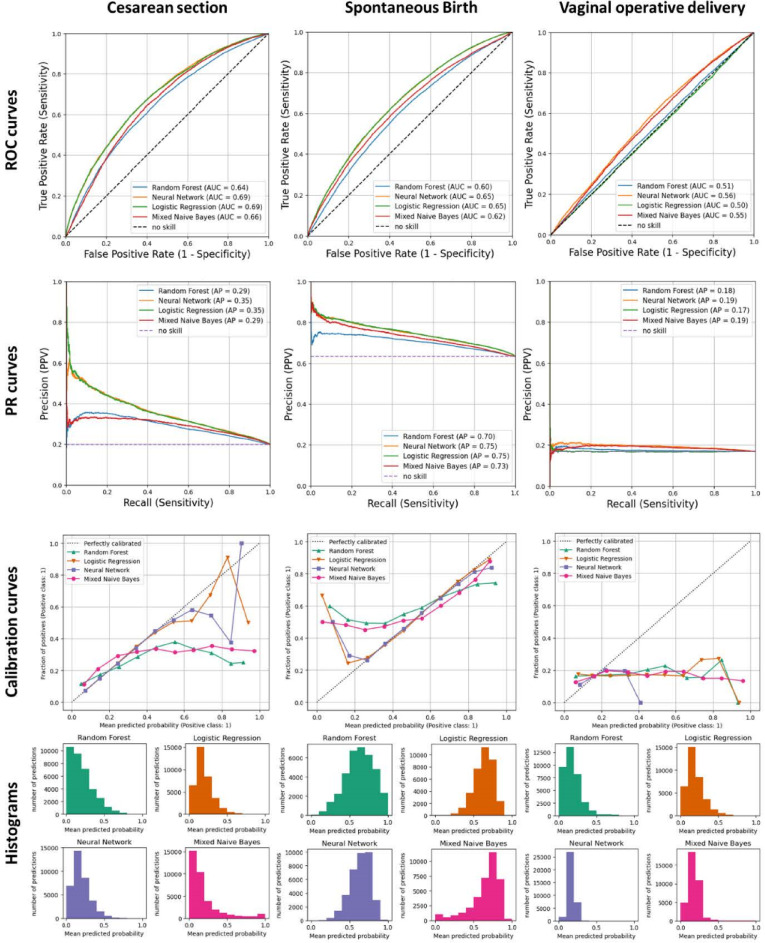
Induction of labour and not "expectant management" is often recommended to prevent adverse perinatal outcomes in late-term pregnancies, but no prognostic prediction model exists for an individualized decision-making. The present study used a data-driven approach to predict mode of delivery at or beyond 41 gestational weeks considering the obstetric management. Low-risk nulliparous women were derived from the nationwide Swedish Medical Birth Register (1998-2019). A two-day-wise prediction in four study groups with increasing gestational age (e.g. group 1: induced at 41-41, expectant management beyond 41 gestational weeks) was conducted. Forty-three features available at the time for decision-making on labour induction in each subgroup were used in the models, including the decision on labour induction itself. The subgroups contained 178,932, 129,449, 90,448 and 61,301 pregnancies, respectively, with imbalanced outcome rates (cesarean delivery < 27%, spontaneous birth > 55%, vaginal operative delivery < 18%). Five different classifiers were compared (random forest, mixed naïve bayes, support vector machine, neural network, logistic regression) with the highest value of the area under the curve being 69% in a hold-out sample. Although the considered features lacked predictive power, the study provides valuable methodological information for predicting the timing of labour induction beyond 41 gestational weeks.
为预防晚期妊娠的不良围产期结局,通常建议引产而非“期待管理”,但目前尚无用于个体化决策的预后预测模型。本研究采用数据驱动方法,考虑产科管理因素,预测妊娠41周及以后的分娩方式。低风险初产妇数据来自瑞典全国医疗出生登记处(1998 - 2019年)。对四个妊娠周数递增的研究组进行了为期两天的预测(例如,第1组:在41 - 41周引产,妊娠41周后进行期待管理)。模型使用了每个亚组在决定引产时可获取的43个特征,包括引产决策本身。各亚组分别包含178,932、129,449、90,448和61,301例妊娠,结局发生率不均衡(剖宫产<27%,顺产>55%,阴道助产<18%)。比较了五种不同的分类器(随机森林、混合朴素贝叶斯、支持向量机、神经网络、逻辑回归),在一个保留样本中曲线下面积的最高值为69%。尽管所考虑的特征缺乏预测能力,但该研究为预测妊娠41周后的引产时机提供了有价值的方法学信息。