Li Ruiqi, Lin Mu-Han, Nguyen Nghi C, Su Fan-Chi, Parsons David, Salcedo Erica, Phillips Elizeva, Domal Sean, Garant Aurelie, Hannan Raquibul, Yang Daniel, Afaq Asim, Lee MinJae, Oz Orhan K, Desai Neil
Department of Radiation Oncology, The University of Texas Southwestern Medical Center, Dallas, TX 75235, USA.
Department of Nuclear Medicine, The University of Texas MD Anderson Cancer Center, Houston, TX 77030, USA.
Cancers (Basel). 2025 Sep 3;17(17):2893. doi: 10.3390/cancers17172893.
To evaluate the feasibility and clinical utility of integrating sequential PSMA-PET imaging into an offline-online adaptive workflow for response-based dominant intraprostatic lesion (DIL)-boosting high-risk prostate cancer treated with stereotactic ablative radiotherapy (SABR).
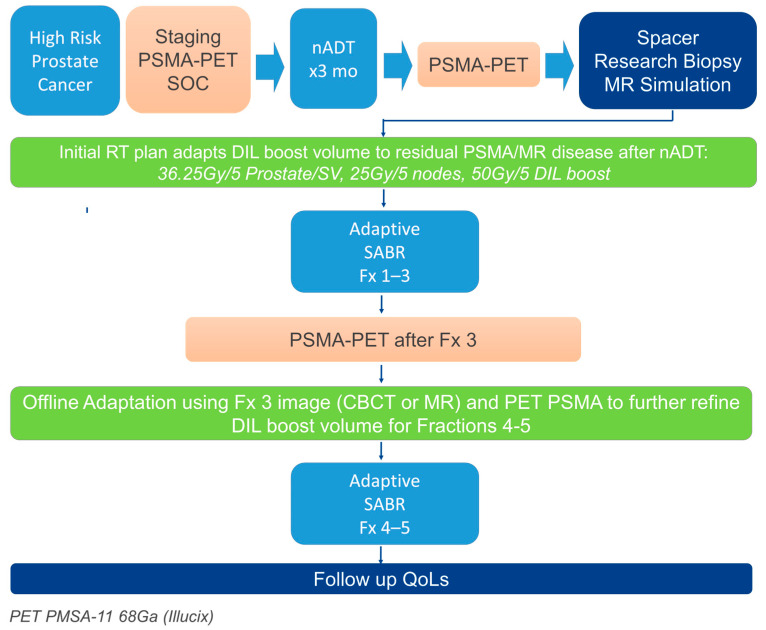
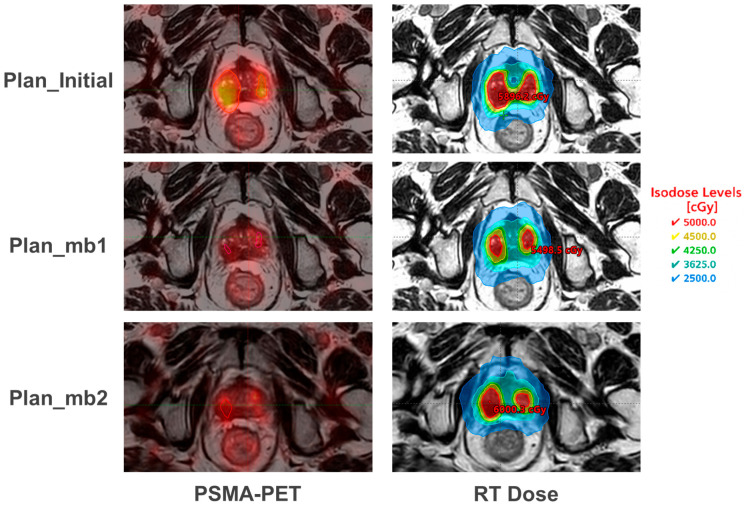
As part of a prospective trial, patients were treated on MR- or CBCT-guided adaptive radiotherapy (ART) systems with prostate/pelvic node 5-fraction SABR (36.25 Gy/25 Gy) with DIL boost (50 Gy). Whereas traditional DIL boost volumes delineate full pre-therapy imaging-defined disease (GTVinitial), this study serially refined DIL boost volumes based on treatment response defined by PSMA-PET scans after neoadjuvant androgen deprivation therapy (nADT, GTVmb1) and fraction 3 SABR (GTVmb2). DIL delineation employed PET-PSMA fusion to CT/MR simulation and was guided by a rule-based %SUVmax threshold approach. Comparisons of GTV volumes and OAR dosimetry were performed between plans using GTVinitial versus GTVmb1/GTVmb2 for DIL boost, for each of the initial cohorts of five patients from the initially treated cohorts.
Five patients treated on MR-Linac ( = 3) or CBCT-based ART ( = 2) were analyzed. Three patients exhibited complete imaging response after nADT, omitting GTVmb boosts. Offline GTVmb refinements based on PSMA-PET were seamlessly integrated into ART workflows without introducing additional treatment time. DIL GTV volumes significantly decreased ( = 0.03) from an initial mean of 11.4 cc (GTVinitial) to 4.1 cc (GTVmb1) and 3.0 cc (GTVmb2). Dosimetric analysis showed meaningful reductions in OAR doses: rectal wall D0.035 cc decreased by up to 12 Gy, while bladder wall D0.035 cc and V18.3 Gy reduced from 52.3 Gy and 52.3 cc (Plan_initial) to 42.9 Gy and 24.9 cc (Plan_mb2), respectively. Urethra doses remained stable, with minor reductions. Sigmoid and femoral head doses remained within acceptable limits. Online adaptation efficiently addressed daily anatomical variations, enabling simulation-free plan re-optimization.
PSMA-PET-guided adaptive microboosting for HRPCa SABR is feasible and effective. Standard MR-Linac and CBCT systems offer practical alternatives to BgRT platforms, enabling biology-driven dose personalization and potentially reducing toxicity.
评估将序贯PSMA-PET成像整合到离线-在线自适应工作流程中的可行性和临床实用性,该工作流程用于基于反应的主导前列腺内病变(DIL)增强,以治疗接受立体定向消融放疗(SABR)的高危前列腺癌。
作为一项前瞻性试验的一部分,患者在MR或CBCT引导的自适应放疗(ART)系统上接受前列腺/盆腔淋巴结5分次SABR(36.25 Gy/25 Gy)并进行DIL增强(50 Gy)。传统的DIL增强体积描绘了完整的治疗前成像定义的疾病(GTV初始),而本研究根据新辅助雄激素剥夺治疗(nADT,GTVmb1)和第3分次SABR(GTVmb2)后PSMA-PET扫描定义的治疗反应,对DIL增强体积进行了连续细化。DIL描绘采用PET-PSMA与CT/MR模拟融合,并以基于规则的%SUVmax阈值方法为指导。对于最初治疗队列中的每组五名患者的初始队列,比较了使用GTV初始与GTVmb1/GTVmb2进行DIL增强的计划之间的GTV体积和OAR剂量测定。
分析了在MR直线加速器(n = 3)或基于CBCT的ART(n = 2)上治疗的五名患者。三名患者在nADT后表现出完全成像反应,无需进行GTVmb增强。基于PSMA-PET的离线GTVmb细化无缝整合到ART工作流程中,而无需引入额外的治疗时间。DIL GTV体积从初始平均值11.4 cc(GTV初始)显著降低(P = 0.03)至4.1 cc(GTVmb1)和3.0 cc(GTVmb2)。剂量分析显示OAR剂量有显著降低:直肠壁D0.035 cc最多降低12 Gy,而膀胱壁D0.035 cc和V18.3 Gy分别从52.3 Gy和52.3 cc(计划初始)降至42.9 Gy和24.9 cc(计划mb2)。尿道剂量保持稳定,略有降低。乙状结肠和股骨头剂量保持在可接受范围内。在线自适应有效地解决了每日解剖学变化,实现了无需模拟的计划重新优化。
PSMA-PET引导的HRPCa SABR自适应微增强是可行且有效的。标准的MR直线加速器和CBCT系统为BgRT平台提供了实用的替代方案,能够实现生物学驱动的剂量个体化,并可能降低毒性。