Martinez Daniela M, Miller Sabbie A, Monteiro Paulo J M
Department of Civil and Environmental Engineering, Universidad del Norte, Barranquilla 081007, Colombia.
Department of Civil and Environmental Engineering, University of California, Davis, Davis, CA 95616, USA.
iScience. 2025 Jul 30;28(8):113052. doi: 10.1016/j.isci.2025.113052. eCollection 2025 Aug 15.
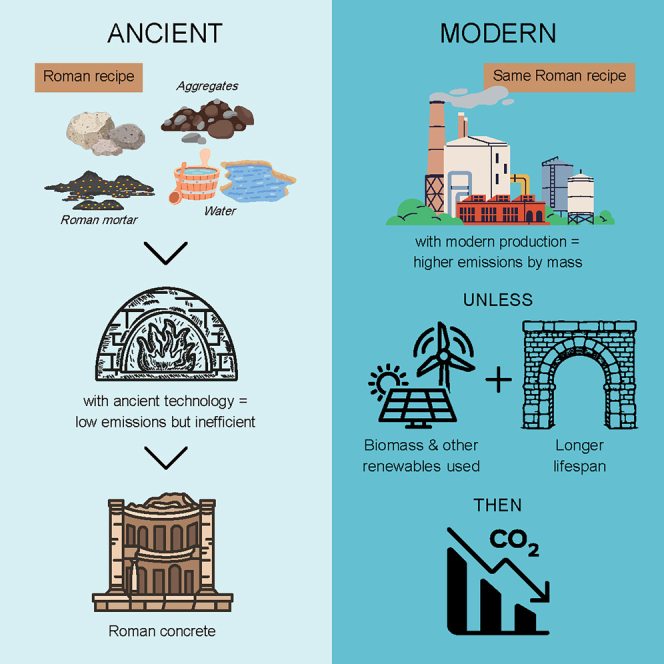
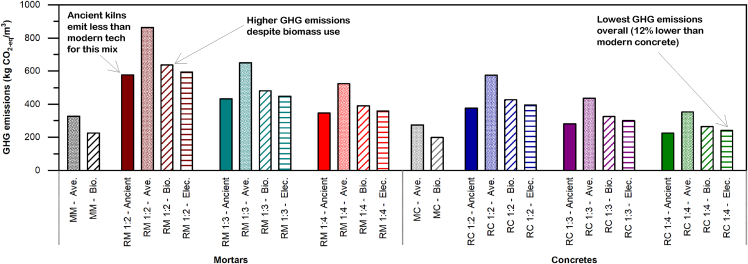
The remarkable longevity of Roman concrete has long fascinated researchers and hinted at its potential as a sustainable alternative to modern concrete formulations. However, rigorous assessment of its environmental impact-particularly in the context of modern production technologies-has been lacking. Here, we follow the life cycle assessment methodology to systematically quantify the impacts of various Roman concrete formulations relative to modern technologies. Our findings reveal nuanced insights into the sustainability prospects of Roman concrete, shedding light on its greenhouse gas emissions, energy demand, particulate matter emissions, and water utilization. Contrary to initial expectations, adopting Roman formulations with current technology may not yield substantial reductions in emissions or energy demand unless used in conjunction with other decarbonization advancements. Nonetheless, our findings underscore the importance of Roman practices, particularly the reliance on biomass as a fuel source, which presents opportunities for decarbonizing modern cement production.
罗马混凝土非凡的耐久性长期以来一直吸引着研究人员,并暗示了其作为现代混凝土配方可持续替代品的潜力。然而,一直缺乏对其环境影响的严格评估——尤其是在现代生产技术背景下。在此,我们遵循生命周期评估方法,系统地量化各种罗马混凝土配方相对于现代技术的影响。我们的研究结果揭示了对罗马混凝土可持续性前景的细微见解,阐明了其温室气体排放、能源需求、颗粒物排放和水资源利用情况。与最初的预期相反,采用当前技术的罗马配方可能不会大幅减少排放或能源需求,除非与其他脱碳进展结合使用。尽管如此,我们的研究结果强调了罗马做法的重要性,特别是对生物质作为燃料来源的依赖,这为现代水泥生产脱碳提供了机会。