Elhariri Ahmed, Patel Jaydeepbhai, Mahadevia Himil, Modi Karnav, Albelal Douaa, Majeed Umair, Jones Jeremy C, Borad Mitesh J, Tran Nguyen H, Rutenberg Michael S, Babiker Hani
Division of Hematology-Oncology, Department of Medicine, Mayo Clinic Florida, Jacksonville, FL, USA.
University of Missouri Kansas City, Kansas City, MO, USA.
J Gastrointest Oncol. 2025 Aug 30;16(4):1658-1666. doi: 10.21037/jgo-2025-100. Epub 2025 Aug 26.
The 5-year overall survival (OS) for stage IV pancreatic cancer is dismal despite aggressive systemic therapy. Stereotactic body radiation therapy (SBRT) involves delivering precise, highly conformal, and biologically effective doses of radiation via a linear accelerator to the tumor region. Clinical trials have shown improvement in OS and progression-free survival (PFS) with SBRT plus standard chemotherapy in oligometastatic (<5 metastatic lesions) solid tumors such as breast, lung, colorectal, and prostate cancers, when compared to chemotherapy alone. Factors predicting response to SBRT need to be further explored in oligometastatic pancreatic cancer (oPC). The study aims to assess the role of SBRT in the management of patients with oPC.
We conducted a retrospective cohort study of oPC patients treated at the Mayo Clinic during the period from January 2012 to January 2022, who underwent SBRT to at least one site, including the primary site and/or sites of metastases, received at least 4 months of chemotherapy, and had a minimum of 1-year follow-up. Pertinent data were collected from the electronic health records after institutional review board (IRB) approval. The response rates (RRs) were assessed using the RECIST v1.1 criteria, and the PFS and OS were calculated using the Kaplan-Meier method. Multivariate Cox regression was used to determine a statistically significant correlation between treatment and genomic characteristics with OS and PFS.
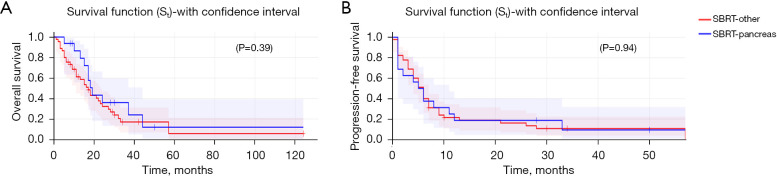
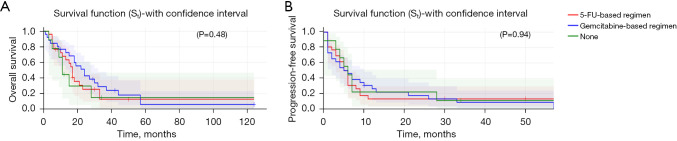
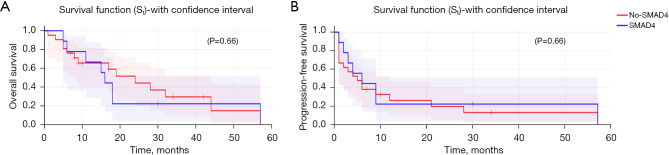
Sixty-one patients with oPC were identified, among whom 38% were female. Eighty-seven percent were Caucasian, and 13% were other ethnicities (African American, Hispanic, and Asian). The median age was 66 years. Patients received gemcitabine (gem) or 5-fluorouracil (5-FU) based chemotherapy. Eight-five percent of patients received chemotherapy within 3 months of SBRT and the median follow-up time of 16 months. The RR was 25% in the primary lesion and 17% in metastatic lesions. SBRT to primary pancreas lesion correlated with higher OS [hazard ratio (HR): 0.27, 95% confidence interval (CI): 0.082-0.89, P=0.03] but showed no difference in PFS (HR: 0.97, P=0.95) when compared to SBRT to any other metastatic site. SBRT to liver metastases had no improvement in OS (P=0.92) or PFS (P=0.70) versus SBRT to other metastatic sites. The type of chemotherapy (gem . 5-FU based) alongside SBRT within 3 months did not influence OS (P=0.47) or PFS (P=0.62) in these patients. Among 30 patients who underwent circulating tumor deoxyribonucleic acid (ctDNA) testing, gene alteration correlated with significantly higher PFS (HR: 0.23, 95% CI: 0.065-0.87, P=0.03) but had no relation with OS (HR: 0.60, 95% CI: 0.18-2.03, P=0.41) compared to patients with undetectable alteration.
SBRT plus chemotherapy may have benefits in some patients with oPC. SBRT to primary pancreas lesion led to better OS compared with SBRT to other metastatic sites. alteration in ctDNA testing correlated with higher PFS in oPC patients who received SBRT. This implies a potential role for genomic biomarker-based patient selection in oPC. These findings are currently being studied in a randomized clinical trial evaluating SBRT plus chemotherapy in oPC (NCT04975516).
尽管进行了积极的全身治疗,IV期胰腺癌的5年总生存率(OS)仍不容乐观。立体定向体部放射治疗(SBRT)是通过直线加速器向肿瘤区域输送精确、高度适形且具有生物学效应的辐射剂量。临床试验表明,与单纯化疗相比,SBRT联合标准化疗可改善寡转移(<5个转移病灶)实体瘤(如乳腺癌、肺癌、结直肠癌和前列腺癌)的OS和无进展生存期(PFS)。寡转移胰腺癌(oPC)中预测对SBRT反应的因素有待进一步探索。本研究旨在评估SBRT在oPC患者管理中的作用。
我们对2012年1月至2022年1月在梅奥诊所接受治疗的oPC患者进行了一项回顾性队列研究,这些患者至少在一个部位(包括原发部位和/或转移部位)接受了SBRT,接受了至少4个月的化疗,且随访时间至少为1年。在机构审查委员会(IRB)批准后,从电子健康记录中收集相关数据。使用RECIST v1.1标准评估缓解率(RRs),并使用Kaplan-Meier方法计算PFS和OS。多变量Cox回归用于确定治疗和基因组特征与OS和PFS之间的统计学显著相关性。
共确定61例oPC患者,其中38%为女性。87%为白种人,13%为其他种族(非裔美国人、西班牙裔和亚裔)。中位年龄为66岁。患者接受了基于吉西他滨(gem)或5-氟尿嘧啶(5-FU)的化疗。85%的患者在SBRT后3个月内接受了化疗,中位随访时间为16个月。原发灶的RR为25%,转移灶的RR为17%。与对任何其他转移部位进行SBRT相比,对胰腺原发灶进行SBRT与更高的OS相关[风险比(HR):0.27,95%置信区间(CI):0.082-0.89,P=0.03],但在PFS方面无差异(HR:0.97,P=0.95)。与对其他转移部位进行SBRT相比,对肝转移进行SBRT在OS(P=0.92)或PFS(P=0.70)方面无改善。在3个月内联合SBRT的化疗类型(基于gem或5-FU)对这些患者的OS(P=0.47)或PFS(P=0.62)没有影响。在30例接受循环肿瘤脱氧核糖核酸(ctDNA)检测的患者中,与未检测到基因改变的患者相比,基因改变与显著更高的PFS相关(HR:0.23,95%CI:0.065-0.87,P=0.03)但与OS无关(HR:0.60,95%CI:0.18-2.03,P=0.41)。
SBRT联合化疗可能对某些oPC患者有益。与对其他转移部位进行SBRT相比,对胰腺原发灶进行SBRT可带来更好的OS。在接受SBRT的oPC患者中,ctDNA检测中的基因改变与更高的PFS相关。这意味着基于基因组生物标志物的患者选择在oPC中可能具有潜在作用。目前正在一项评估oPC中SBRT联合化疗的随机临床试验(NCT04975516)中对这些发现进行研究。