Chen Ce, Wang Guo-Qing, Li Dai-di, Zhang Feng
Key Laboratory of Basic Pharmacology of Ministry of Education and Joint. International Research Laboratory of Ethnomedicine of Ministry of Education and Key Laboratory of Basic Pharmacology of Guizhou Province and Laboratory Animal Centre, Zunyi Medical University, Zunyi, Guizhou, China.
State Key Laboratory of Natural Medicines, School of Traditional Chinese Medicines, China Pharmaceutical University, Nanjing, Jiangsu, China.
Mol Biomed. 2025 Sep 15;6(1):64. doi: 10.1186/s43556-025-00307-1.
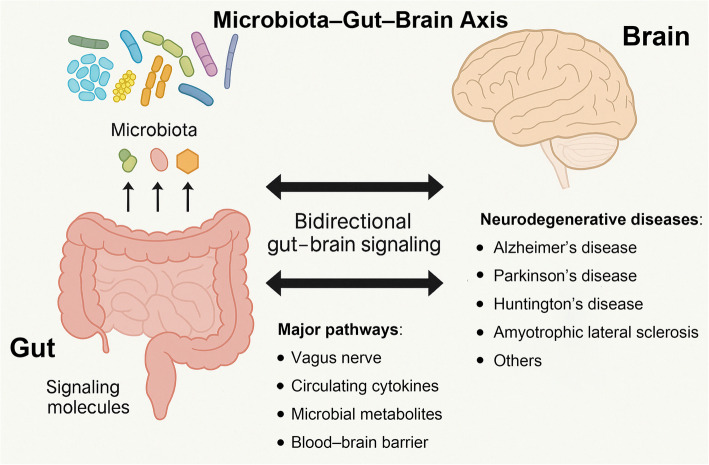
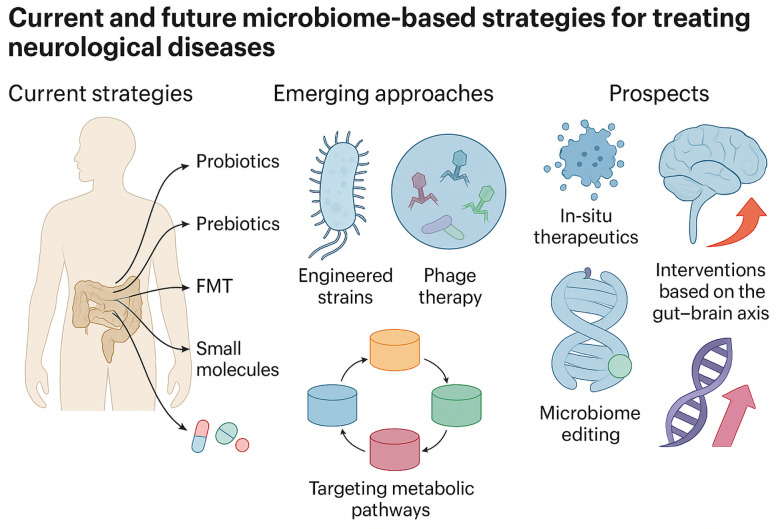
The microbiota-gut-brain axis (MGBA) is an intricate bidirectional communication network that links intestinal microbiota with the central nervous system (CNS) through immune, neural, endocrine, and metabolic pathways. Emerging evidence suggests that dysregulation of the MGBA plays pivotal roles in the onset and progression of neurodegenerative diseases. This review outlines the key molecular mechanisms by which gut microbes modulate neuroinflammation, blood-brain barrier integrity, protein misfolding, and neuronal homeostasis. We discuss how microbial metabolites, such as short-chain fatty acids, tryptophan derivatives, and bile acids, interact with host to influence CNS functions. Disease-specific features are described across Alzheimer's disease, Parkinson's disease, Multiple sclerosis, and Amyotrophic lateral sclerosis, emphasizing the distinct and overlapping pathways through which gut dysbiosis may contribute to pathogenesis. We further explore the translational potential of microbiota-targeted therapies, including probiotics, fecal microbiota transplantation, dietary interventions, and small-molecule modulators. While preclinical results are promising, clinical trials reveal considerable variability, highlighting the need for personalized approaches and robust biomarkers. Challenges remain in deciphering causal relationships, accounting for inter-individual variability, and ensuring reproducibility in therapeutic outcomes. Future research should integrate multi-omics strategies, longitudinal human cohorts, and mechanistic models to clarify the role of the MGBA in neurodegeneration. Collectively, understanding the MGBA provides a transformative perspective on neurodegenerative disease mechanisms and offers innovative therapeutic avenues that bridge neurology, microbiology, and precision medicine.
微生物群-肠道-脑轴(MGBA)是一个复杂的双向通讯网络,它通过免疫、神经、内分泌和代谢途径将肠道微生物群与中枢神经系统(CNS)联系起来。新出现的证据表明,MGBA的失调在神经退行性疾病的发生和发展中起关键作用。这篇综述概述了肠道微生物调节神经炎症、血脑屏障完整性、蛋白质错误折叠和神经元稳态的关键分子机制。我们讨论了微生物代谢产物,如短链脂肪酸、色氨酸衍生物和胆汁酸,如何与宿主相互作用以影响中枢神经系统功能。文中描述了阿尔茨海默病、帕金森病、多发性硬化症和肌萎缩侧索硬化症等疾病的特定特征,强调了肠道微生物群失调可能导致发病机制的不同和重叠途径。我们进一步探讨了针对微生物群的治疗方法的转化潜力,包括益生菌、粪便微生物群移植、饮食干预和小分子调节剂。虽然临床前结果很有前景,但临床试验显示出相当大的变异性,突出了个性化方法和强大生物标志物的必要性。在解读因果关系、考虑个体间变异性以及确保治疗结果的可重复性方面仍然存在挑战。未来的研究应整合多组学策略、纵向人类队列和机制模型,以阐明MGBA在神经退行性变中的作用。总体而言,了解MGBA为神经退行性疾病机制提供了一个变革性的视角,并提供了连接神经学、微生物学和精准医学的创新治疗途径。