Introini Viola, Long Rory, Oyerinde Olawunmi Rashidat, Sender Silvia Sanz, Stein Frank, Hwang Gyu Min, Gutierrez Borja Lopez, Seydel Karl Boynton, Birbeck Gretchen, Bernabeu Maria
bioRxiv. 2025 Sep 8:2025.09.07.674757. doi: 10.1101/2025.09.07.674757.
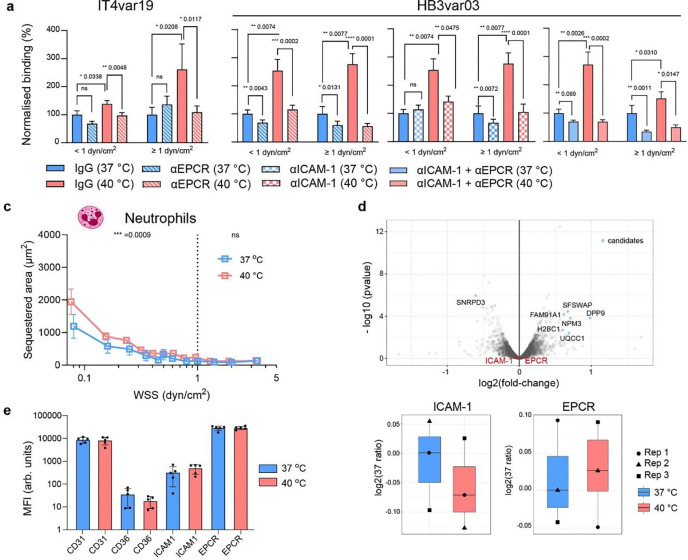
Fever, a universal host defense in infection and inflammation, paradoxically contributes to neurological complications in malaria. While febrile temperatures enhance the expression of parasite virulence proteins that mediate vascular adhesion and disease severity, its effects in the endothelium remain elusive. Here we present a 3D fever-on-a-chip model that recapitulates human brain and lung microvessels under febrile conditions. Short febrile episodes at 40 °C, common in treated cerebral malaria patients, rapidly enhanced iRBC and immune cell binding under flow. Mechanistically, we demonstrated that this phenotype was driven by endothelial glycocalyx shedding, which exposed endothelial receptors EPCR and ICAM-1. Preserving glycocalyx integrity with a broad MMP inhibitor prevented the temperature-induced rise in cytoadhesion. These findings identify fever as a host-specific amplifier of vascular pathology in malaria and highlight endothelial-protective or antipyretic interventions as important strategies to mitigate febrile microvascular pathology.
发热是感染和炎症中一种普遍的宿主防御机制,但矛盾的是,它会导致疟疾的神经并发症。虽然发热温度会增强介导血管黏附及疾病严重程度的寄生虫毒力蛋白的表达,但其在内皮细胞中的作用仍不清楚。在此,我们展示了一种芯片上发热的三维模型,该模型可在发热条件下模拟人类脑和肺微血管。40℃的短期发热发作在接受治疗的脑型疟疾患者中很常见,它会在血流状态下迅速增强感染红细胞(iRBC)与免疫细胞的黏附。从机制上来说,我们证明这种表型是由内皮糖萼脱落驱动的,糖萼脱落会暴露出内皮细胞受体EPCR和ICAM - 1。使用一种广谱基质金属蛋白酶抑制剂保持糖萼完整性可防止温度诱导的细胞黏附增加。这些发现确定发热是疟疾中血管病变的宿主特异性放大器,并强调内皮保护或退热干预作为减轻发热性微血管病变的重要策略。