
采用基于互补分级分离的N端蛋白质组学方法可增强对未处理和炎症结肠组织中天冬酰胺酶切割事件的识别。
Employing complementary fractionation-based N-terminomics approaches enhances the identification of legumain cleavage events in naïve and inflamed colon tissue.
作者信息
Ziegler Alexander R, Parker Benjamin L, Scott Nichollas E, Edgington-Mitchell Laura E
机构信息
Department of Biochemistry and Pharmacology, Bio21 Molecular Science and Biotechnology Institute, The University of Melbourne, Parkville, Victoria, Australia.
Department of Anatomy and Physiology, Medical Building 181, The University of Melbourne, Parkville, Victoria, Australia.
出版信息
Protein Sci. 2025 Oct;34(10):e70186. doi: 10.1002/pro.70186.
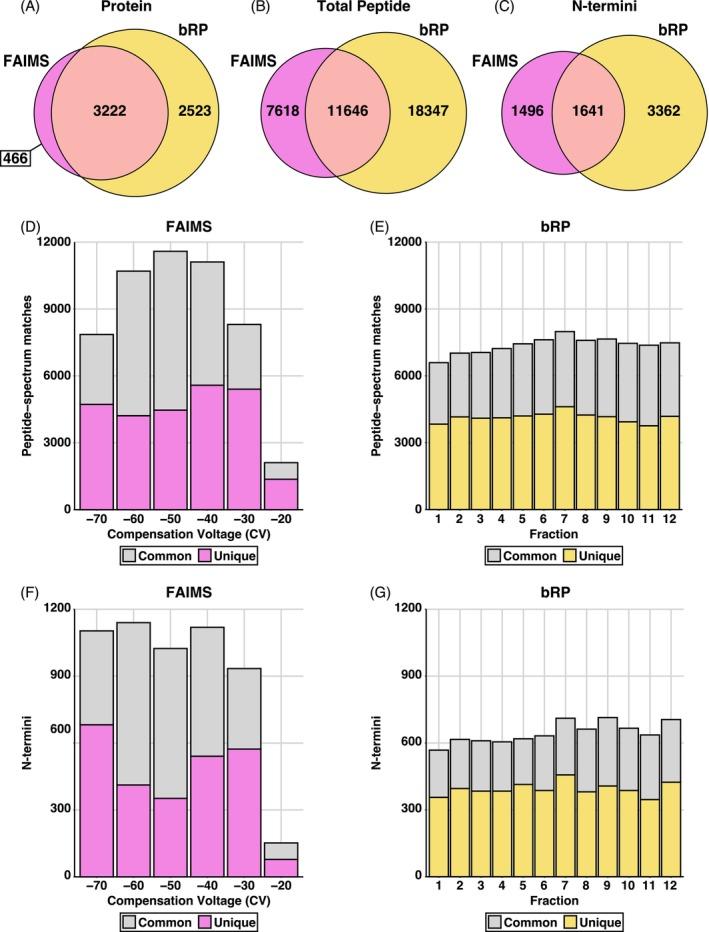
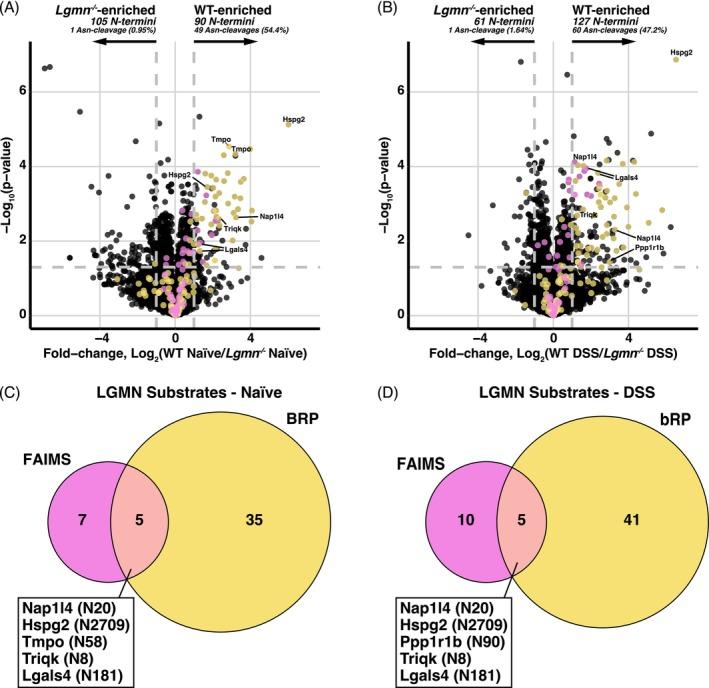
The mammalian lysosomal protease legumain is often dysregulated in pathophysiological conditions including inflammation, neurodegeneration, and cancer, yet its proteolytic targets are poorly defined. To profile protease substrates, degradomics techniques typically employ enrichment strategies to select for sub-stoichiometric and low-abundance peptides generated by proteolytic cleavage. However, recent advancements in degradomics techniques have revealed N-termini enrichment can be circumvented if peptide-based fractionation is employed, enabling simultaneous proteome and N-terminome analysis. Herein, we compare the previously published enrichment-free N-terminomics approach using high-field asymmetric waveform ion mobility spectrometry (FAIMS) to offline basic reverse-phase (bRP) fractionation to assess the complementarity of these fractionation methods for simultaneous proteomic and degradomic analyses. While at the protein level FAIMS and bRP provide access to overlapping proteomic coverage, at the N-terminus level each fractionation technique reveals unique cleavage information. Combining data from the two fractionation approaches revealed 6499 N-terminal peptides with N-terminal TMTpro labeling, allowing the identification of cleavage events modulated in the context of legumain deficiency in naïve murine colons and during dextran sulfate sodium (DSS)-induced colitis. Among these N-termini, we identify 35 putative legumain substrates in naïve and 41 in the DSS-treated colons, supporting a role for legumain in both pro-inflammatory and physiological conditions. Use of an additional negative selection method, High-efficiency Undecanal-based N-Termini EnRichment (HUNTER), further supplements this list of identified legumain substrates. Combined, this study identifies multiple putative substrates of legumain in healthy and inflamed murine colons as well as demonstrates the utility of using complementary fractionation approaches for degradomics studies.
哺乳动物溶酶体蛋白酶豆球蛋白在包括炎症、神经退行性变和癌症在内的病理生理条件下常出现失调,但其蛋白水解靶点却知之甚少。为了分析蛋白酶底物,降解组学技术通常采用富集策略来选择蛋白水解切割产生的亚化学计量和低丰度肽段。然而,降解组学技术的最新进展表明,如果采用基于肽段的分级分离方法,可以避免N端富集,从而实现蛋白质组和N端蛋白质组的同时分析。在此,我们将先前发表的使用高场不对称波形离子迁移谱(FAIMS)的无富集N端蛋白质组学方法与离线碱性反相(bRP)分级分离方法进行比较,以评估这些分级分离方法在蛋白质组学和降解组学同步分析中的互补性。虽然在蛋白质水平上,FAIMS和bRP提供了重叠的蛋白质组覆盖范围,但在N端水平上,每种分级分离技术都揭示了独特的切割信息。将两种分级分离方法的数据相结合,通过N端TMTpro标记揭示了6499个N端肽段,从而能够鉴定在未处理的小鼠结肠中豆球蛋白缺乏以及硫酸葡聚糖钠(DSS)诱导的结肠炎期间受到调节的切割事件。在这些N端中,我们在未处理的结肠中鉴定出35个推定的豆球蛋白底物,在DSS处理的结肠中鉴定出41个,这支持了豆球蛋白在促炎和生理条件下的作用。使用另一种阴性选择方法,即基于高效十一醛的N端富集(HUNTER),进一步补充了已鉴定的豆球蛋白底物列表。综合来看,本研究鉴定了健康和炎症小鼠结肠中豆球蛋白的多个推定底物,并证明了使用互补分级分离方法进行降解组学研究的实用性。


 Zotero 插件