Cardoso Roseni da Silva, de Souza Carliane de Oliveira, Silva Daniel Bernardes, de Lima Lucia Raquel, Menezes Jorge Marcell Coelho, de Lima Mira Raya Paula, Gomes Hiago de Oliveira, Santos Yannice Tatiane da Costa, de Paula Filho Francisco José, Coutinho Henrique Douglas Melo, Teixeira Raimundo Nonato Pereira
Department of Biological Chemistry, Regional University of Cariri, R. Cel. Antonio Luis 1161, Crato 63105000, CE, Brazil.
Science and Technology Center, Federal University of Cariri, Av Ten. Raimundo Rocha 1639, Juazeiro do Norte 63048-080, Ceará, Brazil.
ACS Omega. 2025 Sep 5;10(36):40872-40885. doi: 10.1021/acsomega.5c01460. eCollection 2025 Sep 16.
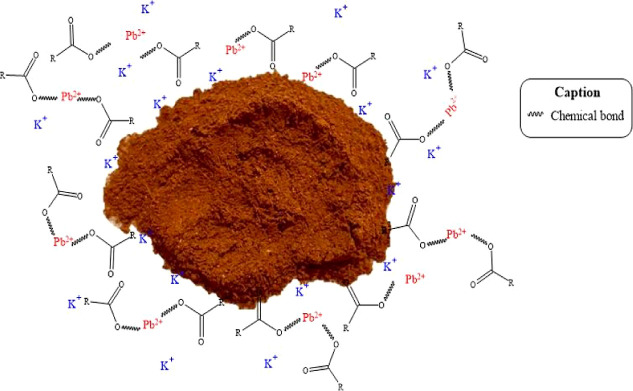
In recent years, the pollution and contamination of water with heavy metals have posed significant risks to human health and have compromised aquatic life. As a result, the use of biosorbent materials to remove these metals from effluents has emerged as an alternative method for their remediation. This study evaluated the adsorption potential of L. stem bark (in natura) for the removal of Pb from aqueous solutions. The process involved the collection, washing, drying, and grinding of the shell, resulting in a powder used for characterization techniques, kinetic assays (conducted at intervals from 1 to 120 min), isotherms using metal solutions ranging from 40 to 600 mg L, and adsorption thermodynamics at temperatures of 278.15, 298.15, and 318.15 K. Desorption assays showed that the adsorbent is reusable, maintaining its efficiency in the adsorption process without significant losses. In coexisting ion tests, it was observed that the evaluated ions did not compete for the same active sites, indicating selectivity in adsorption. The point of zero charge (PZC) of the material was determined to be 6.0, suggesting that its surface becomes positively charged at pH values below this point, favoring the adsorption of negatively charged species. In dosage tests, the amount of material used did not directly influence the adsorption process. The material was characterized using scanning electron microscopy (SEM), which revealed significant morphological differences among the bark samples, including variations in particle shape and size; these differences may affect adsorption capacity. After treatment with Pb ions, crystals were observed on the surface of the bark, suggesting the formation of complexes between the metal ions and biomass components, potentially increasing the material's affinity for the metal. Fourier-transform infrared spectroscopy (FT-IR) showed changes in absorbance bands, highlighting the presence of compounds such as aromatics, carbonyls, and esters. X-ray fluorescence (XRF) analysis revealed a significant difference in Pb ion retention between treated (13.12%) and untreated bark (0.0%). The fact that the raw shells contained no residual metals indicates a promising potential for metal ion removal processes without the need for additional chemical treatments. The adsorption kinetics followed a pseudo-second-order kinetic model, with an adjusted of 0.999. Equilibrium adsorption data were analyzed and best fitted the Sips adsorption model, with a of 138.20 mg g, and the best fit achieved at 278.15 K with an value of 0.998. This indicates that the adsorption process is based on chemical interactions, demonstrating high efficiency in capturing Pb and highlighting the strong affinity of the material for the metal ion, as well as its potential for environmental decontamination. Thermodynamic analysis showed that the reaction was spontaneous at all studied temperatures, with Δ° values of -3.21, -9.01, and -14.8 kJ mol. The process was endothermic, with Δ° = 77.4 kJ mol, and showed increased system disorder, as indicated by Δ° = 0.29 kJ mol K. In view of these findings, this study contributes to the development of sustainable alternatives for environmental decontamination and highlights as a promising natural resource for the treatment of wastewater and industrial effluents, its bark, although little explored, presents high efficiency, low cost, selectivity and reuse, characteristics that position this biosorbent as a viable alternative, compared to conventional technologies such as activated carbon, membranes and nanomaterials.
近年来,重金属对水的污染给人类健康带来了重大风险,并危及水生生物。因此,使用生物吸附材料从废水中去除这些金属已成为一种替代修复方法。本研究评估了L.茎皮(天然状态)从水溶液中去除铅的吸附潜力。该过程包括收集、洗涤、干燥和研磨树皮,得到用于表征技术、动力学分析(每隔1至120分钟进行一次)、使用浓度范围为40至600 mg/L的金属溶液进行等温线测定以及在278.15、298.15和318.15 K温度下进行吸附热力学研究的粉末。解吸试验表明,该吸附剂可重复使用,在吸附过程中保持其效率而无显著损失。在共存离子试验中,观察到所评估的离子不会竞争相同的活性位点,表明吸附具有选择性。该材料的零电荷点(PZC)测定为6.0,这表明在低于该pH值时其表面带正电荷,有利于带负电荷物质的吸附。在剂量试验中,所用材料的量并未直接影响吸附过程。使用扫描电子显微镜(SEM)对该材料进行了表征,结果显示树皮样品之间存在显著的形态差异,包括颗粒形状和大小的变化;这些差异可能会影响吸附能力。用铅离子处理后,在树皮表面观察到晶体,这表明金属离子与生物质成分之间形成了络合物,可能增加了材料对金属的亲和力。傅里叶变换红外光谱(FT-IR)显示吸光度带发生了变化,突出了芳烃、羰基和酯等化合物的存在。X射线荧光(XRF)分析显示,处理过的树皮(13.12%)和未处理的树皮(0.0%)在铅离子保留方面存在显著差异。原生树皮不含残留金属这一事实表明,在无需额外化学处理的情况下,该材料在金属离子去除过程中具有很大潜力。吸附动力学遵循准二级动力学模型,拟合度为0.999。对平衡吸附数据进行分析并最符合Sips吸附模型,吸附量为138.20 mg/g,在278.15 K时拟合度最佳,值为0.998。这表明吸附过程基于化学相互作用,在捕获铅方面具有高效率,突出了该材料对金属离子的强亲和力及其环境净化潜力。热力学分析表明,在所有研究温度下反应都是自发的,Δ°值分别为-3.21、-9.01和-14.8 kJ/mol。该过程是吸热的,Δ° = 77.4 kJ/mol,并且如Δ° = 0.29 kJ/mol·K所示,系统无序度增加。鉴于这些发现,本研究有助于开发可持续的环境净化替代方案,并突出了作为一种有前景的自然资源用于处理废水和工业废水,其树皮虽然研究较少,但具有高效率、低成本、选择性和可重复使用性等特点,与活性炭、膜和纳米材料等传统技术相比,这些特性使这种生物吸附剂成为一种可行的替代方案。