Li Xiaoli, Sun Chanjun, Zhou Binxiong, He Yong
College of Biosystems Engineering and Food Science, Zhejiang University, 866 Yuhangtang Road, Hangzhou 310058, China.
Sci Rep. 2015 Nov 25;5:17210. doi: 10.1038/srep17210.
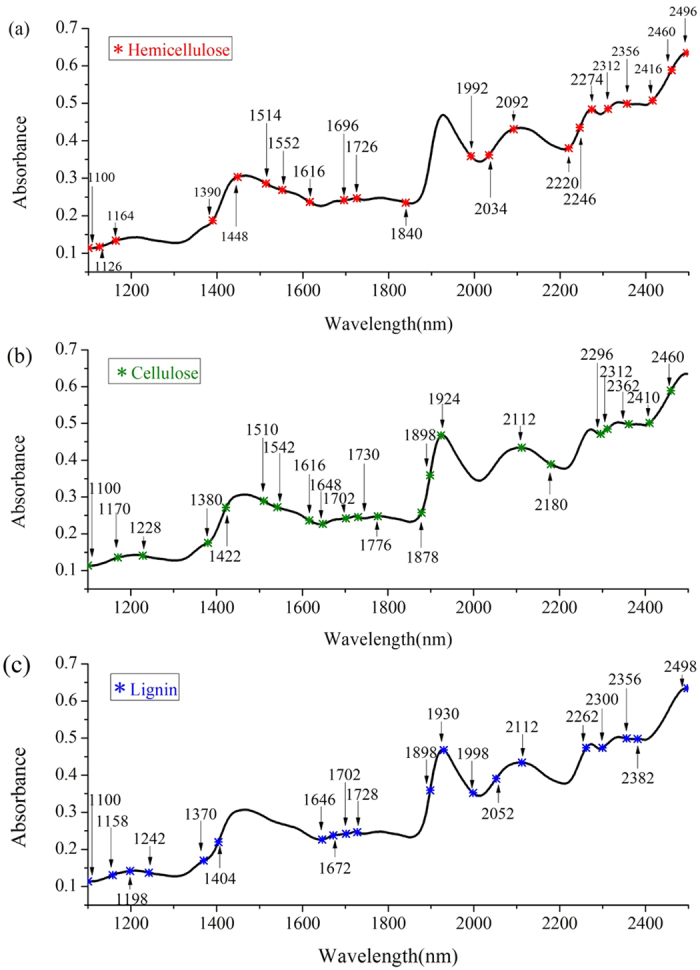
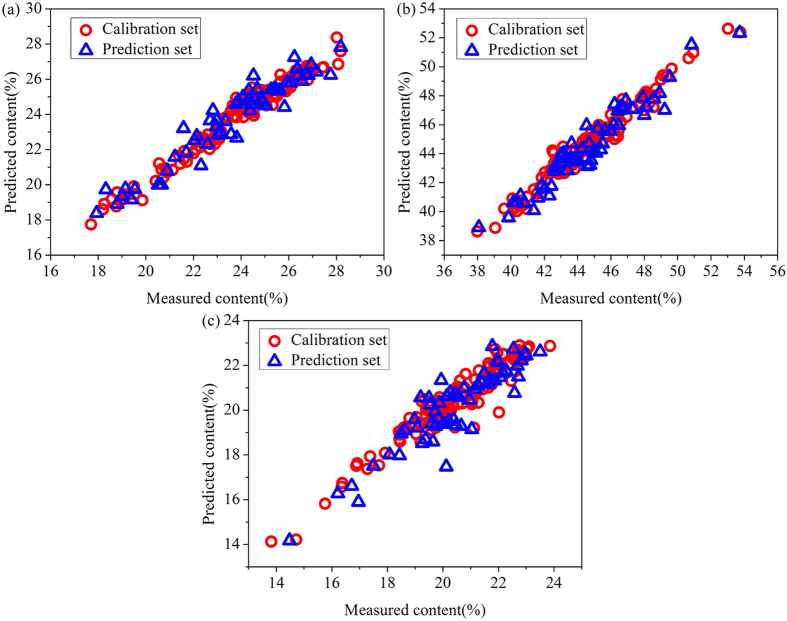
The contents of hemicellulose, cellulose and lignin are important for moso bamboo processing in biomass energy industry. The feasibility of using near infrared (NIR) spectroscopy for rapid determination of hemicellulose, cellulose and lignin was investigated in this study. Initially, the linear relationship between bamboo components and their NIR spectroscopy was established. Subsequently, successive projections algorithm (SPA) was used to detect characteristic wavelengths for establishing the convenient models. For hemicellulose, cellulose and lignin, 22, 22 and 20 characteristic wavelengths were obtained, respectively. Nonlinear determination models were subsequently built by an artificial neural network (ANN) and a least-squares support vector machine (LS-SVM) based on characteristic wavelengths. The LS-SVM models for predicting hemicellulose, cellulose and lignin all obtained excellent results with high determination coefficients of 0.921, 0.909 and 0.892 respectively. These results demonstrated that NIR spectroscopy combined with SPA-LS-SVM is a useful, nondestructive tool for the determinations of hemicellulose, cellulose and lignin in moso bamboo.
半纤维素、纤维素和木质素的含量对于毛竹在生物质能源产业中的加工利用至关重要。本研究探讨了利用近红外(NIR)光谱快速测定半纤维素、纤维素和木质素的可行性。首先,建立了竹子成分与其近红外光谱之间的线性关系。随后,采用连续投影算法(SPA)检测特征波长以建立简便模型。对于半纤维素、纤维素和木质素,分别获得了22、22和20个特征波长。随后基于特征波长通过人工神经网络(ANN)和最小二乘支持向量机(LS-SVM)建立了非线性测定模型。预测半纤维素、纤维素和木质素的LS-SVM模型均取得了优异结果,测定系数分别高达0.921、0.909和0.892。这些结果表明,近红外光谱结合SPA-LS-SVM是一种用于测定毛竹中半纤维素、纤维素和木质素的有效、无损工具。