Payoe Kusal Shasheen, Gadar Kavita, Flahaut Emmanuel, McCarthy Ronan R, Stenbeck Gudrun
Centre for Genomic Engineering and Maintenance, Department of Biosciences, College of Health and Life Sciences, Brunel University London, Uxbridge, United Kingdom.
Antimicrobial Innovations Centre, Department of Biosciences, College of Health and Life Sciences, Brunel University London, Uxbridge, United Kingdom.
Front Pharmacol. 2025 Sep 10;16:1625472. doi: 10.3389/fphar.2025.1625472. eCollection 2025.
Nanotechnology is one of the most rapidly advancing scientific fields, offering innovative solutions in diverse areas such as medicine, agriculture, and materials science. However, concerns regarding the environmental and biological toxicity of nanomaterials continue to rise. It is thus essential to develop reliable, ethical, and cost-effective models to assess the toxicity of Nanoparticles (NPs). This study aims to evaluate the immunotoxicity and systemic effects of various inorganic nanoparticles using (GM) larvae as a non-mammalian model.
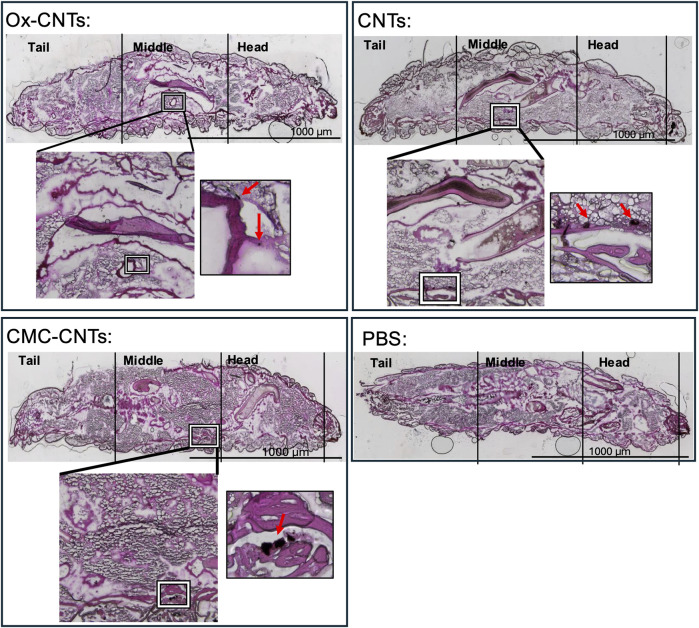
GM larvae were exposed to different types of NPs, including starch-coated and anionic superparamagnetic iron oxide nanoparticles (SPIONs), double-walled carbon nanotubes (CNTs), and gold nanoparticles (GNPs). Flow cytometry was used to monitor haemocyte numbers, while larval survival assays assessed mortality. Histological analyses were conducted to detect CNT accumulation in tissues. The immunosuppressive effects of GNPs were assessed in GM larvae challenged with sub-lethal doses of and .
The results demonstrate NP retention in GM tissues and showed that surface and size properties of NPs significantly influenced their biological effects. Anionic SPIONs lacking a starch coating caused greater haemocyte depletion and higher mortality than their biocompatible coated counterparts. GNP toxicity was found to be size-dependent, with particles between 60 and 100 nm producing the most severe haemocyte depletion, which was comparable to that obtained with the immune suppressant cyclophosphamide.
Overall, this study supports the use of larvae as an effective model for nanoparticle toxicity screening and demonstrates the usefulness of this model in detecting both toxic and immunosuppressive properties of nanomaterials.
纳米技术是发展最为迅速的科学领域之一,在医学、农业和材料科学等多个领域提供创新解决方案。然而,对纳米材料的环境和生物毒性的担忧持续增加。因此,开发可靠、合乎伦理且具有成本效益的模型来评估纳米颗粒(NPs)的毒性至关重要。本研究旨在以转基因(GM)幼虫作为非哺乳动物模型,评估各种无机纳米颗粒的免疫毒性和全身效应。
将GM幼虫暴露于不同类型的纳米颗粒,包括淀粉包被的和阴离子超顺磁性氧化铁纳米颗粒(SPIONs)、双壁碳纳米管(CNTs)和金纳米颗粒(GNPs)。使用流式细胞术监测血细胞数量,同时通过幼虫存活试验评估死亡率。进行组织学分析以检测组织中CNT的积累。在接受亚致死剂量的[具体物质1]和[具体物质2]攻击的GM幼虫中评估GNPs的免疫抑制作用。
结果表明纳米颗粒在GM组织中的滞留情况,并显示纳米颗粒的表面和尺寸特性显著影响其生物学效应。缺乏淀粉包被的阴离子SPIONs比其生物相容性包被的对应物导致更大的血细胞消耗和更高的死亡率。发现GNP毒性具有尺寸依赖性,60至100纳米之间的颗粒产生最严重的血细胞消耗,这与免疫抑制剂环磷酰胺所导致的情况相当。
总体而言,本研究支持将GM幼虫用作纳米颗粒毒性筛选的有效模型,并证明了该模型在检测纳米材料的毒性和免疫抑制特性方面的有用性。