
Home-based traditional Chinese exercise for knee osteoarthritis: a systematic review and meta-analysis of randomized controlled trials.
作者信息
Wang Wenxuan, Lu Haiying, Yan Chuchu, Shan Yawei
机构信息
School of Nursing, Shanghai University of Traditional Chinese Medicine, Shanghai, China.
出版信息
Front Med (Lausanne). 2025 Sep 9;12:1665680. doi: 10.3389/fmed.2025.1665680. eCollection 2025.
BACKGROUND
Home-based traditional Chinese exercise (TCE) has been proven to be a promising method for improving knee function in patients with knee osteoarthritis (KOA). However, no consensus has been reached among studies on its effectiveness. The study aims to evaluate the effectiveness and safety of the home-based TCE, including Tai Chi, Baduanjin, Yijinjing, and Wuqinxi, for improving knee function, pain, quality of life, and mental health in patients with KOA.
METHODS
Eight electronic databases including PubMed, The Cochrane Library, EMBASE, Web of Science, CNKI, Wanfang, VIP, and SinoMed were systematically searched for randomized controlled trials (RCTs) from their inception to February 2025. Two reviewers independently extracted data and assessed methodological quality using the Cochrane Risk of Bias tool. The meta-analysis was conducted using Review Manager 5.4.
RESULTS
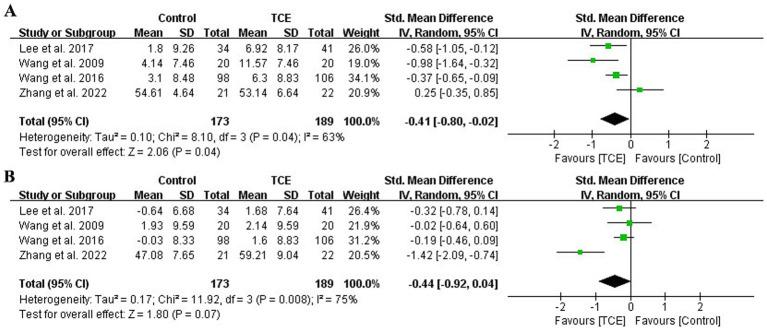
Eleven RCTs involving 854 participants were included. TCE showed a significant improvement in general knee function (SMD = -0.61; 95% CI: -1.02 to -0.20; = 0.003), pain (SMD = -0.52; 95% CI: -0.88 to -0.15; = 0.006), the physical quality of life (SMD = -0.41; 95% CI: -0.80 to -0.02; = 0.04), and depression (SMD = -1.00; 95% CI: -1.74 to -0.26; = 0.008) with minimal adverse events. However, data on stiffness and cost-effectiveness were limited.
CONCLUSION
Home-based TCE is a safe and effective complementary intervention for managing KOA, particularly when integrated into a structured programme combining supervised sessions and home-based practice. Further high-quality RCTs with standardized protocols and longer follow-up are warranted.
SYSTEMATIC REVIEW REGISTRATION
https://www.crd.york.ac.uk/PROSPERO/view/CRD42024503800, Identifier CRD42024503800.


 Zotero 插件