Saleem Junaid, Khalid Baig Moghal Zubair, Tahir Furqan, Al-Ansari Tareq, Osman Ahmed I, McKay Gordon
Division of Sustainable Development, College of Science and Engineering, Hamad Bin Khalifa University, Qatar Foundation, Doha, Qatar.
School of Chemistry and Chemical Engineering, Queen's University Belfast, David Keir Building, Stranmillis Road, Belfast, BT9 5AG, Northern Ireland, UK.
Sci Rep. 2025 Sep 25;15(1):32797. doi: 10.1038/s41598-025-16300-1.
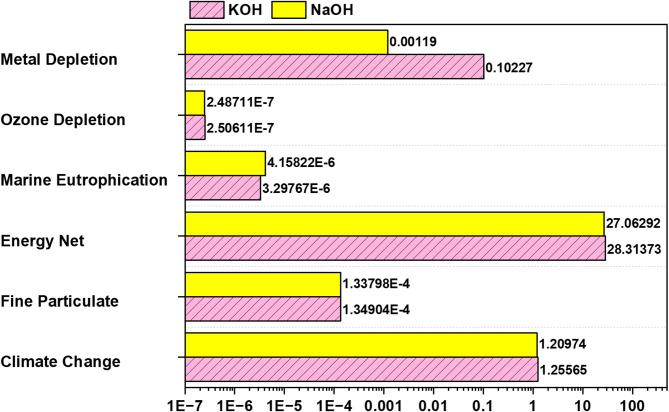
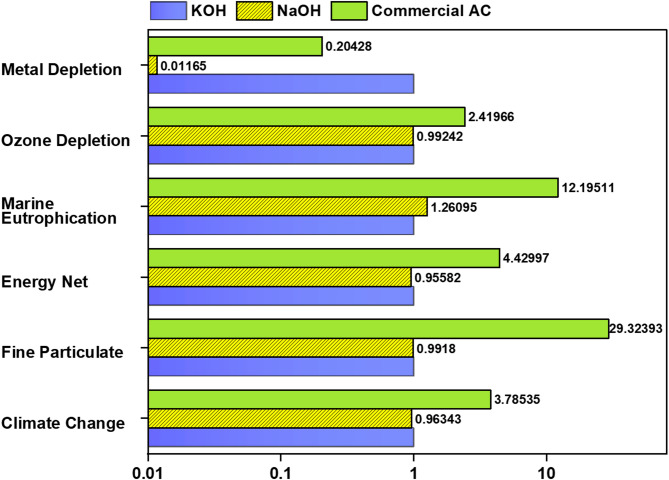
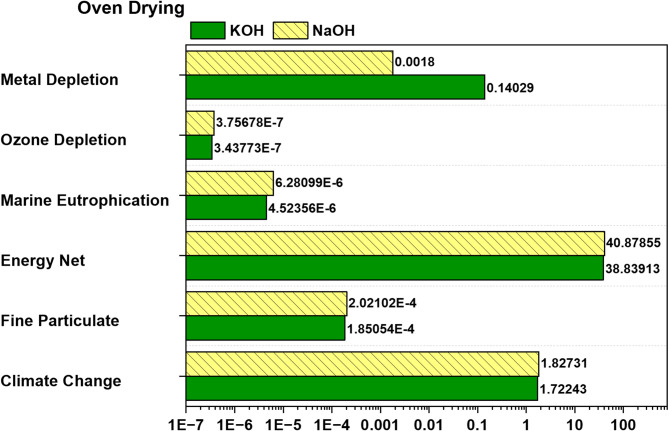
The production of activated carbon (AC) from biomass holds substantial environmental potential, but its impact varies widely depending on the synthesis methods employed. However, unreliable experimental data results in inconsistent life cycle assessments (LCA), often dependent on generic or highly localized information. Most available data focuses solely on production metrics, neglecting crucial performance-based indicators. This study conducts LCA for a conceptual AC production facility designed to produce 1 kg of AC per batch of coconut shell (CS), particularly examining potassium hydroxide (KOH) and sodium hydroxide (NaOH) activation routes. Environmental impacts (EIs) are evaluated using two functional units-mass-based and adsorption-based-and span eighteen metrics, including six key ones: net energy, climate change (CC), ozone depletion, fine particulate matter formation, marine eutrophication, and metal depletion. CC (kg CO₂ eq.) for 1 kg of AC production is 1.255 for KOH and 1.209 for NaOH, while energy requirements (in MJ) are 28.314 for KOH and 27.063 for NaOH. Notably, the pyrolysis step emerges as the most energy-intensive and significant contributor to carbon emissions. Per the adsorption-based unit, the KOH-led pathway shows a higher adsorption capacity of 729 g/kg versus 662 g/kg for NaOH, requiring less AC per kg of dye adsorbed. Consequently, the KOH pathway achieves 5% greater energy efficiency and 6% lower carbon emissions than the NaOH pathway. Synthesized ACs outperform commercial AC in all metrics, especially in energy use and carbon emissions. The study proposes improvements, such as alternative drying methods, to mitigate EIs and emphasizes the need to consider both production efficiency and functional performance to guide sustainable AC production and application.
利用生物质生产活性炭(AC)具有巨大的环境潜力,但其影响因所采用的合成方法而异。然而,不可靠的实验数据导致生命周期评估(LCA)不一致,这些评估往往依赖于通用或高度本地化的信息。大多数现有数据仅关注生产指标,而忽略了关键的基于性能的指标。本研究针对一个概念性的AC生产设施进行了LCA,该设施设计为每批椰子壳(CS)生产1千克AC,特别考察了氢氧化钾(KOH)和氢氧化钠(NaOH)活化路线。使用两个功能单元——基于质量和基于吸附——评估环境影响(EI),涵盖18个指标,包括六个关键指标:净能量、气候变化(CC)、臭氧消耗、细颗粒物形成、海洋富营养化和金属消耗。每生产1千克AC,KOH的CC(千克CO₂当量)为1.255,NaOH为1.209,而能量需求(兆焦)KOH为28.314,NaOH为27.063。值得注意的是,热解步骤是能源密集度最高且对碳排放贡献最大的环节。按照基于吸附的单元,KOH主导的路线显示出更高的吸附容量,为729克/千克,而NaOH为662克/千克,每吸附1千克染料所需的AC更少。因此,KOH路线比NaOH路线的能源效率高5%,碳排放低6%。合成的AC在所有指标上均优于商业AC,尤其是在能源使用和碳排放方面。该研究提出了改进措施,如替代干燥方法,以减轻EI,并强调需要同时考虑生产效率和功能性能,以指导可持续的AC生产和应用。